

Shariah: What Everyone Needs to Know
(Oxford University Press, 2018)
By John L. Esposito and Natana J. DeLong-Bas

(Oxford University Press, 2018)
By John L. Esposito and Natana J. DeLong-Bas
Most Americans and Europeans have by now heard of Shariah. In the West, politicians, media commentators, televangelists, and others have stoked fears that Muslims intend to impose a repressive rule based on Shariah in America and Europe. Shariah has been portrayed as a medieval system that oppresses women, stifles human rights, and imposes harsh punishments like stoning and amputation. In reality, however, Shariah is a complex concept that has been interpreted in many ways over time and around the world. It plays a vital role in the lives of Muslims around the world, offering guidance on everything from personal morality to ritual practices, family life, and finance.
In this timely addition to Oxford's What Everyone Needs to Know® series, John Esposito and Natana DeLong-Bas offer an accessible and thorough guide to this little-understood, but often caricatured system. The book provides clear and even-handed answers to a wide range of questions, covering the history, development, content, and practice of Shariah. What are its origins? What is a Shariah court and how does it work? How does a person become a Muslim in the eyes of Islamic law? Does Islamic law allow Muslims to marry non-Muslims? What are blasphemy laws, and how are they enforced? How does Islamic law govern trade and contracts of sale? Do Muslims in the West want Shariah Law? Is there a need to protect American and European societies from the imposition of Shariah?
By answering the questions that so many people have about Shariah and its role in Muslim life, this book makes an invaluable contribution to the crucial task of fostering mutual understanding in our globalizing, pluralistic societies.

Islam: A Living Faith
(Anselm Academic, 2018)
By Natana J. DeLong-Bas

(Anselm Academic, 2018)
By Natana J. DeLong-Bas
As the faith tradition of 1.6 billion people globally, Islam is the second-largest--and fastest-growing--of all the world's religions. Still, many in the West harbor misconceptions about its people, practices, and beliefs.
Through rich and thorough exploration, Natana DeLong-Bas's Islam: A Living Faith challenges ignorance with facts and false impressions with stories of lived faith. Weaving personal narratives with major historical and contemporary events and developments, DeLong-Bas skillfully and sensitively conveys the teachings, people, and practices of the Islamic faith. This introduction includes sections on the Five Pillars, the Qur'an, and the legacy of Muhammad, as well as on the origin of sectarian identities, the purpose of Shariah and Islamic law, the mystical tradition of Sufism, and Muslim-Christian relations. Stocked with terms, definitions, and recommendations for additional resources, Islam: A Living Faith is perfect for use in the classroom.

Raising Generation Rx: Mothering Kids with Invisible Disabilities in an Age of Inequality
(NYU Press, 2015)
By Linda M. Blum

(NYU Press, 2015)
By Linda M. Blum
Recent years have seen an explosion in the number of children diagnosed with “invisible disabilities” such as ADHD, mood and conduct disorders, and high-functioning autism spectrum disorders. Whether they are viewed as biological problems in brain wiring or as results of the increasing medicalization of childhood, the burden of dealing with the day-to-day trials and complex medical and educational decisions falls almost entirely on mothers. Yet few ask how these mothers make sense of their children’s troubles, and to what extent they feel responsibility or blame. Raising Generation Rx offers a groundbreaking study that situates mothers’ experiences within an age of neuroscientific breakthrough, a high-stakes knowledge-based economy, cutbacks in public services and decent jobs, and increased global competition and racialized class and gender inequality.
Through in-depth interviews, observations of parents’ meetings, and analyses of popular advice, Linda Blum examines the experiences of diverse mothers coping with the challenges of their children’s “invisible disabilities” in the face of daunting social, economic, and political realities. She reveals how mothers in widely varied households learn to advocate for their children in the dense bureaucracies of the educational and medical systems; wrestle with anguishing decisions about the use of psychoactive medications; and live with the inescapable blame and stigma in their communities.

Gay Priori: A Queer Critical Legal Studies Approach to Law Reform
(Duke University Press, 2018)
By Libby Adler

(Duke University Press, 2018)
By Libby Adler
In Gay Priori Libby Adler offers a comprehensive critique of mainstream LGBT legal agendas in the United States and a new direction for LGBT law reform. Adler shows how LGBT equal rights discourse drives legal advocates toward a narrow array of reform objectives—namely, same-sex marriage, antidiscrimination protections, and hate crimes statutes. This approach means that many legal issues that greatly impact the lives of the LGBT community's most marginalized members—especially those who are transgender, homeless, underage, or nonwhite—often go unnoticed. Such a narrow focus on equal rights also fixes and flattens LGBT identities, perpetuates the uneven distribution of resources such as safety, housing, health, and wealth, and limits the capacity for advocates to imagine change. To combat these effects, Adler calls for prioritizing the redistribution of resources in ways that focus on addressing low-profile legal conditions such as foster care and other issues that better meet the needs of LGBT people. Such a shift in perspective, Adler contends, will serve to open up a new world of reform possibilities that the law provides for.

Outsourced Children: Orphanage Care and Adoption in Globalizing China
(Stanford University Press, 2016)
By Leslie K. Wang

(Stanford University Press, 2016)
By Leslie K. Wang
It's no secret that tens of thousands of Chinese children have been adopted by American parents and that Western aid organizations have invested in helping orphans in China—but why have Chinese authorities allowed this exchange, and what does it reveal about processes of globalization?
Countries that allow their vulnerable children to be cared for by outsiders are typically viewed as weaker global players. However, Leslie K. Wang argues that China has turned this notion on its head by outsourcing the care of its unwanted children to attract foreign resources and secure closer ties with Western nations. She demonstrates the two main ways that this "outsourced intimacy" operates as an ongoing transnational exchange: first, through the exportation of mostly healthy girls into Western homes via adoption, and second, through the subsequent importation of first-world actors, resources, and practices into orphanages to care for the mostly special needs youth left behind.
Outsourced Children reveals the different care standards offered in Chinese state-run orphanages that were aided by Western humanitarian organizations. Wang explains how such transnational partnerships place marginalized children squarely at the intersection of public and private spheres, state and civil society, and local and global agendas. While Western societies view childhood as an innocent time, unaffected by politics, this book explores how children both symbolize and influence national futures.
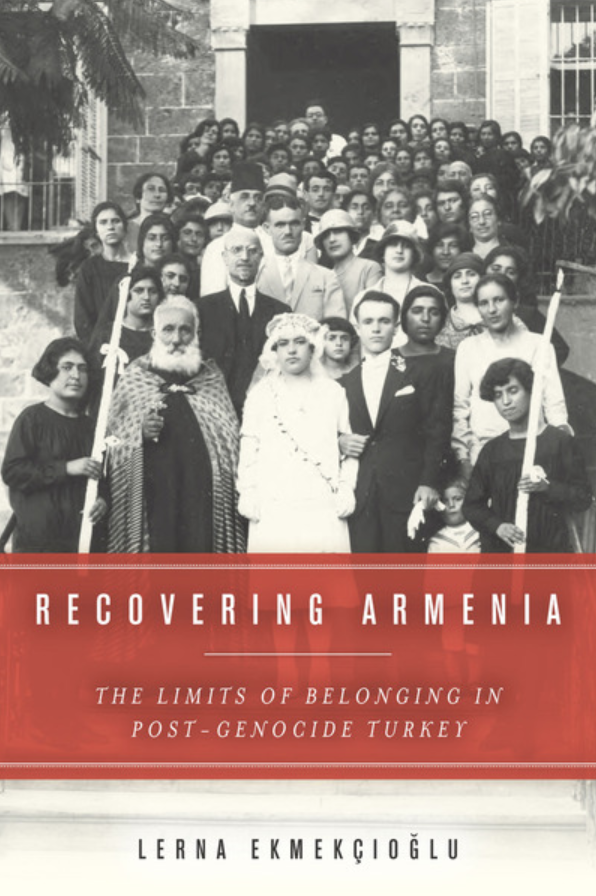
Recovering Armenia: The Limits of Belonging in Post-Genocide Turkey
(Stanford University Press, 2016)
Lerna Ekmekçioglu

(Stanford University Press, 2016)
By Lerna Ekmekçioglu
Recovering Armenia offers the first in-depth study of the aftermath of the 1915 Armenian Genocide and the Armenians who remained in Turkey. Following World War I, as the victorious Allied powers occupied Ottoman territories, Armenian survivors returned to their hometowns optimistic that they might establish an independent Armenia. But Turkish resistance prevailed, and by 1923 the Allies withdrew, the Turkish Republic was established, and Armenians were left again to reconstruct their communities within a country that still considered them traitors. Lerna Ekmekcioglu investigates how Armenians recovered their identity within these drastically changing political conditions.
Reading Armenian texts and images produced in Istanbul from the close of WWI through the early 1930s, Ekmekcioglu gives voice to the community's most prominent public figures, notably Hayganush Mark, a renowned activist, feminist, and editor of the influential journal Hay Gin. These public figures articulated an Armenianess sustained through gendered differences, and women came to play a central role preserving traditions, memory, and the mother tongue within the home. But even as women were being celebrated for their traditional roles, a strong feminist movement found opportunity for leadership within the community. Ultimately, the book explores this paradox: how someone could be an Armenian and a feminist in post-genocide Turkey when, through its various laws and regulations, the key path for Armenians to maintain their identity was through traditionally gendered roles.

Tainted Witness: Why We Doubt What Women Say About Their Lives
(Columbia University Press, 2017)
By Leigh Gilmore

(Columbia University Press, 2017)
By Leigh Gilmore
In 1991, Anita Hill's testimony during Clarence Thomas's Senate confirmation hearing brought the problem of sexual harassment to a public audience. Although widely believed by women, Hill was defamed by conservatives and Thomas was confirmed to the Supreme Court. The tainting of Hill and her testimony is part of a larger social history in which women find themselves caught up in a system that refuses to believe what they say. Hill's experience shows how a tainted witness is not who someone is, but what someone can become.
Why are women so often considered unreliable witnesses to their own experiences? How are women discredited in legal courts and in courts of public opinion? Why is women's testimony so often mired in controversies fueled by histories of slavery and colonialism? How do new feminist witnesses enter testimonial networks and disrupt doubt? Tainted Witnessexamines how gender, race, and doubt stick to women witnesses as their testimony circulates in search of an adequate witness. Judgment falls unequally upon women who bear witness, as well-known conflicts about testimonial authority in the late twentieth and early twenty-first centuries reveal. Women's testimonial accounts demonstrate both the symbolic potency of women's bodies and speech in the public sphere and the relative lack of institutional security and control to which they can lay claim. Each testimonial act follows in the wake of a long and invidious association of race and gender with lying that can be found to this day within legal courts and everyday practices of judgment, defining these locations as willfully unknowing and hostile to complex accounts of harm. Bringing together feminist, literary, and legal frameworks, Leigh Gilmore provides provocative readings of what happens when women's testimony is discredited. She demonstrates how testimony crosses jurisdictions, publics, and the unsteady line between truth and fiction in search of justice.

Women in Global Science: Advancing Academic Careers through International Collaboration
(Stanford University Press, 2017)
By Kathrin Zippel

(Stanford University Press, 2017)
By Kathrin Zippel
Scientific and engineering research is increasingly global, and international collaboration can be essential to academic success. Yet even as administrators and policymakers extol the benefits of global science, few recognize the diversity of international research collaborations and their participants, or take gendered inequalities into account. Women in Global Science is the first book to consider systematically the challenges and opportunities that the globalization of scientific work brings to U.S. academics, especially for women faculty.
Kathrin Zippel looks to the STEM fields as a case study, where gendered cultures and structures in academia have contributed to an underrepresentation of women. While some have approached underrepresentation as a national concern with a national solution, Zippel highlights how gender relations are reconfigured in global academia. For U.S. women in particular, international collaboration offers opportunities to step outside of exclusionary networks at home. International collaboration is not the panacea to gendered inequalities in academia, but, as Zippel argues, international considerations can be key to ending the steady attrition of women in STEM fields and developing a more inclusive academic world.

Gender and Risk-Taking: Economics, Evidence, and Why the Answer Matters
(Routledge, 2017)
By Julie A. Nelson

(Routledge, 2017)
By Julie A. Nelson
The belief that men and women have fundamentally distinct natures, resulting in divergent preferences and behaviours, is widespread. Recently, economists have also engaged in the search for gender differences, with a number claiming to find fundamental gender differences regarding risk-taking, altruism, and competition. In particular, the idea that "women are more risk-averse than men" has become accepted as a truism. But is it true? And what are its causes and consequences?
Gender and Risk Taking makes three contributions. First, it asks whether the belief that men and women have distinct risk preferences is backed up by high quality empirical evidence. The answer turns out to be "no." This leads to a second question: Why, then, does so much of the literature claim to find evidence of "difference"? This, it will be shown, can be attributed to biases arising from too-easy categorical thinking, widespread stereotyping, and a tendency to prefer results that are publishable and that fit one’s prior beliefs. Third, the book explores the economic implications of the conventional association of risk-taking with masculinity and risk-aversion with femininity. Not only fairness in employment, but also the health of the financial sector and national responses to climate change, this book argues, are being compromised.
This volume will be eye-opening for anyone interested in gender, decision-making, cognition, and/or risk, especially in areas relating to employment, finance, management, or public policy.

Jewish Radical Feminism: Voices from the Women’s Liberation Movement
(NYU Press, 2018)
By Joyce Antler

(NYU Press, 2018)
By Joyce Antler
Jewish women were undeniably instrumental in shaping the women’s liberation movement of the 1960s, 70s, and 80s. Yet historians and participants themselves have overlooked their contributions as Jews. This has left many vital questions unasked and unanswered—until now. Delving into archival sources and conducting extensive interviews with these fierce pioneers, Joyce Antler has at last broken the silence about the confluence of feminism and Jewish identity.
Antler’s exhilarating new book features dozens of compelling biographical narratives that reveal the struggles and achievements of Jewish radical feminists in Chicago, New York and Boston, as well as those who participated in the later, self-consciously identified Jewish feminist movement that fought gender inequities in Jewish religious and secular life. Disproportionately represented in the movement, Jewish women’s liberationists helped to provide theories and models for radical action that were used throughout the United States and abroad. Their articles and books became classics of the movement and led to new initiatives in academia, politics, and grassroots organizing. Other Jewish-identified feminists brought the women’s movement to the Jewish mainstream and Jewish feminism to the Left. For many of these women, feminism in fact served as a “portal” into Judaism.
Recovering this deeply hidden history, Jewish Radical Feminismplaces Jewish women’s activism at the center of feminist and Jewish narratives. The stories of over forty women’s liberationists and identified Jewish feminists—from Shulamith Firestone and Susan Brownmiller to Rabbis Laura Geller and Rebecca Alpert—illustrate how women’s liberation and Jewish feminism unfolded over the course of the lives of an extraordinary cohort of women, profoundly influencing the social, political, and religious revolutions of our era.

Control and Protect: Collaboration, Carceral Protection, and Domestic Sex Trafficking in the United States
(University of California Press, 2016)
By Jennifer Musto

(University of California Press, 2016)
By Jennifer Musto
Control and Protect explores the meaning and significance of efforts designed to combat sex trafficking in the United States. A striking case study of the new ways in which law enforcement agents, social service providers, and nongovernmental advocates have joined forces in this campaign, this book reveals how these collaborations consolidate state power and carceral control. This book examines how partnerships forged in the name of fighting domestic sex trafficking have blurred the boundaries between punishment and protection, victim and offender, and state and nonstate authority.

Why Comics?: From Underground to Everywhere
(Harper, 2017)
By Hillary Chute

(Harper, 2017)
By Hillary Chute
The massive impact that comics have had on our culture becomes more and more clear every day, from the critically acclaimed musical Fun Home, based on Alison Bechdel’s groundbreaking comic, to the dozens of superhero films hitting cinemas every year. What is it that makes comics so special? What can this unique art form do that others can’t?
In Why Comics?, comics scholar Hillary Chute reveals the history of comics, underground comics (or comix), and graphic novels, through deep thematic analysis, and fascinating portraits of the fearless men and women behind them. As Scott McCloud revealed the methods behind comics and the way they worked in his classic Understanding Comics, Chute will reveal the themes that Comics handle best, and how the form is uniquely equipped to explore them.
The topics Why Comics? include:
• Why Disaster: with such major works focusing on disasters, from Art Spiegelman’s work, which covers the Holocaust and 9/11 to Keiji Nakazawa’s work covering Heroshima, comics find themselves uniquely suited to convey the scale and disorientation of disaster.
• Why Suburbs: through the work of Chris Ware and Charles Burns, Chute reveals the fascinating ways that Comics illustrate the quiet joys and struggles of suburban existence.
• Why Punk: With an emphasis on DIY aesthetics and rebelling against what came before, the Punk movement would prove to be a fertile ground for some of the most significant modern cartoonists, creating a truly democratic art form.
Chute has created an indispensable guide to comics for those new to the genre, or those who want to understand more about what lies behind their favorite works.

Queer Terror: Life, Death, and Desire in the Settler Colony
(Columbia University Press, 2018)
By C. Heike Schotten

(Columbia University Press, 2018)
By C. Heike Schotten
After Sept. 11, 2001, George W. Bush declared, “Either you are with us, or you are with the terrorists.” Bush’s assertion was not simply jingoist bravado―it encapsulates the civilizationalist moralism that has motivated and defined the United States since its beginning, linking the War on Terror to the nation’s settlement and founding.
In Queer Terror, C. Heike Schotten offers a critique of U.S. settler-colonial empire that draws on political, queer, and critical indigenous theory to situate Bush’s either/or moralism and reframe the concept of terrorism. The categories of the War on Terror exemplify the moralizing politics that insulate U.S. empire from critique, render its victims deserving of its abuses, and delegitimize resistance to it as unthinkable and perverse. Schotten provides an anatomy of this moralism, arguing for a new interpretation of biopolitics that is focused on sovereignty and desire rather than racism and biology. This rethinking of biopolitics puts critical political theory of empire in dialogue with the insights of both native studies and queer theory. Building on queer theory’s refusal of sanctity, propriety, and moralisms of all sorts, Schotten ultimately contends that the answer to Bush’s ultimatum is clear: dissidents must reject the false choice he presents and stand decisively against “us,” rejecting its moralism and the sanctity of its “life,” in order to further a truly emancipatory, decolonizing queer politics.

Unmasking Masculinities: Men and Society
(SAGE Publications, Inc., 2018)
By Edward Morris and Freeden Blume-Oeur

(SAGE Publications, Inc., 2018)
By Edward Morris and Freeden Blume-Oeur
Unmasking Masculinities: Men and Society is a new anthology that provides a fresh and comprehensive introduction to the field of critical masculinity studies. Grounded in the theories of masculinities with explicit connections between various theoretical perspectives and the readings, this book examines unique domains, such as the Presidency or men′s responses to feminism. Through the book’s emphasis on cross-cultural perspectives and experiences, readers will find new and provocative takes on masculinity today, such as nerd masculinity, female masculinity, misogyny through social media, feminism and men, and men’s intimate relationships with other men.

Boys Apart: Racial Uplift and Respectability in All-Male Public Schools
(University Of Minnesota Press, 2018)
By Freeden Blume Oeur

(University of Minnesota Press, 2018)
By Freeden Blume Oeur
While single-sex public schools face much criticism, many Black communities see in them a great promise: that they can remedy a crisis for their young men. Black Boys Apart reveals triumphs, hope, and heartbreak at two all-male schools, a public high school and a charter high school, drawing on Freeden Blume Oeur’s ethnographic work. We meet young men who felt their schools empowered and emasculated them, parents who were frustrated with co-ed schools, teachers who helped pave the road to college, and administrators who saw in Black male academies the advantages of privatizing education.
While the two schools have distinctive histories and ultimately charted different paths, they were both shaped by the convergence of neoliberal ideologies and a politics of Black respectability. As Blume Oeur reveals, all-boys education is less a school reform initiative and instead joins a legacy of efforts to reform Black manhood during periods of stark racial inequality. Black male academies join long-standing attempts to achieve racial uplift in Black communities, but in ways that elevate exceptional young men and aggravate divisions within those communities.
Black Boys Apart shows all-boys schools to be an odd mix of democratic empowerment and market imperatives, racial segregation and intentional sex separation, strict discipline and loving care. Challenging narratives that endorse these schools for nurturing individual resilience in young Black men, this perceptive and penetrating ethnography argues for a holistic approach in which Black communities and their allies promote a collective resilience.

Dissident Friendships: Feminism, Imperialism, and Transnational Solidarity
(University of Illinois Press, 2016)
Edited by Elora Halim Chowdhury and Liz Philipose

(University of Illinois Press, 2016)
Edited by Elora Halim Chowdhury and Liz Philipose
Often perceived as unbridgeable, the boundaries that divide humanity from itself--whether national, gender, racial, political, or imperial--are rearticulated through friendship. Elora Halim Chowdhury and Liz Philipose edit a collection of essays that express the different ways women forge hospitality in deference to or defiance of the structures meant to keep them apart. Emerging out of postcolonial theory, the works discuss instances when the authors have negotiated friendship's complicated, conflicted, and contradictory terrain; offer fresh perspectives on feminists' invested, reluctant, and selective uses of the nation; reflect on how the arts contribute to conversations about feminism, dissent, resistance, and solidarity; and unpack the details of transnational dissident friendships. Contributors: Lori E. Amy, Azza Basarudin, Himika Bhattacharya, Kabita Chakma, Elora Halim Chowdhury, Laurie R. Cohen, Esha Niyogi De, Eglantina Gjermeni, Glen Hill, Alka Kurian, Meredith Madden, Angie Mejia, Chandra T. Mohanty, A. Wendy Nastasi, Nicole Nguyen, Liz Philipose, Anya Stanger, Shreerekha Subramanian, and Yuanfang Dai.

On the Shoulders of Grandmothers: Gender, Migration, and Post-Soviet Nation-State Building
(Routledge, 2017)
By Cinzia D. Solari

(Routledge, 2017)
By Cinzia D. Solari
On the Shoulders of Grandmothers is a global ethnography of Ukrainian transnational migration. Gendered migrant subjectivities are a key site for understanding the production of neoliberal capitalism and Ukrainian nation-state building, a fraught process that places Ukraine precariously between Europe and Russia with dramatic implications for the political economy of the region. However, processes of gender and migration that undergird transnational nation-state building require further attention. Solari compares two patterns of Ukrainian migration: the "forced" exile of middle-aged women, most grandmothers, to Italy and the "voluntary" exodus of families, led by the same cohort of middle-aged women, to the United States. In both receiving sites these migrants are caregivers to the elderly.
Using in-depth interviews and ethnographic data collected in three countries, Solari shows that Ukrainian nation-state building occurs transnationally. She examines the collective practices of migrants who are building the "new" Ukraine from the outside in and shaping both Italy and the United States as well. The Ukrainian state, in order to fulfil its First World aspirations of joining Europe and distancing itself from all things Soviet, is pursuing a gendered reorganization of family and work structures to achieve a transition from socialism to capitalism. This has created a labor force of migrant grandmothers who carry the new Ukraine on their shoulders. Solari shows that this post-Soviet economic transformation requires a change in the moral order as migrant women struggle to understand how to be "good" mothers and grandmothers and men join women in attempts to teach their children to be successful and honorable people, now that the social rules have drastically changed.
Looking at individual migrant women and men and their families in Ukraine allows us to see the production of neoliberal capitalism and new nationalism from the ground up and the outside in for a region that promises to be a flashpoint in our century.

The Managed Body: Developing Girls and Menstrual Health in the Global South
(Palgrave Macmillan, 2018)
By Chris Bobel

(Palgrave Macmillan, 2018)
By Chris Bobel
The Managed Body productively complicates ‘menstrual hygiene management’ (MHM)--a growing social movement to support menstruating girls in the Global South. Bobel offers an invested critique of the complicated discourses of MHM including its conceptual and practical links with the Water, Sanitation and Hygiene (WASH) development sector, human rights and ‘the girling of development.’ Drawing on analysis of in-depth interviews, participant observations and the digital materials of NGOs and social businesses, Bobel shows how MHM frames problems and solutions to capture attention and direct resources to this highly-tabooed topic. She asserts that MHM organizations often inadvertently rely upon weak evidence and spectacularized representations to make the claim of a ‘hygienic crisis’ that authorizes rescue. And, she argues, the largely product-based solutions that follow fail to challenge the social construction of the menstrual body as dirty and in need of concealment. While cast as fundamental to preserving girls’ dignity, MHM prioritizes ‘technological fixes’ that teach girls to discipline their developing bodies vis a vis consumer culture, a move that actually accommodates more than it resists the core problem of menstrual stigma.

A Postcolonial Self: Korean Immigrant Theology and Church
(SUNY Press, 2015)
By Choi Hee An

(SUNY Press, 2015)
By Choi Hee An
Theologian Choi Hee An explores how Korean immigrants create a new, postcolonial identity in response to life in the United States. A Postcolonial Self begins with a discussion of a Korean ethnic self (“Woori” or “we”) and how it differs from Western norms. Choi then looks at the independent self, the theological debates over this concept, and the impact of racism, sexism, classism, and postcolonialism on the formation of this self. She concludes with a look at how Korean immigrants, especially immigrant women, cope with the transition to US culture, including prejudice and discrimination, and the role the Korean immigrant church plays in this. Choi posits that an emergent postcolonial self can be characterized as “I and We with Others.” In Korean immigrant theology and church, an extension of this can be characterized as “radical hospitality,” a concept that challenges both immigrants and American society to consider a new mutuality.

Stand Your Ground: A History of America's Love Affair with Lethal Self-Defense
(Beacon Press, 2018)
By Caroline E. Light

(Beacon Press, 2018)
By Caroline E. Light
After a young, white gunman killed twenty-six people at Sandy Hook Elementary School in Newtown, Connecticut, in December 2012, conservative legislators lamented that the tragedy could have been avoided if the schoolteachers had been armed and the classrooms equipped with guns. Similar claims were repeated in the aftermath of other recent shootings—after nine were killed in a church in Charleston, South Carolina, and in the aftermath of the massacre in the Pulse nightclub in Orlando, Florida. Despite inevitable questions about gun control, there is a sharp increase in firearm sales in the wake of every mass shooting.
Yet, this kind of DIY-security activism predates the contemporary gun rights movement—and even the stand-your-ground self-defense laws adopted in thirty-three states, or the thirteen million civilians currently licensed to carry concealed firearms. As scholar Caroline Light proves, support for “good guys with guns” relies on the entrenched belief that certain “bad guys with guns” threaten us all.
Stand Your Ground explores the development of the American right to self-defense and reveals how the original “duty to retreat” from threat was transformed into a selective right to kill. In her rigorous genealogy, Light traces white America’s attachment to racialized, lethal self-defense by unearthing its complex legal and social histories—from the original “castle laws” of the 1600s, which gave white men the right to protect their homes, to the brutal lynching of “criminal” Black bodies during the Jim Crow era and the radicalization of the NRA as it transitioned from a sporting organization to one of our country’s most powerful lobbying forces.
In this convincing treatise on the United States’ unprecedented ascension as the world’s foremost stand-your-ground nation, Light exposes a history hidden in plain sight, showing how violent self-defense has been legalized for the most privileged and used as a weapon against the most vulnerable.