
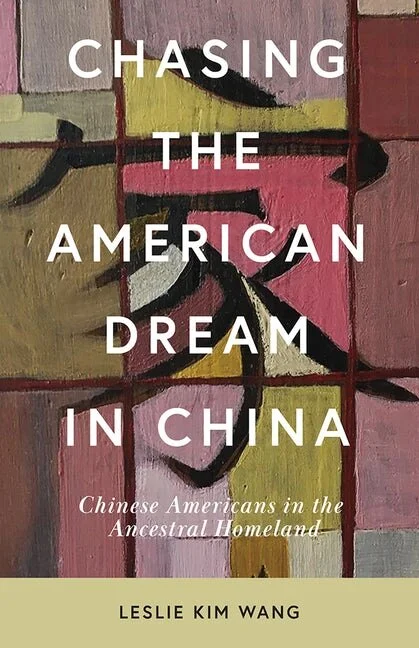
Chasing the American Dream in China: Chinese Americans in the Ancestral Homeland
(Rutgers University Press, 2021)
By Leslie Wang

(Rutgers University Press, 2021)
By Leslie Wang
Few studies have highlighted the stories of middle-class children of immigrants who move to their ancestral homelands—countries with which they share cultural ties but haven’t necessarily had direct contact. Chasing the American Dream in China addresses this gap by examining the lives of highly educated American-born Chinese (ABC) professionals who “return” to the People’s Republic of China to build their careers. Analyzing the motivations and experiences of these individuals deepens our knowledge about transnationalism among the second-generation as they grapple with complex issues of identity and societal belonging in the ethnic homeland. This book demonstrates how these professional migrants maneuver between countries and cultures to further their careers and maximize opportunities in the rapidly changing global economy. When used strategically, the versatile nature of their ethnic identities positions them as indispensable bridges between the global superpowers of China and the United States in their competition for global dominance.

Women, Power, and Property: The Paradox of Gender Equality Laws in India
(Cambridge University Press, 2020)
By Rachel E. Brulé

(Cambridge University Press, 2020)
By Rachel E. Brulé
Quotas for women in government have swept the globe. Yet we know little about their capacity to upend entrenched social, political, and economic hierarchies. Women, Power, and Property explores this question within the context of India, the world's largest democracy. Brulé employs a research design that maximizes causal inference alongside extensive field research to explain the relationship between political representation, backlash, and economic empowerment. Her findings show that women in government – gatekeepers – catalyze access to fundamental economic rights to property. Women in politics have the power to support constituent rights at critical junctures, such as marriage negotiations, when they can strike integrative solutions to intrahousehold bargaining. Yet there is a paradox: quotas are essential for enforcement of rights, but they generate backlash against women who gain rights without bargaining leverage. In this groundbreaking study, Brulé shows how well-designed quotas can operate as a crucial tool to foster equality and benefit the women they are meant to empower.

The Doctor and Mrs. A: Ethics and Counter-Ethics in an Indian Dream Analysis
(Fordham University Press, 2020)
By Sarah Pinto

(Fordham University Press, 2020)
By Sarah Pinto
Just before India’s independence, a young Punjabi woman, ill at ease in her marriage and eager for personal and national freedom, sat down with psychiatrist Dev Satya Nand for an experiment in his new method of dream analysis. The published analysis documents a surge of emotion and reflections on sexuality, gender, marriage, ambition, trauma, and art. “Mrs. A.” (as she is known) turned to female figures from Hindu myth to reimagine her social world and its ethical arrangements, envisioning a future beyond marriage, colonial rule, and gendered constraints.
This book explores the conversation between Mrs. A. and Satya Nand, its window onto gender and sexuality in late colonial Indian society, and the ways Mrs. A. put ethics in motion, creating alternatives to ideals of belonging, recognition, and consciousness. It finds in Mrs. A.’s musings repertoires for the creative transformation of ideals and explores the possibilities of thinking with a dynamic concept of counter-ethics. An unconventional history of gender and sexuality in late colonialism, this book reminds us that the west did not invent feminism, that psychiatry’s history of innovation and creativity is global, and that ethical thinking does not need to center on western myths or paradigms.

From Domestic Women to Sensitive Young Men: Translating the Individual in Early Colonial Korea
(Harvard University Asia Center, 2017)
By Yoon Sun Yang

(Harvard University Asia Center, 2017)
By Yoon Sun Yang
The notion of the individual was initially translated into Korean near the end of the nineteenth century and took root during the early years of Japanese colonial influence. Yoon Sun Yang argues that the first literary iterations of the Korean individual were prototypically female figures appearing in the early colonial domestic novel—a genre developed by reform-minded male writers—as schoolgirls, housewives, female ghosts, femmes fatales, and female same-sex partners. Such female figures have long been viewed as lacking in modernity because, unlike numerous male characters in Korean literature after the late 1910s, they did not assert their own modernity, or that of the nation, by exploring their interiority. Yang, however, shows that no reading of Korean modernity can ignore these figures, because the early colonial domestic novel cast them as individuals in terms of their usefulness or relevance to the nation, whether model citizens or iconoclasts.
By including these earlier narratives within modern Korean literary history and positing that they too were engaged in the translation of individuality into Korean, Yang’s study not only disrupts the canonical account of a non-gendered, linear progress toward modern Korean selfhood but also expands our understanding of the role played by translation in Korea’s construction of modern gender roles.

Sexual States: Governance and the Struggle over the Antisodomy Law in India
(Duke University Press, 2016)
By Jyoti Puri
(Duke University Press, 2016)
By Jyoti Puri
In Sexual States, Jyoti Puri uses the example of the efforts to decriminalize homosexuality in India to show how the regulation of sexuality is fundamentally tied to the creation and enduring existence of the state. Between 2001 and 2013, activists attempted to rewrite section 377 of the Indian Penal Code, which outlaws homosexual behavior. Having interviewed activists and NGO workers throughout five metropolitan centers, investigated crime statistics at the National Crime Records Bureau, visited various state institutions, and met with the police, Puri found that section 377 is but one element of the large and complex systems of laws, practices, policies, and discourses that regulate Indian sexuality. Intended to mitigate sexuality's threat to the social order, this regulation works to preserve the views of the state as inevitable, legitimate, and indispensable. By highlighting the various means through which the regulation of sexuality constitutes India's heterogeneous and fragmented.

Laiza- Sometimes the End is Only a Beginning
(Notionpress, 2016)
By Kudrat Dutta Chaudhary

(Notionpress, 2016)
By Kudrat Dutta Chaudhary
In the summer of 2015, an earthquake that strikes Nepal causes destruction and the entire Nepali community perishes in the catastrophe.
Nineteen-year-old Laiza's parents die in the disaster and she and her younger brother, Ratan are forced to move to Kathmandu with their uncle. The struggle to find resources and the strained relationship between Laiza and her aunt forces her to move to India. Once she reaches there Laiza stays with her aunt's cousin, Rohit, as she looks for a better future and is subsequently hired as a lady's maid by a high profile household that holds a dark secret. She soon finds herself trapped in a world she never imagined. While tackling with the sorrow of her past and present, Laiza finds friends where she least expects them- in the company of a Manipuri and a Ukrainian girl along with an Indian Army soldier of the Gorkha Regiment, whose father went missing in the Earthquake.
Follow Laiza on her journey as a young woman who overcomes grief and learns to hold on to hope in the face of tragedy.

Ishtyle: Accenting Gay Indian Nightlife
(University of Michigan Press, 2020)
By Kareem Khubchandani

(University of Michigan Press, 2020)
By Kareem Khubchandani
Gay nightlife as sociopolitical performance
Ishtyle follows queer South Asian men across borders into gay neighborhoods, nightclubs, bars, and house parties in Bangalore and Chicago. Bringing the cultural practices they are most familiar with into these spaces, these men accent the aesthetics of nightlife cultures through performance. Kareem Khubchandani develops the notion of “ishtyle” to name this accented style, while also showing how brown bodies inadvertently become accents themselves, ornamental inclusions in the racialized grammar of desire. Ishtyleallows us to reimagine a global class perpetually represented as docile and desexualized workers caught in the web of global capitalism. The book highlights a different kind of labor, the embodied work these men do to feel queer and sexy together. Engaging major themes in queer studies, Khubchandani explains how his interlocutors’ performances stage relationships between: colonial law and public sexuality; film divas and queer fans; and race, caste, and desire. Ultimately, the book demonstrates that the unlikely site of nightlife can be a productive venue for the study of global politics and its institutional hierarchies.

South Asian Filmscapes: Transregional Encounters
(University of Washington Press, 2020)
Edited By Elora Chowdhury and Esha Niyogi De

(University of Washington Press, 2020)
Edited By Aaron Elora Chowdhury and Esha Niyogi De
In South Asia massive anticolonial movements in the twentieth century created nation-states and reset national borders, forming the basis for emerging film cultures. Following the upheaval of the partition of India and Pakistan in 1947 and the Bangladesh Liberation War of 1971, new national cinemas promoted and reinforced prevailing hierarches of identity and belonging. At the same time, industrial and independent cinemas contributed to remarkably porous and hybrid film cultures, reflecting the intertwining of South Asian histories and their reciprocal cultural influences. This cross-fertilization within South Asian cultural production continues today.
South Asian Filmscapes excavates these complex politics and poetics of bordered identity and crossings through selected histories of cinema in South Asia. Several essays reveal ways in which fixed notions of national identity have been destabilized by the cross-border mobility of filmed arts and practitioners, while others interrogate how filmic politics intersects with discourses of nationalism, sexuality and gender, religion, and language. Together, they offer a fluid approach to the multiple histories and encounters that conjure “South Asia” as a geographic and political entity in the region and globally through a cinematic imagination.

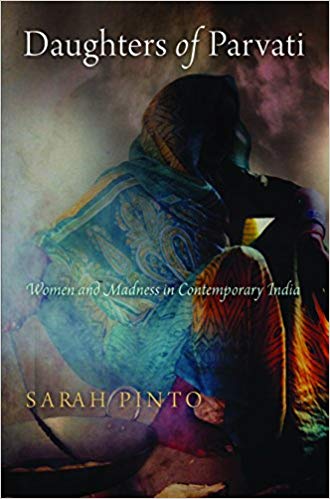
Daughters of Parvati: Women and the Madness in Contemporary India
(University of Pennsylvania Press, 2014)
By Sarah Pinto
(University of Pennsylvania Press, 2014)
By Sarah Pinto
In her role as devoted wife, the Hindu goddess Parvati is the divine embodiment of viraha, the agony of separation from one's beloved, a form of love that is also intense suffering. These contradictory emotions reflect the overlapping dissolutions of love, family, and mental health explored by Sarah Pinto in this visceral ethnography.
Daughters of Parvati centers on the lives of women in different settings of psychiatric care in northern India, particularly the contrasting environments of a private mental health clinic and a wing of a government hospital. Through an anthropological consideration of modern medicine in a nonwestern setting, Pinto challenges the dominant framework for addressing crises such as long-term involuntary commitment, poor treatment in homes, scarcity of licensed practitioners, heavy use of pharmaceuticals, and the ways psychiatry may reproduce constraining social conditions. Inflected by the author's own experience of separation and single motherhood during her fieldwork, Daughters of Parvati urges us to think about the ways women bear the consequences of the vulnerabilities of love and family in their minds, bodies, and social worlds.

Outsourced Children: Orphanage Care and Adoption in Globalizing China
(Stanford University Press, 2016)
By Leslie K. Wang

(Stanford University Press, 2016)
By Leslie K. Wang
It's no secret that tens of thousands of Chinese children have been adopted by American parents and that Western aid organizations have invested in helping orphans in China—but why have Chinese authorities allowed this exchange, and what does it reveal about processes of globalization?
Countries that allow their vulnerable children to be cared for by outsiders are typically viewed as weaker global players. However, Leslie K. Wang argues that China has turned this notion on its head by outsourcing the care of its unwanted children to attract foreign resources and secure closer ties with Western nations. She demonstrates the two main ways that this "outsourced intimacy" operates as an ongoing transnational exchange: first, through the exportation of mostly healthy girls into Western homes via adoption, and second, through the subsequent importation of first-world actors, resources, and practices into orphanages to care for the mostly special needs youth left behind.
Outsourced Children reveals the different care standards offered in Chinese state-run orphanages that were aided by Western humanitarian organizations. Wang explains how such transnational partnerships place marginalized children squarely at the intersection of public and private spheres, state and civil society, and local and global agendas. While Western societies view childhood as an innocent time, unaffected by politics, this book explores how children both symbolize and influence national futures.

A Postcolonial Self: Korean Immigrant Theology and Church
(SUNY Press, 2015)
By Choi Hee An

(SUNY Press, 2015)
By Choi Hee An
Theologian Choi Hee An explores how Korean immigrants create a new, postcolonial identity in response to life in the United States. A Postcolonial Self begins with a discussion of a Korean ethnic self (“Woori” or “we”) and how it differs from Western norms. Choi then looks at the independent self, the theological debates over this concept, and the impact of racism, sexism, classism, and postcolonialism on the formation of this self. She concludes with a look at how Korean immigrants, especially immigrant women, cope with the transition to US culture, including prejudice and discrimination, and the role the Korean immigrant church plays in this. Choi posits that an emergent postcolonial self can be characterized as “I and We with Others.” In Korean immigrant theology and church, an extension of this can be characterized as “radical hospitality,” a concept that challenges both immigrants and American society to consider a new mutuality.