
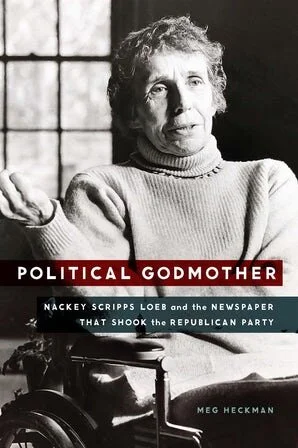
Political Godmother: Nackey Scripps Loeb and the Newspaper That Shook the Republican Party
(Potomac Books/University of Nebraska Press, 2020)
By Meg Heckman
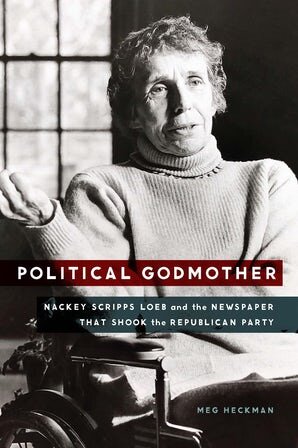
( Potomac Books/University of Nebraska Press, 2020)
By Meg Heckman
Newspaper publisher and GOP kingmaker Nackey Scripps Loeb headed the Union Leader Corporation, one of the most unusual—and influential—local newspaper companies in the United States. Her unapologetic conservatism and powerful perch in the home of the first-in-the-nation presidential primary elicited fear and respect while her leadership of New Hampshire’s Union Leader gave her an outsized role in American politics.
In Political Godmother Meg Heckman looks at Loeb’s rough-and-tumble political life against the backdrop of the right-wing media landscape of the late twentieth century. Heckman reveals Loeb as a force of nature, more than willing to wield her tremendous clout and able to convince the likes of Pat Buchanan to challenge a sitting president. Although Loeb initially had no interest in the newspaper business, she eventually penned more than a thousand front-page editorials, drew political cartoons, and became a regular on C-SPAN.
A fascinating look at power politics in action, Political Godmother reveals how one woman ignited conservatism’s transformation of the contemporary Republican Party.
Dying to Count: Post-Abortion Care and Global Reproductive Health Politics in Senegal
(Rutgers University Press, 2021)
By Siri Suh

( Rutgers University Press, 2021)
By Siri Suh
During the early 1990s, global health experts developed a new model of emergency obstetric care: post-abortion care or PAC. In developing countries with restrictive abortion laws and where NGOs relied on US family planning aid, PAC offered an apolitical approach to addressing the consequences of unsafe abortion. In Dying to Count, Siri Suh traces how national and global population politics collide in Senegal as health workers, health officials, and NGO workers strive to demonstrate PAC’s effectiveness in the absence of rigorous statistical evidence that the intervention reduces maternal mortality. Suh argues that pragmatically assembled PAC data convey commitments to maternal mortality reduction goals while obscuring the frequency of unsafe abortion and the inadequate care women with complications are likely to receive if they manage to reach a hospital. At a moment when African women face the highest risk worldwide of death from complications related to pregnancy, birth, or abortion, Suh’s ethnography of PAC in Senegal makes a critical contribution to studies of global health, population and development, African studies, and reproductive justice.

Women, Power, and Property: The Paradox of Gender Equality Laws in India
(Cambridge University Press, 2020)
By Rachel E. Brulé

(Cambridge University Press, 2020)
By Rachel E. Brulé
Quotas for women in government have swept the globe. Yet we know little about their capacity to upend entrenched social, political, and economic hierarchies. Women, Power, and Property explores this question within the context of India, the world's largest democracy. Brulé employs a research design that maximizes causal inference alongside extensive field research to explain the relationship between political representation, backlash, and economic empowerment. Her findings show that women in government – gatekeepers – catalyze access to fundamental economic rights to property. Women in politics have the power to support constituent rights at critical junctures, such as marriage negotiations, when they can strike integrative solutions to intrahousehold bargaining. Yet there is a paradox: quotas are essential for enforcement of rights, but they generate backlash against women who gain rights without bargaining leverage. In this groundbreaking study, Brulé shows how well-designed quotas can operate as a crucial tool to foster equality and benefit the women they are meant to empower.

#HashtagActivism: Networks of Race and Gender Justice
(MIT Press, 2020)
By Moya Bailey

(MIT Press, 2020)
By Moya Bailey
How marginalized groups use Twitter to advance counter-narratives, preempt political spin, and build diverse networks of dissent.
The power of hashtag activism became clear in 2011, when #IranElection served as an organizing tool for Iranians protesting a disputed election and offered a global audience a front-row seat to a nascent revolution. Since then, activists have used a variety of hashtags, including #JusticeForTrayvon, #BlackLivesMatter, #YesAllWomen, and #MeToo to advocate, mobilize, and communicate. In this book, Sarah Jackson, Moya Bailey, and Brooke Foucault Welles explore how and why Twitter has become an important platform for historically disenfranchised populations, including Black Americans, women, and transgender people. They show how marginalized groups, long excluded from elite media spaces, have used Twitter hashtags to advance counternarratives, preempt political spin, and build diverse networks of dissent.
The authors describe how such hashtags as #MeToo, #SurvivorPrivilege, and #WhyIStayed have challenged the conventional understanding of gendered violence; examine the voices and narratives of Black feminism enabled by #FastTailedGirls, #YouOKSis, and #SayHerName; and explore the creation and use of #GirlsLikeUs, a network of transgender women. They investigate the digital signatures of the “new civil rights movement”—the online activism, storytelling, and strategy-building that set the stage for #BlackLivesMatter—and recount the spread of racial justice hashtags after the killing of Michael Brown in Ferguson, Missouri, and other high-profile incidents of killings by police. Finally, they consider hashtag created by allies, including #AllMenCan and #CrimingWhileWhite.

Design Justice: Community-Led Practices to Build the Worlds We Need
(MIT Press, 2020)
By Sasha Costanza-Chock

(MIT Press, 2020)
By Sasha Costanza-Chock
An exploration of how design might be led by marginalized communities, dismantle structural inequality, and advance collective liberation and ecological survival.
The open access edition of this book was made possible by generous funding from Knowledge Unlatched and the MIT Press Frank Urbanowski Memorial Fund.
What is the relationship between design, power, and social justice? “Design justice” is an approach to design that is led by marginalized communities and that aims explicitly to challenge, rather than reproduce, structural inequalities. It has emerged from a growing community of designers in various fields who work closely with social movements and community-based organizations around the world.
This book explores the theory and practice of design justice, demonstrates how universalist design principles and practices erase certain groups of people—specifically, those who are intersectionally disadvantaged or multiply burdened under the matrix of domination (white supremacist heteropatriarchy, ableism, capitalism, and settler colonialism)—and invites readers to “build a better world, a world where many worlds fit; linked worlds of collective liberation and ecological sustainability.” Along the way, the book documents a multitude of real-world community-led design practices, each grounded in a particular social movement. Design Justice goes beyond recent calls for design for good, user-centered design, and employment diversity in the technology and design professions; it connects design to larger struggles for collective liberation and ecological survival.

Diversifying Power: Why We Need Antiracist, Feminist Leadership on Climate and Energy
(Island Press, 2020)
By Jennie C. Stephens

(Island Press, 2020)
By Jennie C. Stephens
The climate crisis is a crisis of leadership. For too long too many leaders have prioritized corporate profits over the public good, exacerbating climate vulnerabilities while reinforcing economic and racial injustice. Transformation to a just, sustainable renewable-based society requires leaders who connect social justice to climate and energy.
During the Trump era, connections among white supremacy; environmental destruction; and fossil fuel dependence have become more conspicuous. Many of the same leadership deficiencies that shaped the inadequate response in the United States to the coronavirus pandemic have also thwarted the US response to the climate crisis. The inadequate and ineffective framing of climate change as a narrow, isolated, discrete problem to be “solved” by technical solutions is failing. The dominance of technocratic, white, male perspectives on climate and energy has inhibited investments in social change and social innovations. With new leadership and diverse voices, we can strengthen climate resilience, reduce racial and economic inequities, and promote social justice.
In Diversifying Power, energy expert Jennie Stephens argues that the key to effectively addressing the climate crisis is diversifying leadership so that antiracist, feminist priorities are central. All politics is now climate politics, so all policies, from housing to health, now have to integrate climate resilience and renewable energy.
Stephens takes a closer look at climate and energy leadership related to job creation and economic justice, health and nutrition, housing and transportation. She looks at why we need to resist by investing in bold diverse leadership to curb the “the polluter elite.” We need to reclaim and restructure climate and energy systems so policies are explicitly linked to social, economic, and racial justice.
Inspirational stories of diverse leaders who integrate antiracist, feminist values to build momentum for structural transformative change are woven throughout the book, along with Stephens’ experience as a woman working on climate and energy. The shift from a divided, unequal, extractive, and oppressive society to a just, sustainable, regenerative, and healthy future has already begun.
But structural change needs more bold and ambitious leaders at all levels, like Alexandria Ocasio-Cortez with the Green New Deal, or the Secwepemc women of the Tiny House Warriors resisting the Trans Mountain pipeline.
Diversifying Power offers hope and optimism. Stephens shows how the biggest challenges facing society are linked and anyone can get involved to leverage the power of collective action. By highlighting the creative individuals and organizations making change happen, she provides inspiration and encourages transformative action on climate and energy justice.

Sexual States: Governance and the Struggle over the Antisodomy Law in India
(Duke University Press, 2016)
By Jyoti Puri
(Duke University Press, 2016)
By Jyoti Puri
In Sexual States, Jyoti Puri uses the example of the efforts to decriminalize homosexuality in India to show how the regulation of sexuality is fundamentally tied to the creation and enduring existence of the state. Between 2001 and 2013, activists attempted to rewrite section 377 of the Indian Penal Code, which outlaws homosexual behavior. Having interviewed activists and NGO workers throughout five metropolitan centers, investigated crime statistics at the National Crime Records Bureau, visited various state institutions, and met with the police, Puri found that section 377 is but one element of the large and complex systems of laws, practices, policies, and discourses that regulate Indian sexuality. Intended to mitigate sexuality's threat to the social order, this regulation works to preserve the views of the state as inevitable, legitimate, and indispensable. By highlighting the various means through which the regulation of sexuality constitutes India's heterogeneous and fragmented.

Maria Baldwin’s Worlds: A Story of Black New England and the Fight for Racial Justice
(University of Massachusetts Press, 2019)
By Kathleen Weiler

(University of Massachusetts Press, 2019)
By Kathleen Weiler
Maria Baldwin (1856–1922) held a special place in the racially divided society of her time, as a highly respected educator at a largely white New England school and an activist who carried on the radical spirit of the Boston area’s internationally renowned abolitionists from a generation earlier.
African American sociologist Adelaide Cromwell called Baldwin “the lone symbol of Negro progress in education in the greater Boston area” during her lifetime. Baldwin used her respectable position to fight alongside more radical activists like William Monroe Trotter for full citizenship for fellow members of the black community. And, in her professional and personal life, she negotiated and challenged dominant white ideas about black womanhood. In Maria Baldwin’s Worlds, Kathleen Weiler reveals both Baldwin’s victories and what fellow activist W. E. B. Du Bois called her “quiet courage” in everyday life, in the context of the wider black freedom struggle in New England.

Abortion Regret: The New Attack on Reproductive Freedom
(Praeger, 2019)
By J. Shoshanna Ehrlich and Alesha E. Doan

(Praeger, 2019)
By J. Shoshanna Ehrlich and Alesha E. Doan
An indispensable resource for students, scholars, and activists concerned about current attacks on abortion rights, this book offers an unmatched account of the emergence, consolidation, and consequences of the antiabortion movement's paternalistic abortion regret narrative.
• Examines the historical continuity of the abortion regret narrative as a political strategy used to limit women's access to abortion
• Asserts that the abortion regret narrative is intimately tied to a gendered and paternalistic construction of women's divine role as mothers
• Examines the antiabortion movement's strategy to place the "grieving" mother at the center of its oppositional narrative
• Uses interviews, textual analysis of primary sources, and content analysis of state antiabortion policies to trace the growing impact of the abortion regret narrative
• Examines and reveals the antiabortion movement's calculated political motivation for using the abortion regret narrative as its primary strategy to oppose abortion rights

An Archive of the Catastrophe: The Unused Footage of Claude Lanzmann's Shoah
(SUNY Press, 2019)
By Jennifer Cazenave

(SUNY Press, 2019)
By Jennifer Cazenave
Comprehensive analysis of 220 hours of outtakes that impels us to reexamine our assumptions about a crucial Holocaust documentary.
Claude Lanzmann’s 1985 magnum opus, Shoah, is a canonical documentary on the Holocaust—and in film history. Over the course of twelve years, Lanzmann gathered 230 hours of location filming and interviews with survivors, witnesses, and perpetrators, which he condensed into a 9½-hour film. The unused footage was scattered and inaccessible for years before it was restored and digitized by the United States Holocaust Memorial Museum. In An Archive of the Catastrophe, Jennifer Cazenave presents the first comprehensive study of this collection. She argues that the outtakes pose a major challenge to the representational and theoretical paradigms produced by the documentary, while offering new meanings of Shoah and of Holocaust testimony writ large. They lend fresh insight into issues raised by the film, including questions of resistance, rescue, refugees, and, above all, gender—Lanzmann’s twenty hours of interviews with women make up a mere ten minutes of the finished documentary. As a rare instance of outtakes preserved during the predigital era of cinema, this unused footage challenges us to establish a new critical framework for understanding how documentaries are constructed and reshapes the way we view this key Holocaust film.

Interdisciplinary Approaches to Human Rights: History, Politics, Practice
(Routledge, 2019)
Edited By Ranjini Srikanth and Elora Halim Chowdhury

(Routledge, 2019)
Edited By Ranjini Srikanth and Elora Halim Chowdhury
Interdisciplinary Approaches to Human Rights: History, Politics, Practice is an edited collection that brings together analyses of human rights work from multiple disciplines. Within the academic sphere, this book will garner interest from scholars who are invested in human rights as a field of study, as well as those who research, and are engaged in, the praxis of human rights.
Referring to the historical and cross-cultural study of human rights, the volume engages with disciplinary debates in political philosophy, gender and women’s studies, Global South/Third World studies, international relations, psychology, and anthropology. At the same time, the authors employ diverse methodologies including oral history, theoretical and discourse analysis, ethnography, and literary and cinema studies. Within the field of human rights studies, this book attends to the critical academic gap on interdisciplinary and praxis-based approaches to the field, as opposed to a predominantly legalistic focus, drawing from case studies from a wide range of contexts in the Global South, including Bangladesh, Colombia, Haiti, India, Mexico, Palestine, and Sudan, as well as from Australia and the United States in the Global North.
For students who will go on to become researchers, practitioners, policy makers, and activists, this collection of essays will demonstrate the multifaceted landscape of human rights and the multiple forces (philosophical, political, cultural, economic, historical) that affect it.

Monstrous Intimacies: Making Post Slavery Subjects
(Duke University Press Books, 2010)
By Christina Sharpe

(Duke University Press Books, 2010)
By Christina Sharpe
Arguing that the fundamental, familiar, sexual violence of slavery and racialized subjugation have continued to shape black and white subjectivities into the present, Christina Sharpe interprets African diasporic and Black Atlantic visual and literary texts that address those “monstrous intimacies” and their repetition as constitutive of post-slavery subjectivity. Her illuminating readings juxtapose Frederick Douglass’s narrative of witnessing the brutal beating of his Aunt Hester with Essie Mae Washington-Williams’s declaration of freedom in Dear Senator: A Memoir by the Daughter of Strom Thurmond, as well as the “generational genital fantasies” depicted in Gayl Jones’s novel Corregidora with a firsthand account of such “monstrous intimacies” in the journals of an antebellum South Carolina senator, slaveholder, and vocal critic of miscegenation. Sharpe explores the South African–born writer Bessie Head’s novel Maru—about race, power, and liberation in Botswana—in light of the history of the KhoiSan woman Saartje Baartman, who was displayed in Europe as the “Hottentot Venus” in the nineteenth century. Reading Isaac Julien’s film The Attendant, Sharpe takes up issues of representation, slavery, and the sadomasochism of everyday black life. Her powerful meditation on intimacy, subjection, and subjectivity culminates in an analysis of Kara Walker’s black silhouettes, and the critiques leveled against both the silhouettes and the artist.

Acts of Gaiety: LGBT Performance and the Politics of Pleasure
(University of Michigan Press, 2012)
By Sarah Warner

(University of Michigan Press, 2012)
By Sarah Warner
Against queer theory's long-suffering romance with mourning and melancholia and a national agenda that urges homosexuals to renounce pleasure if they want to be taken seriously, Acts of Gaiety seeks to reanimate notions of "gaiety" as a political value for LGBT activism by recovering earlier mirthful modes of political performance. The book mines the archives of lesbian-feminist activism of the 1960s–70s, highlighting the outrageous gaiety—including camp, kitsch, drag, guerrilla theater, zap actions, rallies, manifestos, pageants, and parades alongside "legitimate theater”-- at the center of the social and theatrical performances of the era. Juxtaposing figures such as Valerie Solanas and Jill Johnston with more recent performers and activists including Hothead Paisan, Bitch and Animal, and the Five Lesbian Brothers, Sara Warner shows how reclaiming this largely discarded and disavowed past elucidates possibilities for being and belonging. Acts of Gaietyexplores the mutually informing histories of gayness as politics and as joie de vivre, along with the centrality of liveliness to queer performance and protest.

Resisting Reality: Social Construction and Social Critique
(Oxford University Press, 2011)
By Sally Haslanger

(Oxford University Press, 2011)
By Sally Haslanger
Contemporary theorists use the term "social construction" with the aim of exposing how what's purportedly "natural" is often at least partly social and, more specifically, how this masking of the social is politically significant. In these previously published essays, Sally Haslanger draws on insights from feminist and critical race theory to explore and develop the idea that gender and race are positions within a structure of social relations. On this interpretation, the point of saying that gender and race are socially constructed is not to make a causal claim about the origins of our concepts of gender and race, or to take a stand in the nature/nurture debate, but to locate these categories within a realist social ontology. This is politically important, for by theorizing how gender and race fit within different structures of social relations we are better able to identify and combat forms of systematic injustice.
Although the central essays of the book focus on a critical social realism about gender and race, these accounts function as case studies for a broader critical social realism. To develop this broader approach, several essays offer reworked notions of ideology, practice, and social structure, drawing on recent research in sociology and social psychology. Ideology, on the proposed view, is a relatively stable set of shared dispositions to respond to the world, often in ways that also shape the world to evoke those very dispositions. This looping of our dispositions through the material world enables the social to appear natural.
Additional essays in the book situate this approach to social phenomena in relation to philosophical methodology, and to specific debates in metaphysics, epistemology, and philosophy of language. The book as a whole explores the interface between analytic philosophy and critical theory.

Reclaiming the Feminist Vision: Consciousness-Raising and Small Group Practice
(McFarland, 2014)
By Janet L. Freedman

(McFarland, 2014)
By Janet L. Freedman
It’s called consciousness-raising (CR). Asking questions about our experiences and sharing insights and analyses with others can be the basis for informed activism for positive social change. CR provided the entry point for feminists who shaped the women’s liberation movement in the late 1960s and 1970s, and is now being revitalized across class, race and geography in face-to-face groups and on the internet.
Reclaiming the Feminist Vision traces the origins, principles and impact of consciousness-raising; reveals how the process migrated to other settings, sometimes maintaining the original political intent and sometimes diluting it. The book calls for the renewal of the practice to help feminists regain their voices and their power in shaping social movement history.

Forever Suspect: Racialized Surveillance of Muslim Americans in the War on Terror (2018)
(Rutgers University Press, 2018)
By Saher Selod

(Rutgers University Press, 2018)
By Saher Selod
The declaration of a “War on Terror” in the aftermath of the September 11, 2001 terrorist attacks brought sweeping changes to the American criminal justice and national security systems, as well as a massive shift in the American public opinion of both individual Muslims and the Islamic religion generally. Since that time, sociologist Saher Selod argues, Muslim Americans have experienced higher levels of racism in their everyday lives. In Forever Suspect, Selod shows how a specific American religious identity has acquired racial meanings, resulting in the hyper surveillance of Muslim citizens. Drawing on forty-eight in-depth interviews with South Asian and Arab Muslim Americans, she investigates how Muslim Americans are subjected to racialized surveillance in both an institutional context by the state and a social context by their neighbors and co-workers. Forever Suspect underscores how this newly racialized religious identity changes the social location of Arabs and South Asians on the racial hierarchy further away from whiteness and compromises their status as American citizens.

Myths & Ms.: An Inter-Generational Play about Reincarnation and Abortion
(Anaphora Literary Press, 2018)
By Rosie Rosenzweig

(Anaphora Literary Press, 2018)
By Rosie Rosenzweig
A ghost hovers watching and waiting to embody itself in the most auspicious womb. Its goal is to fulfill what it couldn’t in its last lifetime called “soul work.” Myths & Ms. is an intergenerational play about abortion and reincarnation, dramatizing the changing attitudes and conditions towards abortion in the 20th and 21st centuries. This idea of reincarnation highlights the strident voices from the pro-choice and pro-life camps.

Gay Priori: A Queer Critical Legal Studies Approach to Law Reform
(Duke University Press, 2018)
By Libby Adler

(Duke University Press, 2018)
By Libby Adler
In Gay Priori Libby Adler offers a comprehensive critique of mainstream LGBT legal agendas in the United States and a new direction for LGBT law reform. Adler shows how LGBT equal rights discourse drives legal advocates toward a narrow array of reform objectives—namely, same-sex marriage, antidiscrimination protections, and hate crimes statutes. This approach means that many legal issues that greatly impact the lives of the LGBT community's most marginalized members—especially those who are transgender, homeless, underage, or nonwhite—often go unnoticed. Such a narrow focus on equal rights also fixes and flattens LGBT identities, perpetuates the uneven distribution of resources such as safety, housing, health, and wealth, and limits the capacity for advocates to imagine change. To combat these effects, Adler calls for prioritizing the redistribution of resources in ways that focus on addressing low-profile legal conditions such as foster care and other issues that better meet the needs of LGBT people. Such a shift in perspective, Adler contends, will serve to open up a new world of reform possibilities that the law provides for.

Tainted Witness: Why We Doubt What Women Say About Their Lives
(Columbia University Press, 2017)
By Leigh Gilmore

(Columbia University Press, 2017)
By Leigh Gilmore
In 1991, Anita Hill's testimony during Clarence Thomas's Senate confirmation hearing brought the problem of sexual harassment to a public audience. Although widely believed by women, Hill was defamed by conservatives and Thomas was confirmed to the Supreme Court. The tainting of Hill and her testimony is part of a larger social history in which women find themselves caught up in a system that refuses to believe what they say. Hill's experience shows how a tainted witness is not who someone is, but what someone can become.
Why are women so often considered unreliable witnesses to their own experiences? How are women discredited in legal courts and in courts of public opinion? Why is women's testimony so often mired in controversies fueled by histories of slavery and colonialism? How do new feminist witnesses enter testimonial networks and disrupt doubt? Tainted Witnessexamines how gender, race, and doubt stick to women witnesses as their testimony circulates in search of an adequate witness. Judgment falls unequally upon women who bear witness, as well-known conflicts about testimonial authority in the late twentieth and early twenty-first centuries reveal. Women's testimonial accounts demonstrate both the symbolic potency of women's bodies and speech in the public sphere and the relative lack of institutional security and control to which they can lay claim. Each testimonial act follows in the wake of a long and invidious association of race and gender with lying that can be found to this day within legal courts and everyday practices of judgment, defining these locations as willfully unknowing and hostile to complex accounts of harm. Bringing together feminist, literary, and legal frameworks, Leigh Gilmore provides provocative readings of what happens when women's testimony is discredited. She demonstrates how testimony crosses jurisdictions, publics, and the unsteady line between truth and fiction in search of justice.

Women in Global Science: Advancing Academic Careers through International Collaboration
(Stanford University Press, 2017)
By Kathrin Zippel

(Stanford University Press, 2017)
By Kathrin Zippel
Scientific and engineering research is increasingly global, and international collaboration can be essential to academic success. Yet even as administrators and policymakers extol the benefits of global science, few recognize the diversity of international research collaborations and their participants, or take gendered inequalities into account. Women in Global Science is the first book to consider systematically the challenges and opportunities that the globalization of scientific work brings to U.S. academics, especially for women faculty.
Kathrin Zippel looks to the STEM fields as a case study, where gendered cultures and structures in academia have contributed to an underrepresentation of women. While some have approached underrepresentation as a national concern with a national solution, Zippel highlights how gender relations are reconfigured in global academia. For U.S. women in particular, international collaboration offers opportunities to step outside of exclusionary networks at home. International collaboration is not the panacea to gendered inequalities in academia, but, as Zippel argues, international considerations can be key to ending the steady attrition of women in STEM fields and developing a more inclusive academic world.