

Inceptions: Literary Beginnings and Contingencies of Form
(Fordham University Press, 2021)
By Kevin Ohi

(Fordham University Press, 2021)
By Kevin Ohi
The beginning is both internal and external to the text it initiates, and that noncoincidence points to the text’s vexed relation with its outside. Hence the nontrivial self-reflexivity of any textual beginning, which must bear witness to the self-grounding quality of the literary work— its inability either to comprise its inception or to externalize it in an authorizing exteriority. In a different but related way, the fact that they must begin renders our lives and our desires opaque to us; what Freud called “latency” marks not only sexuality but human thought with a self-division shaped by asynchronicity.
From Henry James’s New York Edition prefaces to George Eliot’s epigraphs, from Ovid’s play with meter to Charles Dickens’s thematizing of the ex nihilo emergence of character, from Wallace Stevens’s abstract consideration of poetic origins to James Baldwin’s, Carson McCullers’s, and Eudora Welty’s descriptions of queer childhood, writers repeatedly confront the problem of inception. Inception introduces a fundamental contingency into texts and psyches alike: in the beginning, all could have been otherwise.
For Kevin Ohi, the act of inception, and the potential it embodies, enables us to see making and unmaking coincide within the mechanism of creation. In this sense, Inceptions traces an ethics of reading, the possibility of perceiving, in the ostensibly finished forms of lives and texts, the potentiality inherent in their having started forth.

Misogynoir Transformed: Black Women's Digital Resistance
(New York University, 2021)
By Moya Bailey

(New York University Press, 2021)
By Moya Bailey
When Moya Bailey first coined the term misogynoir, she defined it as the ways anti-Black and misogynistic representation shape broader ideas about Black women, particularly in visual culture and digital spaces. She had no idea that the term would go viral, touching a cultural nerve and quickly entering into the lexicon. Misogynoir now has its own Wikipedia page and hashtag, and has been featured on Comedy Central’s The Daily Show and CNN’s Cuomo Prime Time. In Misogynoir Transformed, Bailey delves into her groundbreaking concept, highlighting Black women’s digital resistance to anti-Black misogyny on YouTube, Facebook, Tumblr, and other platforms.
At a time when Black women are depicted as more ugly, deficient, hypersexual, and unhealthy than their non-Black counterparts, Bailey explores how Black women have bravely used social-media platforms to confront misogynoir in a number of courageous—and, most importantly, effective—ways. Focusing on queer and trans Black women, she shows us the importance of carving out digital spaces, where communities are built around queer Black webshows and hashtags like #GirlsLikeUs.
Bailey shows how Black women actively reimagine the world by engaging in powerful forms of digital resistance at a time when anti-Black misogyny is thriving on social media. A groundbreaking work, Misogynoir Transformed highlights Black women’s remarkable efforts to disrupt mainstream narratives, subvert negative stereotypes, and reclaim their lives.

Ishtyle: Accenting Gay Indian Nightlife
(University of Michigan Press, 2020)
By Kareem Khubchandani

(University of Michigan Press, 2020)
By Kareem Khubchandani
Gay nightlife as sociopolitical performance
Ishtyle follows queer South Asian men across borders into gay neighborhoods, nightclubs, bars, and house parties in Bangalore and Chicago. Bringing the cultural practices they are most familiar with into these spaces, these men accent the aesthetics of nightlife cultures through performance. Kareem Khubchandani develops the notion of “ishtyle” to name this accented style, while also showing how brown bodies inadvertently become accents themselves, ornamental inclusions in the racialized grammar of desire. Ishtyleallows us to reimagine a global class perpetually represented as docile and desexualized workers caught in the web of global capitalism. The book highlights a different kind of labor, the embodied work these men do to feel queer and sexy together. Engaging major themes in queer studies, Khubchandani explains how his interlocutors’ performances stage relationships between: colonial law and public sexuality; film divas and queer fans; and race, caste, and desire. Ultimately, the book demonstrates that the unlikely site of nightlife can be a productive venue for the study of global politics and its institutional hierarchies.

The Oxford Handbook on Global LGBT and Sexual Diversity Politics
(Oxford University Press, 2020)
By Michael J. Bosia, Sandra M. McEvoy, and Momin Rahman

(Oxford University Press, 2020)
By Michael J. Bosia, Sandra M. McEvoy, and Momin Rahman
This Handbook contains chapters on the struggles for LGBT rights and the security of sexual and gender minorities around the world, with a substantial number of contributions from the Global South. It contextualizes the regional case studies within relevant theoretical frameworks from the sociology of sexualities, critical race studies, postcolonialism, indigenous theories, social movement theory, and international relations theory. Therefore, it provides readers with up-to-date empirical material as well as various ways of assessing the analytical significance, commonalities, and differences of global LGBT politics. As such, the chapters combine to present an overall interdisciplinary and critical perspective on contemporary LGBT politics.
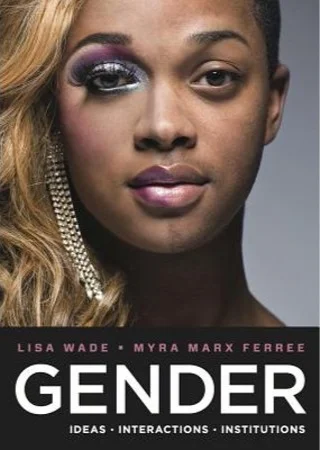
Gender: Ideas, Interactions, Institutions
(W. W. Norton & Company, 2014)
By Lisa Wade and Myra Marx Ferree

(W. W. Norton & Company, 2014)
By Lisa Wade and Myra Marx Ferree
A lively exploration of current questions of gender and their application to students today.
Wade and Ferree’s first edition textbook is a lively introduction to the sociology of gender. Probing questions, the same ones that students often bring to the course, frame readable chapters that are packed with the most up-to-date scholarship available―in language students will understand. The authors use memorable examples mined from pop culture, history, psychology, biology, and everyday life to truly engage students in the study of gender and spark interest in sociological perspectives.

Acts of Gaiety: LGBT Performance and the Politics of Pleasure
(University of Michigan Press, 2012)
By Sarah Warner

(University of Michigan Press, 2012)
By Sarah Warner
Against queer theory's long-suffering romance with mourning and melancholia and a national agenda that urges homosexuals to renounce pleasure if they want to be taken seriously, Acts of Gaiety seeks to reanimate notions of "gaiety" as a political value for LGBT activism by recovering earlier mirthful modes of political performance. The book mines the archives of lesbian-feminist activism of the 1960s–70s, highlighting the outrageous gaiety—including camp, kitsch, drag, guerrilla theater, zap actions, rallies, manifestos, pageants, and parades alongside "legitimate theater”-- at the center of the social and theatrical performances of the era. Juxtaposing figures such as Valerie Solanas and Jill Johnston with more recent performers and activists including Hothead Paisan, Bitch and Animal, and the Five Lesbian Brothers, Sara Warner shows how reclaiming this largely discarded and disavowed past elucidates possibilities for being and belonging. Acts of Gaietyexplores the mutually informing histories of gayness as politics and as joie de vivre, along with the centrality of liveliness to queer performance and protest.

The Tolerance Trap: How God, Genes, and Good Intentions are Sabotaging Gay Equality
(NYU Press, 2014)
By Suzanna Walters

(NYU Press, 2014)
By Suzanna Walters
From Glee to gay marriage, from lesbian senators to out gay Marines, we have undoubtedly experienced a seismic shift in attitudes about gays in American politics and culture. Our reigning national story is that a new era of rainbow acceptance is at hand. But dig a bit deeper, and this seemingly brave new gay world is disappointing. For all of the undeniable changes, the plea for tolerance has sabotaged the full integration of gays into American life. Same-sex marriage is unrecognized and unpopular in the vast majority of states, hate crimes proliferate, and even in the much vaunted “gay friendly” world of Hollywood and celebrity culture, precious few stars are openly gay.
In The Tolerance Trap, Suzanna Walters takes on received wisdom about gay identities and gay rights, arguing that we are not “almost there,” but on the contrary have settled for a watered-down goal of tolerance and acceptance rather than a robust claim to full civil rights. After all, we tolerate unpleasant realities: medicine with strong side effects, a long commute, an annoying relative. Drawing on a vast array of sources and sharing her own personal journey, Walters shows how the low bar of tolerance demeans rather than ennobles both gays and straights alike. Her fascinating examination covers the gains in political inclusion and the persistence of anti-gay laws, the easy-out sexual freedom of queer youth and the suicides and murders of those in decidedly intolerant environments. She challenges both “born that way” storylines that root civil rights in biology, and “god made me that way” arguments that similarly situate sexuality as innate and impervious to decisions we make to shape it. A sharp and provocative cultural critique, this book deftly argues that a too-soon declaration of victory short-circuits full equality and deprives us all of the transformative possibilities of full integration. Tolerance is not the end goal, but a dead end. In The Tolerance Trap, Walters presents a complicated snapshot of a world-shifting moment in American history—one that is both a wake-up call and a call to arms for anyone seeking true equality.

Gay Priori: A Queer Critical Legal Studies Approach to Law Reform
(Duke University Press, 2018)
By Libby Adler

(Duke University Press, 2018)
By Libby Adler
In Gay Priori Libby Adler offers a comprehensive critique of mainstream LGBT legal agendas in the United States and a new direction for LGBT law reform. Adler shows how LGBT equal rights discourse drives legal advocates toward a narrow array of reform objectives—namely, same-sex marriage, antidiscrimination protections, and hate crimes statutes. This approach means that many legal issues that greatly impact the lives of the LGBT community's most marginalized members—especially those who are transgender, homeless, underage, or nonwhite—often go unnoticed. Such a narrow focus on equal rights also fixes and flattens LGBT identities, perpetuates the uneven distribution of resources such as safety, housing, health, and wealth, and limits the capacity for advocates to imagine change. To combat these effects, Adler calls for prioritizing the redistribution of resources in ways that focus on addressing low-profile legal conditions such as foster care and other issues that better meet the needs of LGBT people. Such a shift in perspective, Adler contends, will serve to open up a new world of reform possibilities that the law provides for.

Queer Terror: Life, Death, and Desire in the Settler Colony
(Columbia University Press, 2018)
By C. Heike Schotten

(Columbia University Press, 2018)
By C. Heike Schotten
After Sept. 11, 2001, George W. Bush declared, “Either you are with us, or you are with the terrorists.” Bush’s assertion was not simply jingoist bravado―it encapsulates the civilizationalist moralism that has motivated and defined the United States since its beginning, linking the War on Terror to the nation’s settlement and founding.
In Queer Terror, C. Heike Schotten offers a critique of U.S. settler-colonial empire that draws on political, queer, and critical indigenous theory to situate Bush’s either/or moralism and reframe the concept of terrorism. The categories of the War on Terror exemplify the moralizing politics that insulate U.S. empire from critique, render its victims deserving of its abuses, and delegitimize resistance to it as unthinkable and perverse. Schotten provides an anatomy of this moralism, arguing for a new interpretation of biopolitics that is focused on sovereignty and desire rather than racism and biology. This rethinking of biopolitics puts critical political theory of empire in dialogue with the insights of both native studies and queer theory. Building on queer theory’s refusal of sanctity, propriety, and moralisms of all sorts, Schotten ultimately contends that the answer to Bush’s ultimatum is clear: dissidents must reject the false choice he presents and stand decisively against “us,” rejecting its moralism and the sanctity of its “life,” in order to further a truly emancipatory, decolonizing queer politics.

After the Wrath of God: AIDS, Sexuality, & American Religion
(Oxford University Press, 2015)
By Anthony M. Petro

(Oxford University Press, 2015)
By Anthony M. Petro
On a cold February morning in 1987, amidst freezing rain and driving winds, a group of protesters stood outside of the Unitarian Universalist Church in Amherst, Massachusetts. The target of their protest was the minister inside, who was handing out condoms to his congregation while delivering a sermon about AIDS, dramatizing the need for the church to confront the seemingly ever-expanding crisis. The minister's words and actions were met with a standing ovation from the overflowing audience, but he could not linger to enjoy their applause. Having received threats in advance of the service, he dashed out of the sanctuary immediately upon finishing his sermon. Such was the climate for religious AIDS activism in the 1980s.
In After the Wrath of God, Anthony Petro vividly narrates the religious history of AIDS in America. Delving into the culture wars over sex, morality, and the future of the American nation, he demonstrates how religious leaders and AIDS activists have shaped debates over sexual morality and public health from the 1980s to the present day. While most attention to religion and AIDS foregrounds the role of the Religious Right, Petro takes a much broader view, encompassing the range of mainline Protestant, evangelical, and Catholic groups--alongside AIDS activist organizations--that shaped public discussions of AIDS prevention and care in the U.S. Petro analyzes how the AIDS crisis prompted American Christians across denominations and political persuasions to speak publicly about sexuality--especially homosexuality--and to foster a moral discourse on sex that spoke not only to personal concerns but to anxieties about the health of the nation. He reveals how the epidemic increased efforts to advance a moral agenda regarding the health benefits of abstinence and monogamy, a legacy glimpsed as much in the traction gained by abstinence education campaigns as in the more recent cultural purchase of gay marriage.
The first book to detail the history of religion and the AIDS epidemic in the U.S., After the Wrath of God is essential reading for anyone concerned with the intersection of religion and public health.