

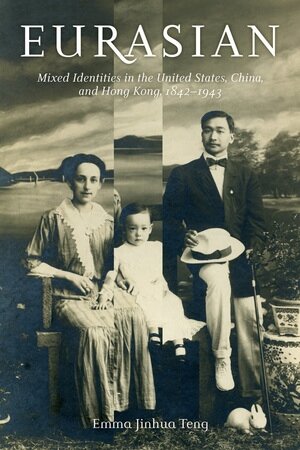
EurasianMixed Identities in the United States, China, and Hong Kong, 1842–1943
(University of California Press, 2013)
By Emma Teng
(University of California Press, 2013)
By Emma Teng
In the second half of the nineteenth century, global labor migration, trade, and overseas study brought China and the United States into close contact, leading to new cross-cultural encounters that brought mixed-race families into being. Yet the stories of these families remain largely unknown. How did interracial families negotiate their identities within these societies when mixed-race marriage was taboo and “Eurasian” often a derisive term?
In Eurasian, Emma Jinhua Teng compares Chinese-Western mixed-race families in the United States, China, and Hong Kong, examining both the range of ideas that shaped the formation of Eurasian identities in these diverse contexts and the claims set forth by individual Eurasians concerning their own identities. Teng argues that Eurasians were not universally marginalized during this era, as is often asserted. Rather, Eurasians often found themselves facing contradictions between exclusionary and inclusive ideologies of race and nationality, and between overt racism and more subtle forms of prejudice that were counterbalanced by partial acceptance and privilege.
By tracing the stories of mixed and transnational families during an earlier era of globalization, Eurasian also demonstrates to students, faculty, scholars, and researchers how changes in interracial ideology have allowed the descendants of some of these families to reclaim their dual heritage with pride.

Coming of Age in Jim Crow DC: Navigating the Politics of Everyday Life
(New York University Press, 2019)
By Paula Austin

(New York University Press, 2019)
By Paula Austin
Coming of Age in Jim Crow DC offers a complex narrative of the everyday lives of black young people in a racially, spatially, economically, and politically restricted Washington, DC, during the 1930s. In contrast to the ways in which young people have been portrayed by researchers, policy makers, law enforcement, and the media, Paula C. Austin draws on previously unstudied archival material to present black poor and working class young people as thinkers, theorists, critics, and commentators as they reckon with the boundaries imposed on them in a Jim Crow city that was also the American emblem of equality.
The narratives at the center of this book provide a different understanding of black urban life in the early twentieth century, showing that ordinary people were expert at navigating around the limitations imposed by the District of Columbia’s racially segregated politics. Coming of Age in Jim Crow DC is a fresh take on the New Negro movement, and a vital contribution to the history of race in America.

Misogynoir Transformed: Black Women's Digital Resistance
(New York University, 2021)
By Moya Bailey

(New York University Press, 2021)
By Moya Bailey
When Moya Bailey first coined the term misogynoir, she defined it as the ways anti-Black and misogynistic representation shape broader ideas about Black women, particularly in visual culture and digital spaces. She had no idea that the term would go viral, touching a cultural nerve and quickly entering into the lexicon. Misogynoir now has its own Wikipedia page and hashtag, and has been featured on Comedy Central’s The Daily Show and CNN’s Cuomo Prime Time. In Misogynoir Transformed, Bailey delves into her groundbreaking concept, highlighting Black women’s digital resistance to anti-Black misogyny on YouTube, Facebook, Tumblr, and other platforms.
At a time when Black women are depicted as more ugly, deficient, hypersexual, and unhealthy than their non-Black counterparts, Bailey explores how Black women have bravely used social-media platforms to confront misogynoir in a number of courageous—and, most importantly, effective—ways. Focusing on queer and trans Black women, she shows us the importance of carving out digital spaces, where communities are built around queer Black webshows and hashtags like #GirlsLikeUs.
Bailey shows how Black women actively reimagine the world by engaging in powerful forms of digital resistance at a time when anti-Black misogyny is thriving on social media. A groundbreaking work, Misogynoir Transformed highlights Black women’s remarkable efforts to disrupt mainstream narratives, subvert negative stereotypes, and reclaim their lives.

Reading Contemporary African American and Black British Women Writers: Narrative, Race, Ethics.
(Routledge, 2020)
By Sheldon George

(Routledge, 2020)
By Sheldon George
Contemporary African American and Black British Women Writers: Narrative, Race, Ethics brings together British and American scholars to explore how, in texts by contemporary black women writers in the U. S. and Britain, formal narrative techniques express new understandings of race or stimulate ethical thinking about race in a reader. Taken together, the essays also demonstrate that black women writers from both sides of the Atlantic borrow formal structures and literary techniques from one another to describe the workings of structural racism in the daily lives of black subjects and to provoke readers to think anew about race. Narratology has only recently begun to use race as a category of narrative theory. This collection seeks both to show the ethical effects of narrative form on individual readers and to foster reconceptualizations of narrative theory that account for the workings of race within literature and culture.

Lacan and Race: Racism, Identity and Psychoanalytic Theory
(Routledge, 2021)
By Sheldon George

(Routledge, 2021)
By Sheldon George
This edited volume draws upon Lacanian psychoanalytic theory to examine the conscious and unconscious forces underlying race as a social formation, conceptualizing race, racial identity, and racism in ways that go beyond traditional modes of psychoanalytic thought.
Featuring contributions by Lacanian scholars from diverse geographical and disciplinary contexts, chapters span a wide breadth of topics, including white nationalism and contemporary debates over confederate monuments; emergent theories of race rooted in Afropessimism and postcolonialism; analyses of racism in apartheid and American slavery; clinical reflections on Latinx and other racialized patients; and applications of Lacan’s concepts of the lamella, drive and sexuation to processes of racialization. The collection both reorients readers’ understandings of race through its deployment of Lacanian theory and redefines the Lacanian subject through its theorizing of subjectivity in relation to race, racism and racial identification.
Lacan and Race will be a definitive text for psychoanalytic theorists and contemporary scholars of race, appealing to readers across the fields of psychology, cultural studies, humanities, politics, and sociology.

Beyond Repair? Mayan Women's Protagonism in the Aftermath of Genocidal Harm
(Rutgers University Press, 2019)
By Alison Crosby & M. Brinton Lykes

(Rutgers University Press, 2019)
By Alison Crosby & M. Brinton Lykes
Mayan Women’s Protagonism in the Aftermath of Genocidal Harm
Beyond Repair? explores Mayan women’s agency in the search for redress for harm suffered during the genocidal violence perpetrated by the Guatemalan state in the early 1980s at the height of the thirty-six-year armed conflict. The book draws on eight years of feminist participatory action research conducted with fifty-four Q’eqchi’, Kaqchikel, Chuj, and Mam women who are seeking truth, justice, and reparation for the violence they experienced during the war, and the women’s rights activists, lawyers, psychologists, Mayan rights activists, and researchers who have accompanied them as intermediaries for over a decade. Alison Crosby and M. Brinton Lykes use the concept of “protagonism” to deconstruct dominant psychological discursive constructions of women as “victims,” “survivors,” “selves,” “individuals,” and/or “subjects.” They argue that at different moments Mayan women have been actively engaged as protagonists in constructivist and discursive performances through which they have narrated new, mobile meanings of “Mayan woman,” repositioning themselves at the interstices of multiple communities and in their pursuit of redress for harm suffered.

Antigone in the Americas: Democracy, Sexuality and Death in the Settler Colonial Present
(SUNY Press, 2021)
By Andrés Henao Castro

(SUNY Press, 2021)
By Andrés Henao Castro
Argues for a decolonial reinterpretation of Sophocles’ classical tragedy, Antigone, that can help us to rethink the anti-colonial politics of militant mourning in the Americas.
Sophocles’ classical tragedy, Antigone, is continually reinvented, particularly in the Americas. Theater practitioners and political theorists alike revisit the story to hold states accountable for their democratic exclusions, as Antigone did in disobeying the edict of her uncle, Creon, for refusing to bury her brother, Polynices. Antigone in the Americas not only analyzes the theoretical reception of Antigone, when resituated in the Americas, but further introduces decolonial rumination as a new interpretive methodology through which to approach classical texts. Traveling between modern present and ancient past, Andrés Fabián Henao Castro focuses on metics (resident aliens) and slaves, rather than citizens, making the feminist politics of burial long-associated with Antigone relevant for theorizing militant forms of mourning in the global south. Grounded in settler colonial critique, black and woman of color feminisms, and queer and trans of color critique, Antigone in the Americas offers a more radical interpretation of Antigone, one relevant to subjects situated under multiple and interlocking systems of oppression.