
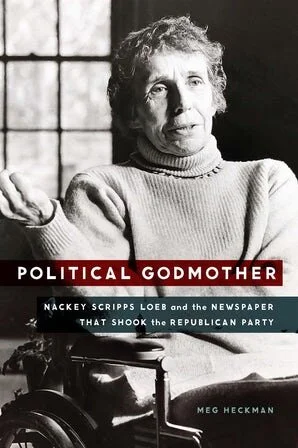
Political Godmother: Nackey Scripps Loeb and the Newspaper That Shook the Republican Party
(Potomac Books/University of Nebraska Press, 2020)
By Meg Heckman
( Potomac Books/University of Nebraska Press, 2020)
By Meg Heckman
Newspaper publisher and GOP kingmaker Nackey Scripps Loeb headed the Union Leader Corporation, one of the most unusual—and influential—local newspaper companies in the United States. Her unapologetic conservatism and powerful perch in the home of the first-in-the-nation presidential primary elicited fear and respect while her leadership of New Hampshire’s Union Leader gave her an outsized role in American politics.
In Political Godmother Meg Heckman looks at Loeb’s rough-and-tumble political life against the backdrop of the right-wing media landscape of the late twentieth century. Heckman reveals Loeb as a force of nature, more than willing to wield her tremendous clout and able to convince the likes of Pat Buchanan to challenge a sitting president. Although Loeb initially had no interest in the newspaper business, she eventually penned more than a thousand front-page editorials, drew political cartoons, and became a regular on C-SPAN.
A fascinating look at power politics in action, Political Godmother reveals how one woman ignited conservatism’s transformation of the contemporary Republican Party.

Imagining "We" in the Age of "I" Romance and Social Bonding in Contemporary Culture
(Routledge Press, 2021)
By Suzanne Leonard

(Routledge Press, 2021)
By Suzanne Leonard
In the early twenty-first century shifts in gender and sexuality, work and mobility patterns and especially technology have provoked interest in perceived threats to social bonding on a global scale. This edited collection explores the fracturing of couple culture but also its persistence.
Looking at a variety of media sites—including film, television, popular print fiction, new media and new technologies—this volume’s diverse range of contributors examine how mediated scenes of intimacy proliferate, while real-life experiences are cast in a newly uncertain light. The collection thus challenges a latent but growing tendency towards perceptions of romantic decline, in a variety of cultural contexts and with attention to the impact of COVID-19.
This is an accessible and timely collection suitable for scholars in gender studies, media, cultural studies and communication studies.

South Asian Filmscapes: Transregional Encounters
(University of Washington Press, 2020)
Edited By Elora Chowdhury and Esha Niyogi De

(University of Washington Press, 2020)
Edited By Aaron Elora Chowdhury and Esha Niyogi De
In South Asia massive anticolonial movements in the twentieth century created nation-states and reset national borders, forming the basis for emerging film cultures. Following the upheaval of the partition of India and Pakistan in 1947 and the Bangladesh Liberation War of 1971, new national cinemas promoted and reinforced prevailing hierarches of identity and belonging. At the same time, industrial and independent cinemas contributed to remarkably porous and hybrid film cultures, reflecting the intertwining of South Asian histories and their reciprocal cultural influences. This cross-fertilization within South Asian cultural production continues today.
South Asian Filmscapes excavates these complex politics and poetics of bordered identity and crossings through selected histories of cinema in South Asia. Several essays reveal ways in which fixed notions of national identity have been destabilized by the cross-border mobility of filmed arts and practitioners, while others interrogate how filmic politics intersects with discourses of nationalism, sexuality and gender, religion, and language. Together, they offer a fluid approach to the multiple histories and encounters that conjure “South Asia” as a geographic and political entity in the region and globally through a cinematic imagination.

The Television Code: Regulating the Screen to Safeguard the Industry
(University of Texas Press, 2018)
By Deborah Jaramillo

(University of Texas Press, 2018)
By Deborah Jaramillo
The broadcasting industry’s trade association, the National Association of Broadcasters (NAB), sought to sanitize television content via its self-regulatory document, the Television Code. The Code covered everything from the stories, images, and sounds of TV programs (no profanity, illicit sex and drinking, negative portrayals of family life and law enforcement officials, or irreverence for God and religion) to the allowable number of commercial minutes per hour of programming. It mandated that broadcasters make time for religious programming and discouraged them from charging for it. And it called for tasteful and accurate coverage of news, public events, and controversial issues.
Using archival documents from the Federal Communications Commission, NBC, the NAB, and a television reformer, Senator William Benton, this book explores the run-up to the adoption of the 1952 Television Code from the perspectives of the government, TV viewers, local broadcasters, national networks, and the industry’s trade association. Deborah L. Jaramillo analyzes the competing motives and agendas of each of these groups as she builds a convincing case that the NAB actually developed the Television Code to protect commercial television from reformers who wanted more educational programming, as well as from advocates of subscription television, an alternative distribution model to the commercial system. By agreeing to self-censor content that viewers, local stations, and politicians found objectionable, Jaramillo concludes, the NAB helped to ensure that commercial broadcast television would remain the dominant model for decades to come.

Antigone in the Americas: Democracy, Sexuality and Death in the Settler Colonial Present
(SUNY Press, 2021)
By Andrés Henao Castro

(SUNY Press, 2021)
By Andrés Henao Castro
Argues for a decolonial reinterpretation of Sophocles’ classical tragedy, Antigone, that can help us to rethink the anti-colonial politics of militant mourning in the Americas.
Sophocles’ classical tragedy, Antigone, is continually reinvented, particularly in the Americas. Theater practitioners and political theorists alike revisit the story to hold states accountable for their democratic exclusions, as Antigone did in disobeying the edict of her uncle, Creon, for refusing to bury her brother, Polynices. Antigone in the Americas not only analyzes the theoretical reception of Antigone, when resituated in the Americas, but further introduces decolonial rumination as a new interpretive methodology through which to approach classical texts. Traveling between modern present and ancient past, Andrés Fabián Henao Castro focuses on metics (resident aliens) and slaves, rather than citizens, making the feminist politics of burial long-associated with Antigone relevant for theorizing militant forms of mourning in the global south. Grounded in settler colonial critique, black and woman of color feminisms, and queer and trans of color critique, Antigone in the Americas offers a more radical interpretation of Antigone, one relevant to subjects situated under multiple and interlocking systems of oppression.

Hercules and the King of Portugal: Icons of Masculinity and Nation in Calderón’s Spain
(University of Nebraska Press, 2019)
By Dian Fox

(University of Nebraska Press, 2019)
By Dian Fox
Hercules and the King of Portugal investigates how representations of masculinity figure in the fashioning of Spanish national identity, scrutinizing ways that gender performances of two early modern male icons—Hercules and King Sebastian—are structured to express enduring nationhood. The classical hero Hercules features prominently in Hispanic foundational fictions and became intimately associated with the Hapsburg monarchy in the early sixteenth century. King Sebastian of Portugal (1554–78), both during his lifetime and after his violent death, has been inserted into his own land’s charter myth, even as competing interests have adapted his narratives to promote Spanish power.
The hybrid oral and written genre of poetic Spanish theater, as purveyor and shaper of myth, was well situated to stage and resolve dilemmas relating both to lineage determined by birth and performance of masculinity, in ways that would ideally uphold hierarchy. Dian Fox’s ideological analysis exposes how the two icons are subject to political manipulations in seventeenth-century Spanish theater and other media. Fox finds that officially sanctioned and sometimes popularly produced narratives are undercut by dynamic social and gendered processes: “Hercules” and “Sebastian” slip outside normative discourses and spaces to enact nonnormative behaviors and unreproductive masculinities.

An Archive of the Catastrophe: The Unused Footage of Claude Lanzmann's Shoah
(SUNY Press, 2019)
By Jennifer Cazenave

(SUNY Press, 2019)
By Jennifer Cazenave
Comprehensive analysis of 220 hours of outtakes that impels us to reexamine our assumptions about a crucial Holocaust documentary.
Claude Lanzmann’s 1985 magnum opus, Shoah, is a canonical documentary on the Holocaust—and in film history. Over the course of twelve years, Lanzmann gathered 230 hours of location filming and interviews with survivors, witnesses, and perpetrators, which he condensed into a 9½-hour film. The unused footage was scattered and inaccessible for years before it was restored and digitized by the United States Holocaust Memorial Museum. In An Archive of the Catastrophe, Jennifer Cazenave presents the first comprehensive study of this collection. She argues that the outtakes pose a major challenge to the representational and theoretical paradigms produced by the documentary, while offering new meanings of Shoah and of Holocaust testimony writ large. They lend fresh insight into issues raised by the film, including questions of resistance, rescue, refugees, and, above all, gender—Lanzmann’s twenty hours of interviews with women make up a mere ten minutes of the finished documentary. As a rare instance of outtakes preserved during the predigital era of cinema, this unused footage challenges us to establish a new critical framework for understanding how documentaries are constructed and reshapes the way we view this key Holocaust film.

Shaping the Future of African American Film: Color-Coded Economics and the Story Behind the Numbers
(Rutgers University Press, 2014)
By Monica Ndounou

(Rutgers University Press, 2014)
By Monica White Ndounou
In Hollywood, we hear, it’s all about the money. It’s a ready explanation for why so few black films get made—no crossover appeal, no promise of a big payoff. But what if the money itself is color-coded? What if the economics that governs film production is so skewed that no film by, about, or for people of color will ever look like a worthy investment unless it follows specific racial or gender patterns? This, Monica Ndounou shows us, is precisely the case. In a work as revealing about the culture of filmmaking as it is about the distorted economics of African American film, Ndounou clearly traces the insidious connections between history, content, and cash in black films.
How does history come into it? Hollywood’s reliance on past performance as a measure of potential success virtually guarantees that historically underrepresented, underfunded, and undersold African American films devalue the future prospects of black films. So the cycle continues as it has for nearly a century. Behind the scenes, the numbers are far from neutral. Analyzing the onscreen narratives and off-screen circumstances behind nearly two thousand films featuring African Americans in leading and supporting roles, including such recent productions as Bamboozled, Beloved, and Tyler Perry’s Diary of a Mad Black Woman, Ndounou exposes the cultural and racial constraints that limit not just the production but also the expression and creative freedom of black films. Her wide-ranging analysis reaches into questions of literature, language, speech and dialect, film images and narrative, acting, theater and film business practices, production history and financing, and organizational history.
By uncovering the ideology behind profit-driven industry practices that reshape narratives by, about, and for people of color, this provocative work brings to light existing limitations—and possibilities for reworking stories and business practices in theater, literature, and film.
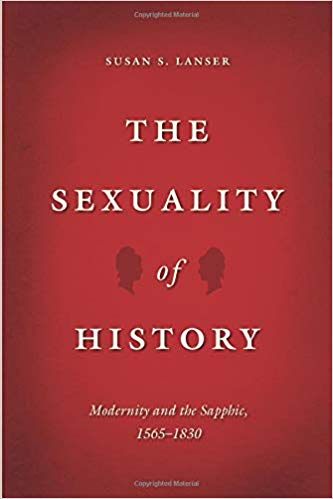
The Sexuality of History: Modernity and the Sapphic, 1565-1830
(University of Chicago Press, 2014)
By Sue Lanser
(University of Chicago Press, 2014)
By Sue Lanser
The period of reform, revolution, and reaction that characterized seventeenth- and eighteenth-century Europe also witnessed an intensified interest in lesbians. In scientific treatises and orientalist travelogues, in French court gossip and Dutch court records, in passionate verse, in the rising novel, and in cross-dressed flirtations on the English and Spanish stage, poets, playwrights, philosophers, and physicians were placing sapphic relations before the public eye.
In The Sexuality of History, Susan S. Lanser shows how intimacies between women became harbingers of the modern, bringing the sapphic into the mainstream of some of the most significant events in Western Europe. Ideas about female same-sex relations became a focal point for intellectual and cultural contests between authority and liberty, power and difference, desire and duty, mobility and change, order and governance. Lanser explores the ways in which a historically specific interest in lesbians intersected with, and stimulated, systemic concerns that would seem to have little to do with sexuality. Departing from the prevailing trend of queer reading whereby scholars ferret out hidden content in “closeted” texts, Lanser situates overtly erotic representations within wider spheres of interest. The Sexuality of History shows that just as we can understand sexuality by studying the past, so too can we understand the past by studying sexuality.

Myths & Ms.: An Inter-Generational Play about Reincarnation and Abortion
(Anaphora Literary Press, 2018)
By Rosie Rosenzweig

(Anaphora Literary Press, 2018)
By Rosie Rosenzweig
A ghost hovers watching and waiting to embody itself in the most auspicious womb. Its goal is to fulfill what it couldn’t in its last lifetime called “soul work.” Myths & Ms. is an intergenerational play about abortion and reincarnation, dramatizing the changing attitudes and conditions towards abortion in the 20th and 21st centuries. This idea of reincarnation highlights the strident voices from the pro-choice and pro-life camps.