

The Color of Creatorship: Race, Intellectual Property, and the Making of Americans
(Stanford University Press, 2020)
By Anjali Vats
(Stanford University Press, 2020)
By Anjali Vats
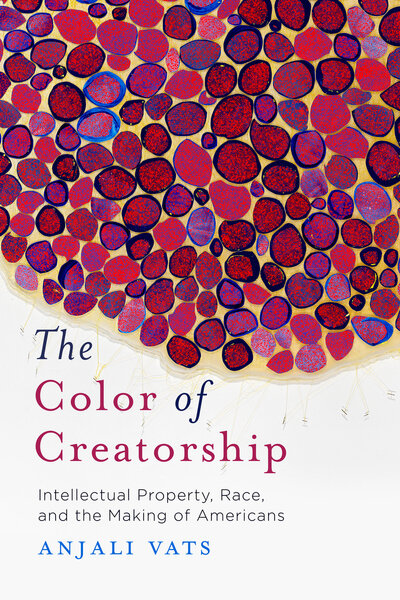
The Color of Creatorship examines how copyright, trademark, and patent discourses work together to form American ideals around race, citizenship, and property.
Working through key moments in intellectual property history since 1790, Anjali Vats reveals that even as they have seemingly evolved, American understandings of who is a creator and who is an infringer have remained remarkably racially conservative and consistent over time. Vats examines archival, legal, political, and popular culture texts to demonstrate how intellectual properties developed alongside definitions of the "good citizen," "bad citizen," and intellectual labor in racialized ways. Offering readers a theory of critical race intellectual property, Vats historicizes the figure of the citizen-creator, the white male maker who was incorporated into the national ideology as a key contributor to the nation's moral and economic development. She also traces the emergence of racial panics around infringement, arguing that the post-racial creator exists in opposition to the figure of the hyper-racial infringer, a national enemy who is the opposite of the hardworking, innovative American creator.
The Color of Creatorship contributes to a rapidly-developing conversation in critical race intellectual property. Vats argues that once anti-racist activists grapple with the underlying racial structures of intellectual property law, they can better advocate for strategies that resist the underlying drivers of racially disparate copyright, patent, and trademark policy.e harassment, fought racial discrimination, and aligned themselves with the dispossessed. Whether they were themselves straight, gay, or otherwise queer, they brought sexual dissidence and radicalism into conversation at the height of the Left's influence on American culture.
Combining rich archival research with inventive analysis of art and literature, Love’s Next Meeting explores the relationship between homosexuality and the Left in American culture between 1920 and 1960. Aaron S. Lecklider uncovers a lively cast of individuals and dynamic expressive works, revealing remarkably progressive engagement with homosexuality among radicals, workers, and the poor. Leftists connected sexual dissidence with radical gender politics, antiracism, and challenges to censorship and obscenity laws through the 1920s and 1930s. In the process, a wide array of activists, organizers, artists, and writers laid the foundation for a radical movement through which homosexual lives and experiences were given shape and new political identities were forged. Love's Next Meeting cuts to the heart of some of the biggest questions in American history: questions about socialism, about sexuality, about the supposed clash still making headlines today between leftist politics and identity politics. What emerges is a dramatic, sexually vibrant story of the shared struggles for liberation across the twentieth century.

No Refuge: Ethics and the Global Refugee Crisis
(Oxford, 2020)
By Serena Parekh

(Oxford, 2020)
By Serena Parekh
Syrians crossing the Mediterranean in ramshackle boats bound for Europe; Sudanese refugees, their belongings on their backs, fleeing overland into neighboring countries; children separated from their parents at the US/Mexico border--these are the images that the Global Refugee Crisis conjures to many. In the news we often see photos of people in transit, suffering untold deprivations in desperate bids to escape their countries and find safety. But behind these images, there is a second crisis--a crisis of arrival. Refugees in the 21st century have only three real options--urban slums, squalid refugee camps, or dangerous journeys to seek asylum--and none provide genuine refuge.
In No Refuge, political philosopher Serena Parekh calls this the second refugee crisis: the crisis of the millions of people who, having fled their homes, are stuck for decades in the dehumanizing and hopeless limbo of refugees camps and informal urban spaces, most of which are in the Global South. Ninety-nine percent of these refugees are never resettled in other countries. Their suffering only begins when they leave their war-torn homes. As Parekh urgently argues by drawing from numerous first-person accounts, conditions in many refugee camps and urban slums are so bleak that to make people live in them for prolonged periods of time is to deny them human dignity. It's no wonder that refugees increasingly risk their lives to seek asylum directly in the West.
Drawing from extensive first-hand accounts of life as a refugee with nowhere to go, Parekh argues that we need a moral response to these crises--one that assumes the humanity of refugees in addition to the challenges that states have when they accept refugees. Only once we grasp that the global refugee crisis has these two dimensions--the asylum crisis for Western states and the crisis for refugees who cannot find refuge--can we reckon with a response proportionate to the complexities we face. Countries and citizens have a moral obligation to address the structures that unjustly prevent refugees from accessing the minimum conditions of human dignity. As Parekh shows, there are ways we as citizens can respond to the global refugee crisis, and indeed we are morally obligated to do so.

Making Mirrors: Righting/Writing by and For Refugees
(Interlink, 2019)
By Becky Thompson, Co-edited with Jehan Bseiso

(Interlink, 2019)
By Becky Thompson, Co-edited with Jehan Bseiso
Making Mirrors began on two continents, envisioned by Palestinian poet and aid worker, Jehan Bseiso, and Becky Thompson, a US-based poet changed by months of greeting refugees after their perilous journey across the Aegean Sea.
This anthology uses mirrors to reflect imagistic connections that allow us to see ourselves in each other, those on rafts and those standing on the shore, those waiting/writing in detention and those writing from places of relative safety, those who lift their children to the sky and those whose bodies are at the bottom of the sea.
Making Mirrors offers a poetics of belonging- to the earth, family, and memories packed into backpacks. The poems go beyond refugee/citizen binaries and illuminate exile as a forced/creative space.
As the refugee crisis fades from the front page of newspapers, this collection is a plea against historical amnesia and inertia; the poems are an antidote that reaches beyond despair to renewed action.
Contributors include: Abbas Sheikhi, Abu Bakr Khaal, Adele Ne Jame, Ahmad Almallah, Ahmed Qaisania, Angela Farmer, Baha' Budair, Becky Thompson, Bronwen Griffiths, Eman Abedelhadi, Fadwa Soleiman, Fady Joudah, Fatima Al Hassan, Fouad Mohammed Fouad, Gbenga Adesina, Golan Haji, Hajer Almosleh, Hayan Charara, Ibtisam Barakat, Jehan Bseiso, Jose A. Alcantara, Lena Khalaf Tuffaha, Lisa Suhair Majaj, Marilyn Hacker, Marisa Frasca, Merna Ann Hecht, Mohsen Emadi, Mootacem Bellah Mhiri, Naomi Shihab Nye, Nathalie Handal, Nawwar Kamal Al Hassani, Nisreen Aj, Nora Barghati, Omar Mousa Alsayyed, Rewa Zeinati, Ruth Awad, Saad Abdullah, Sanaa Shuaybe, Sara Abou Rashed, Sara Saleh, Sharif S. Elmusa, Sholeh Wolpe, Zeina Azzam, Zeina Hashem Beck, and Zoe Holman.

An Archive of the Catastrophe: The Unused Footage of Claude Lanzmann's Shoah
(SUNY Press, 2019)
By Jennifer Cazenave

(SUNY Press, 2019)
By Jennifer Cazenave
Comprehensive analysis of 220 hours of outtakes that impels us to reexamine our assumptions about a crucial Holocaust documentary.
Claude Lanzmann’s 1985 magnum opus, Shoah, is a canonical documentary on the Holocaust—and in film history. Over the course of twelve years, Lanzmann gathered 230 hours of location filming and interviews with survivors, witnesses, and perpetrators, which he condensed into a 9½-hour film. The unused footage was scattered and inaccessible for years before it was restored and digitized by the United States Holocaust Memorial Museum. In An Archive of the Catastrophe, Jennifer Cazenave presents the first comprehensive study of this collection. She argues that the outtakes pose a major challenge to the representational and theoretical paradigms produced by the documentary, while offering new meanings of Shoah and of Holocaust testimony writ large. They lend fresh insight into issues raised by the film, including questions of resistance, rescue, refugees, and, above all, gender—Lanzmann’s twenty hours of interviews with women make up a mere ten minutes of the finished documentary. As a rare instance of outtakes preserved during the predigital era of cinema, this unused footage challenges us to establish a new critical framework for understanding how documentaries are constructed and reshapes the way we view this key Holocaust film.

Immigration Policy in the Age of Punishment: Detention, Deportation and Border Control
(Columbia University Press, 2018)
Edited by David C. Brotherton and Philip Kretsedemas

(Columbia University Press, 2018)
Edited by David C. Brotherton and Philip Kretsedemas
The events of 2016 catapulted immigration policy to the forefront of public debate, and Donald Trump’s administration has signaled a harsh turn in enforcement. Yet the deportation, detention, and border-control policies that North American and European countries have embraced are by no means new. In this book, sociologists David C. Brotherton and Philip Kretsedemas bring together an interdisciplinary group of contributors to reconsider the immigration policies of the Obama era and beyond in terms of a decades-long “age of punishment.”
Immigration Policy in the Age of Punishment takes a critical, interdisciplinary, and transnational look at current issues surrounding immigration in the U.S. and abroad. It examines key features of this age of punishment, connecting neoliberal governance, global labor markets, and the national obsession with securing borders to explain critical research and theory on immigration enforcement. Contributors document the continuities between presidential administrations and across countries from many perspectives, with chapters discussing Canada, Australia, France, the UK, the Dominican Republic, and Mexico in addition to the U.S. They offer macro-level analyses of deportations and border enforcement, analyses of national policy and jurisprudence, and ethnographic accounts of the daily life experience of the prison-to-deportation pipeline, the making of deportability, and post-deportation transitions for noncitizens. This book highlights new directions in critical immigration policy and enforcement and deportation studies with the aim of problematizing the age of punishment that currently reigns over borders and those who seek to cross them.

On the Shoulders of Grandmothers: Gender, Migration, and Post-Soviet Nation-State Building
(Routledge, 2017)
By Cinzia D. Solari

(Routledge, 2017)
By Cinzia D. Solari
On the Shoulders of Grandmothers is a global ethnography of Ukrainian transnational migration. Gendered migrant subjectivities are a key site for understanding the production of neoliberal capitalism and Ukrainian nation-state building, a fraught process that places Ukraine precariously between Europe and Russia with dramatic implications for the political economy of the region. However, processes of gender and migration that undergird transnational nation-state building require further attention. Solari compares two patterns of Ukrainian migration: the "forced" exile of middle-aged women, most grandmothers, to Italy and the "voluntary" exodus of families, led by the same cohort of middle-aged women, to the United States. In both receiving sites these migrants are caregivers to the elderly.
Using in-depth interviews and ethnographic data collected in three countries, Solari shows that Ukrainian nation-state building occurs transnationally. She examines the collective practices of migrants who are building the "new" Ukraine from the outside in and shaping both Italy and the United States as well. The Ukrainian state, in order to fulfil its First World aspirations of joining Europe and distancing itself from all things Soviet, is pursuing a gendered reorganization of family and work structures to achieve a transition from socialism to capitalism. This has created a labor force of migrant grandmothers who carry the new Ukraine on their shoulders. Solari shows that this post-Soviet economic transformation requires a change in the moral order as migrant women struggle to understand how to be "good" mothers and grandmothers and men join women in attempts to teach their children to be successful and honorable people, now that the social rules have drastically changed.
Looking at individual migrant women and men and their families in Ukraine allows us to see the production of neoliberal capitalism and new nationalism from the ground up and the outside in for a region that promises to be a flashpoint in our century.