
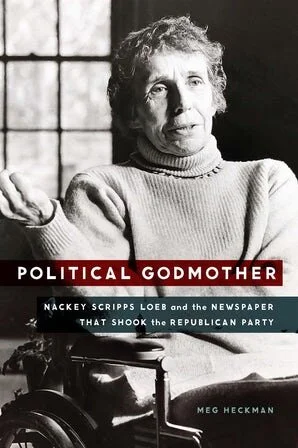
Political Godmother: Nackey Scripps Loeb and the Newspaper That Shook the Republican Party
(Potomac Books/University of Nebraska Press, 2020)
By Meg Heckman
( Potomac Books/University of Nebraska Press, 2020)
By Meg Heckman
Newspaper publisher and GOP kingmaker Nackey Scripps Loeb headed the Union Leader Corporation, one of the most unusual—and influential—local newspaper companies in the United States. Her unapologetic conservatism and powerful perch in the home of the first-in-the-nation presidential primary elicited fear and respect while her leadership of New Hampshire’s Union Leader gave her an outsized role in American politics.
In Political Godmother Meg Heckman looks at Loeb’s rough-and-tumble political life against the backdrop of the right-wing media landscape of the late twentieth century. Heckman reveals Loeb as a force of nature, more than willing to wield her tremendous clout and able to convince the likes of Pat Buchanan to challenge a sitting president. Although Loeb initially had no interest in the newspaper business, she eventually penned more than a thousand front-page editorials, drew political cartoons, and became a regular on C-SPAN.
A fascinating look at power politics in action, Political Godmother reveals how one woman ignited conservatism’s transformation of the contemporary Republican Party.

EurasianMixed Identities in the United States, China, and Hong Kong, 1842–1943
(University of California Press, 2013)
By Emma Teng

(University of California Press, 2013)
By Emma Teng
In the second half of the nineteenth century, global labor migration, trade, and overseas study brought China and the United States into close contact, leading to new cross-cultural encounters that brought mixed-race families into being. Yet the stories of these families remain largely unknown. How did interracial families negotiate their identities within these societies when mixed-race marriage was taboo and “Eurasian” often a derisive term?
In Eurasian, Emma Jinhua Teng compares Chinese-Western mixed-race families in the United States, China, and Hong Kong, examining both the range of ideas that shaped the formation of Eurasian identities in these diverse contexts and the claims set forth by individual Eurasians concerning their own identities. Teng argues that Eurasians were not universally marginalized during this era, as is often asserted. Rather, Eurasians often found themselves facing contradictions between exclusionary and inclusive ideologies of race and nationality, and between overt racism and more subtle forms of prejudice that were counterbalanced by partial acceptance and privilege.
By tracing the stories of mixed and transnational families during an earlier era of globalization, Eurasian also demonstrates to students, faculty, scholars, and researchers how changes in interracial ideology have allowed the descendants of some of these families to reclaim their dual heritage with pride.

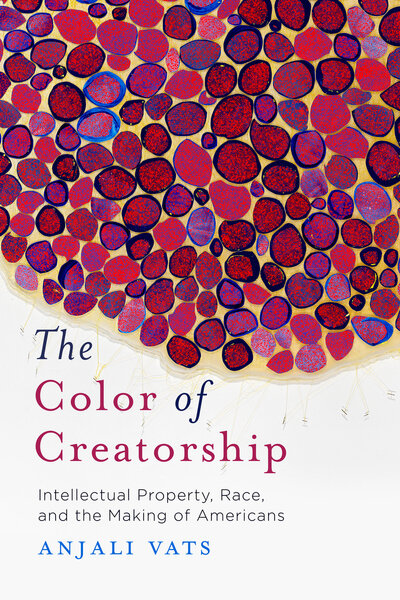
The Color of Creatorship: Race, Intellectual Property, and the Making of Americans
(Stanford University Press, 2020)
By Anjali Vats
(Stanford University Press, 2020)
By Anjali Vats
The Color of Creatorship examines how copyright, trademark, and patent discourses work together to form American ideals around race, citizenship, and property.
Working through key moments in intellectual property history since 1790, Anjali Vats reveals that even as they have seemingly evolved, American understandings of who is a creator and who is an infringer have remained remarkably racially conservative and consistent over time. Vats examines archival, legal, political, and popular culture texts to demonstrate how intellectual properties developed alongside definitions of the "good citizen," "bad citizen," and intellectual labor in racialized ways. Offering readers a theory of critical race intellectual property, Vats historicizes the figure of the citizen-creator, the white male maker who was incorporated into the national ideology as a key contributor to the nation's moral and economic development. She also traces the emergence of racial panics around infringement, arguing that the post-racial creator exists in opposition to the figure of the hyper-racial infringer, a national enemy who is the opposite of the hardworking, innovative American creator.
The Color of Creatorship contributes to a rapidly-developing conversation in critical race intellectual property. Vats argues that once anti-racist activists grapple with the underlying racial structures of intellectual property law, they can better advocate for strategies that resist the underlying drivers of racially disparate copyright, patent, and trademark policy.e harassment, fought racial discrimination, and aligned themselves with the dispossessed. Whether they were themselves straight, gay, or otherwise queer, they brought sexual dissidence and radicalism into conversation at the height of the Left's influence on American culture.
Combining rich archival research with inventive analysis of art and literature, Love’s Next Meeting explores the relationship between homosexuality and the Left in American culture between 1920 and 1960. Aaron S. Lecklider uncovers a lively cast of individuals and dynamic expressive works, revealing remarkably progressive engagement with homosexuality among radicals, workers, and the poor. Leftists connected sexual dissidence with radical gender politics, antiracism, and challenges to censorship and obscenity laws through the 1920s and 1930s. In the process, a wide array of activists, organizers, artists, and writers laid the foundation for a radical movement through which homosexual lives and experiences were given shape and new political identities were forged. Love's Next Meeting cuts to the heart of some of the biggest questions in American history: questions about socialism, about sexuality, about the supposed clash still making headlines today between leftist politics and identity politics. What emerges is a dramatic, sexually vibrant story of the shared struggles for liberation across the twentieth century.

Coming of Age in Jim Crow DC: Navigating the Politics of Everyday Life
(New York University Press, 2019)
By Paula Austin

(New York University Press, 2019)
By Paula Austin
Coming of Age in Jim Crow DC offers a complex narrative of the everyday lives of black young people in a racially, spatially, economically, and politically restricted Washington, DC, during the 1930s. In contrast to the ways in which young people have been portrayed by researchers, policy makers, law enforcement, and the media, Paula C. Austin draws on previously unstudied archival material to present black poor and working class young people as thinkers, theorists, critics, and commentators as they reckon with the boundaries imposed on them in a Jim Crow city that was also the American emblem of equality.
The narratives at the center of this book provide a different understanding of black urban life in the early twentieth century, showing that ordinary people were expert at navigating around the limitations imposed by the District of Columbia’s racially segregated politics. Coming of Age in Jim Crow DC is a fresh take on the New Negro movement, and a vital contribution to the history of race in America.

Adulthood and Other Fictions: American Literature and the Unmaking of Age
(Oxford University Press, 2019)
By Sari Edelstein

(Oxford University Press, 2019)
By Sari Edelstein
While the field of childhood studies has blossomed in recent years, few scholars have taken up the question of age more broadly as a lens for reading American literature. Adulthood and Other Fictions shows how a diverse array of nineteenth-century writers, thinkers, and artists responded to the rise of chronological age in social and political life. Over the course of the century, age was added to the census; schools were organized around age groups; birthday cards were mass-produced; geriatrics became a medical specialty. Adulthood and Other Fictions reads American literature as a rich, critical account of this modern culture of age, and it examines how our most well-known writers registered and often resisted age expectations, particularly as they applied to women and people of color.
More than simply adding age to the list of identity categories that have become de rigueur sites of scholarly attention, Adulthood and Other Fictions argues that these other measures of social location (race, gender, sexuality, class) are largely legible through the seemingly more natural and essential identity defined by age. That is, longstanding cultural ideals about maturity and development anchor ideologies of heterosexuality, race, nationalism, and capitalism, and in this sense, age rhetoric serves as one of our most pervasive disciplinary discourses. Writers including Louisa May Alcott, Frederick Douglass, and Henry James anticipated the ageism of our moment, but they also recognized how age norms both structure and limit the lives of individuals at all points on the age continuum. Ultimately, the volume argues for an intersectional understanding of age that challenges the celebration of independence and autonomy imbricated in US fantasies of adulthood and in American identity itself.

Diversifying Power: Why We Need Antiracist, Feminist Leadership on Climate and Energy
(Island Press, 2020)
By Jennie C. Stephens

(Island Press, 2020)
By Jennie C. Stephens
The climate crisis is a crisis of leadership. For too long too many leaders have prioritized corporate profits over the public good, exacerbating climate vulnerabilities while reinforcing economic and racial injustice. Transformation to a just, sustainable renewable-based society requires leaders who connect social justice to climate and energy.
During the Trump era, connections among white supremacy; environmental destruction; and fossil fuel dependence have become more conspicuous. Many of the same leadership deficiencies that shaped the inadequate response in the United States to the coronavirus pandemic have also thwarted the US response to the climate crisis. The inadequate and ineffective framing of climate change as a narrow, isolated, discrete problem to be “solved” by technical solutions is failing. The dominance of technocratic, white, male perspectives on climate and energy has inhibited investments in social change and social innovations. With new leadership and diverse voices, we can strengthen climate resilience, reduce racial and economic inequities, and promote social justice.
In Diversifying Power, energy expert Jennie Stephens argues that the key to effectively addressing the climate crisis is diversifying leadership so that antiracist, feminist priorities are central. All politics is now climate politics, so all policies, from housing to health, now have to integrate climate resilience and renewable energy.
Stephens takes a closer look at climate and energy leadership related to job creation and economic justice, health and nutrition, housing and transportation. She looks at why we need to resist by investing in bold diverse leadership to curb the “the polluter elite.” We need to reclaim and restructure climate and energy systems so policies are explicitly linked to social, economic, and racial justice.
Inspirational stories of diverse leaders who integrate antiracist, feminist values to build momentum for structural transformative change are woven throughout the book, along with Stephens’ experience as a woman working on climate and energy. The shift from a divided, unequal, extractive, and oppressive society to a just, sustainable, regenerative, and healthy future has already begun.
But structural change needs more bold and ambitious leaders at all levels, like Alexandria Ocasio-Cortez with the Green New Deal, or the Secwepemc women of the Tiny House Warriors resisting the Trans Mountain pipeline.
Diversifying Power offers hope and optimism. Stephens shows how the biggest challenges facing society are linked and anyone can get involved to leverage the power of collective action. By highlighting the creative individuals and organizations making change happen, she provides inspiration and encourages transformative action on climate and energy justice.

Maria Baldwin’s Worlds: A Story of Black New England and the Fight for Racial Justice
(University of Massachusetts Press, 2019)
By Kathleen Weiler

(University of Massachusetts Press, 2019)
By Kathleen Weiler
Maria Baldwin (1856–1922) held a special place in the racially divided society of her time, as a highly respected educator at a largely white New England school and an activist who carried on the radical spirit of the Boston area’s internationally renowned abolitionists from a generation earlier.
African American sociologist Adelaide Cromwell called Baldwin “the lone symbol of Negro progress in education in the greater Boston area” during her lifetime. Baldwin used her respectable position to fight alongside more radical activists like William Monroe Trotter for full citizenship for fellow members of the black community. And, in her professional and personal life, she negotiated and challenged dominant white ideas about black womanhood. In Maria Baldwin’s Worlds, Kathleen Weiler reveals both Baldwin’s victories and what fellow activist W. E. B. Du Bois called her “quiet courage” in everyday life, in the context of the wider black freedom struggle in New England.

The Television Code: Regulating the Screen to Safeguard the Industry
(University of Texas Press, 2018)
By Deborah Jaramillo

(University of Texas Press, 2018)
By Deborah Jaramillo
The broadcasting industry’s trade association, the National Association of Broadcasters (NAB), sought to sanitize television content via its self-regulatory document, the Television Code. The Code covered everything from the stories, images, and sounds of TV programs (no profanity, illicit sex and drinking, negative portrayals of family life and law enforcement officials, or irreverence for God and religion) to the allowable number of commercial minutes per hour of programming. It mandated that broadcasters make time for religious programming and discouraged them from charging for it. And it called for tasteful and accurate coverage of news, public events, and controversial issues.
Using archival documents from the Federal Communications Commission, NBC, the NAB, and a television reformer, Senator William Benton, this book explores the run-up to the adoption of the 1952 Television Code from the perspectives of the government, TV viewers, local broadcasters, national networks, and the industry’s trade association. Deborah L. Jaramillo analyzes the competing motives and agendas of each of these groups as she builds a convincing case that the NAB actually developed the Television Code to protect commercial television from reformers who wanted more educational programming, as well as from advocates of subscription television, an alternative distribution model to the commercial system. By agreeing to self-censor content that viewers, local stations, and politicians found objectionable, Jaramillo concludes, the NAB helped to ensure that commercial broadcast television would remain the dominant model for decades to come.

Insurance Era: Risk, Governance, and the Privatization of Security in Postwar America
(University of Chicago Press, 2021)
By Caley Horan

(University of Chicago Press, 2021)
By Caley Horan
Risk, Governance, and the Privatization of Security in Postwar America
Actuarial thinking is everywhere in contemporary America, an often unnoticed byproduct of the postwar insurance industry’s political and economic influence. Calculations of risk permeate our institutions, influencing how we understand and manage crime, education, medicine, finance, and other social issues. Caley Horan’s remarkable book charts the social and economic power of private insurers since 1945, arguing that these institutions’ actuarial practices played a crucial and unexplored role in insinuating the social, political, and economic frameworks of neoliberalism into everyday life.
Analyzing insurance marketing, consumption, investment, and regulation, Horan asserts that postwar America’s obsession with safety and security fueled the exponential expansion of the insurance industry and the growing importance of risk management in other fields. Horan shows that the rise and dissemination of neoliberal values did not happen on its own: they were the result of a project to unsocialize risk, shrinking the state’s commitment to providing support, and heaping burdens upon the people often least capable of bearing them. Insurance Era is a sharply researched and fiercely written account of how and why private insurance and its actuarial market logic came to be so deeply lodged in American visions of social welfare.

Contested Transformation: Race, Gender & Political Leadership in 21st Century America
(Cambridge University Press, 2016)
By Carol Hardy-Fanta

(Cambridge University Press, 2016)
By Carol Hardy-Fanta
Contested Transformation constitutes the first comprehensive study of racial and ethnic minorities holding elective office in the United States at the beginning of the twenty-first century. Building on data from the Gender and Multicultural Leadership (GMCL) National Database and Survey, it provides a baseline portrait of Black, Latino, Asian American, and American Indian elected officials - the women and men holding public office at national, state, and local levels of government. Analysis reveals commonalities and differences across race and gender groups on their backgrounds, paths to public office, leadership roles, and policy positions. Challenging mainstream political science theories in their applicability to elected officials of color, the book offers new understandings of the experiences of those holding public office today. Gains in political leadership and influence by people of color are transforming the American political landscape, but they have occurred within a contested political context, one where struggles for racial and gender equality continue.
Provides detailed findings on the backgrounds and political trajectories of elected officials of color by race and gender giving academics access to new information needed for their research
The book's compelling narrative of contested transformation makes it accessible to a wide audience, from students to political activists to media commentators
Explores topics currently under debate such as immigration policy, voting rights, and the death penalty, being relevant for the 2016 US Presidential election and beyond

Abortion Regret: The New Attack on Reproductive Freedom
(Praeger, 2019)
By J. Shoshanna Ehrlich and Alesha E. Doan

(Praeger, 2019)
By J. Shoshanna Ehrlich and Alesha E. Doan
An indispensable resource for students, scholars, and activists concerned about current attacks on abortion rights, this book offers an unmatched account of the emergence, consolidation, and consequences of the antiabortion movement's paternalistic abortion regret narrative.
• Examines the historical continuity of the abortion regret narrative as a political strategy used to limit women's access to abortion
• Asserts that the abortion regret narrative is intimately tied to a gendered and paternalistic construction of women's divine role as mothers
• Examines the antiabortion movement's strategy to place the "grieving" mother at the center of its oppositional narrative
• Uses interviews, textual analysis of primary sources, and content analysis of state antiabortion policies to trace the growing impact of the abortion regret narrative
• Examines and reveals the antiabortion movement's calculated political motivation for using the abortion regret narrative as its primary strategy to oppose abortion rights

Miss Anne in Harlem: The White Women of the Black Renaissance
(Harper Paperback, 2014)
By Carla Kaplan

(Harper Paperback, 2014)
By Carla Kaplan
Celebrated scholar Carla Kaplan’s cultural biography, Miss Anne in Harlem: The White Women of the Black Renaissance, focuses on white women, collectively called “Miss Anne,” who became Harlem Renaissance insiders.
The 1920s in New York City was a time of freedom, experimentation, and passion—with Harlem at the epicenter. White men could go uptown to see jazz and modern dance, but women who embraced black culture too enthusiastically could be ostracized.
Miss Anne in Harlem focuses on six of the unconventional, free-thinking women, some from Manhattan high society, many Jewish, who crossed race lines and defied social conventions to become a part of the culture and heartbeat of Harlem.
Ethnic and gender studies professor Carla Kaplan brings the interracial history of the Harlem Renaissance to life with vivid prose, extensive research, and period photographs.

Encounter on the Great Plains: Scandinavian Settlers and the Dispossession of Dakota Indians, 1890-1930
(Oxford University Press, 2013)
By Karen Hansen

(Oxford University Press, 2013)
By Karen Hansen
In 1904, the first Scandinavian settlers moved onto the Spirit Lake Dakota Indian Reservation. These land-hungry immigrants struggled against severe poverty, often becoming the sharecropping tenants of Dakota landowners. Yet the homesteaders' impoverishment did not impede their quest to acquire Indian land, and by 1929 Scandinavians owned more reservation acreage than their Dakota neighbors. Norwegian homesteader Helena Haugen Kanten put it plainly: "We stole the land from the Indians."
With this largely unknown story at its center, Encounter on the Great Plains brings together two dominant processes in American history: the unceasing migration of newcomers to North America, and the protracted dispossession of Indigenous peoples who inhabited the continent.
Drawing on fifteen years of archival research and 130 oral histories, Karen V. Hansen explores the epic issues of co-existence between settlers and Indigenous peoples and the effect of racial hierarchies, both legal and cultural, on marginalized peoples. Hansen offers a wealth of intimate detail about daily lives and community events, showing how both Dakotas and Scandinavians resisted assimilation and used their rights as new citizens to combat attacks on their cultures. In this flowing narrative, women emerge as resourceful agents of their own economic interests. Dakota women gained autonomy in the use of their allotments, while Scandinavian women staked and "proved up" their own claims.
Hansen chronicles the intertwined stories of Dakotas and immigrants-women and men, farmers, domestic servants, and day laborers. Their shared struggles reveal efforts to maintain a language, sustain a culture, and navigate their complex ties to more than one nation. The history of the American West cannot be told without these voices: their long connections, intermittent conflicts, and profound influence over one another defy easy categorization and provide a new perspective on the processes of immigration and land taking.

The Political Consequences of Motherhood
(University of Michigan Press, 2014)
By Jill Greenlee

(University of Michigan Press, 2014)
By Jill Greenlee
American political activists and candidates have used motherhood to rally women’s interest, support, and participation throughout American history. Jill S. Greenlee investigates the complex relationship between motherhood and women’s political attitudes. Combining a historical overview of the ways motherhood has been used for political purposes with recent political opinion surveys and individual-level analysis, she explains how and when motherhood shapes women’s thoughts and preferences.
Greenlee argues that two mechanisms account for the durability of motherhood politics. First, women experience attitudinal shifts when they become mothers. Second, “mother” is a broad-based identity, widely shared and ideologically unconstrained, that lends itself to appeals across the political spectrum to build support for candidates and policy issues.

Reclaiming the Feminist Vision: Consciousness-Raising and Small Group Practice
(McFarland, 2014)
By Janet L. Freedman

(McFarland, 2014)
By Janet L. Freedman
It’s called consciousness-raising (CR). Asking questions about our experiences and sharing insights and analyses with others can be the basis for informed activism for positive social change. CR provided the entry point for feminists who shaped the women’s liberation movement in the late 1960s and 1970s, and is now being revitalized across class, race and geography in face-to-face groups and on the internet.
Reclaiming the Feminist Vision traces the origins, principles and impact of consciousness-raising; reveals how the process migrated to other settings, sometimes maintaining the original political intent and sometimes diluting it. The book calls for the renewal of the practice to help feminists regain their voices and their power in shaping social movement history.

Regulating Desire: From the Virtuous Maiden to the Purity Princess
(SUNY, 2014)
By Shoshanna Ehrlich

(SUNY, 2014)
By Shoshanna Ehrlick
Starting with the mid-nineteenth-century campaign by the American Female Moral Reform Society to criminalize seduction and moving forward to the late twentieth-century conservative effort to codify a national abstinence-only education policy, Regulating Desire explores the legal regulation of young women’s sexuality in the United States. The book covers five distinct time periods in which changing social conditions generated considerable public anxiety about youthful female sexuality and examines how successive generations of reformers sought to revise the law in an effort to manage unruly desires and restore a gendered social order. J. Shoshanna Ehrlich draws upon a rich array of primary source materials, including reform periodicals, court cases, legislative hearing records, and abstinence curricula to create an interdisciplinary narrative of socially embedded legal change. Capturing the complex and dynamic nature of the relationship between the state and the sexualized youthful female body, she highlights how the law both embodies and shapes gendered understandings of normative desire as mediated by considerations of race and class.

Between the Novel and the News: The Emergence of American Women's Writing
(University of Virginia Press, 2014)
By Sari Edelstein

(University of Virginia Press, 2014)
By Sari Edelstein
While American literary history has long acknowledged the profound influence of journalism on canonical male writers, Sari Edelstein argues that American women writers were also influenced by a dynamic relationship with the mainstream press. From the early republic through the turn of the twentieth century, she offers a comprehensive reassessment of writers such as Catharine Maria Sedgwick, Harriet Jacobs, and Charlotte Perkins Gilman. Drawing on slave narratives, sentimental novels, and realist fiction, Edelstein examines how advances in journalism—including the emergence of the penny press, the rise of the story-paper, and the birth of eyewitness reportage—shaped not only a female literary tradition but also gender conventions themselves.
Excluded from formal politics and lacking the vote, women writers were deft analysts of the prevalent tropes and aesthetic gestures of journalism, which they alternately relied upon and resisted in their efforts to influence public opinion and to intervene in political debates. Ultimately, Between the Novel and the News is a project of recovery that transforms our understanding of the genesis and the development of American women’s writing.

Forever Suspect: Racialized Surveillance of Muslim Americans in the War on Terror (2018)
(Rutgers University Press, 2018)
By Saher Selod

(Rutgers University Press, 2018)
By Saher Selod
The declaration of a “War on Terror” in the aftermath of the September 11, 2001 terrorist attacks brought sweeping changes to the American criminal justice and national security systems, as well as a massive shift in the American public opinion of both individual Muslims and the Islamic religion generally. Since that time, sociologist Saher Selod argues, Muslim Americans have experienced higher levels of racism in their everyday lives. In Forever Suspect, Selod shows how a specific American religious identity has acquired racial meanings, resulting in the hyper surveillance of Muslim citizens. Drawing on forty-eight in-depth interviews with South Asian and Arab Muslim Americans, she investigates how Muslim Americans are subjected to racialized surveillance in both an institutional context by the state and a social context by their neighbors and co-workers. Forever Suspect underscores how this newly racialized religious identity changes the social location of Arabs and South Asians on the racial hierarchy further away from whiteness and compromises their status as American citizens.

Gay Priori: A Queer Critical Legal Studies Approach to Law Reform
(Duke University Press, 2018)
By Libby Adler

(Duke University Press, 2018)
By Libby Adler
In Gay Priori Libby Adler offers a comprehensive critique of mainstream LGBT legal agendas in the United States and a new direction for LGBT law reform. Adler shows how LGBT equal rights discourse drives legal advocates toward a narrow array of reform objectives—namely, same-sex marriage, antidiscrimination protections, and hate crimes statutes. This approach means that many legal issues that greatly impact the lives of the LGBT community's most marginalized members—especially those who are transgender, homeless, underage, or nonwhite—often go unnoticed. Such a narrow focus on equal rights also fixes and flattens LGBT identities, perpetuates the uneven distribution of resources such as safety, housing, health, and wealth, and limits the capacity for advocates to imagine change. To combat these effects, Adler calls for prioritizing the redistribution of resources in ways that focus on addressing low-profile legal conditions such as foster care and other issues that better meet the needs of LGBT people. Such a shift in perspective, Adler contends, will serve to open up a new world of reform possibilities that the law provides for.

Outsourced Children: Orphanage Care and Adoption in Globalizing China
(Stanford University Press, 2016)
By Leslie K. Wang

(Stanford University Press, 2016)
By Leslie K. Wang
It's no secret that tens of thousands of Chinese children have been adopted by American parents and that Western aid organizations have invested in helping orphans in China—but why have Chinese authorities allowed this exchange, and what does it reveal about processes of globalization?
Countries that allow their vulnerable children to be cared for by outsiders are typically viewed as weaker global players. However, Leslie K. Wang argues that China has turned this notion on its head by outsourcing the care of its unwanted children to attract foreign resources and secure closer ties with Western nations. She demonstrates the two main ways that this "outsourced intimacy" operates as an ongoing transnational exchange: first, through the exportation of mostly healthy girls into Western homes via adoption, and second, through the subsequent importation of first-world actors, resources, and practices into orphanages to care for the mostly special needs youth left behind.
Outsourced Children reveals the different care standards offered in Chinese state-run orphanages that were aided by Western humanitarian organizations. Wang explains how such transnational partnerships place marginalized children squarely at the intersection of public and private spheres, state and civil society, and local and global agendas. While Western societies view childhood as an innocent time, unaffected by politics, this book explores how children both symbolize and influence national futures.