
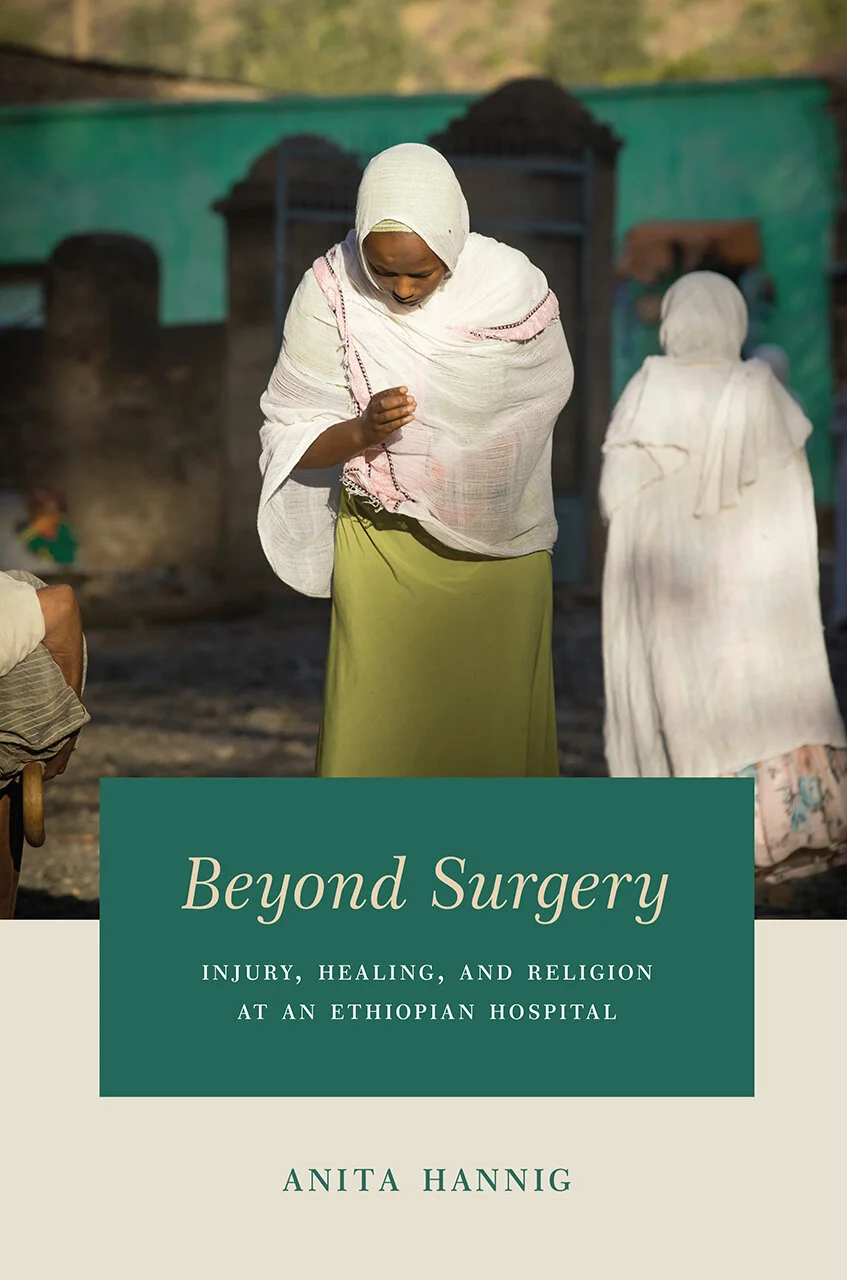
Beyond Surgery: Injury, Healing, and Religion at an Ethiopian Hospital
(The University of Chicago Press, 2017)
By Anita Hannig

( The University of Chicago Press, 2017)
By Anita Hannig
Over the past few decades, maternal childbirth injuries have become a potent symbol of Western biomedical intervention in Africa, affecting over one million women across the global south. Western-funded hospitals have sprung up, offering surgical sutures that ostensibly allow women who suffer from obstetric fistula to return to their communities in full health. Journalists, NGO staff, celebrities, and some physicians have crafted a stock narrative around this injury, depicting afflicted women as victims of a backward culture who have their fortunes dramatically reversed by Western aid. With Beyond Surgery, medical anthropologist Anita Hannig unsettles this picture for the first time and reveals the complicated truth behind the idea of biomedical intervention as quick-fix salvation.
Through her in-depth ethnography of two repair and rehabilitation centers operating in Ethiopia, Hannig takes the reader deep into a world inside hospital walls, where women recount stories of loss and belonging, shame and delight. As she chronicles the lived experiences of fistula patients in clinical treatment, Hannig explores the danger of labeling “culture” the culprit, showing how this common argument ignores the larger problem of insufficient medical access in rural Africa. Beyond Surgery portrays the complex social outcomes of surgery in an effort to deepen our understanding of medical missions in Africa, expose cultural biases, and clear the path toward more effective ways of delivering care to those who need it most.
Dying to Count: Post-Abortion Care and Global Reproductive Health Politics in Senegal
(Rutgers University Press, 2021)
By Siri Suh

( Rutgers University Press, 2021)
By Siri Suh
During the early 1990s, global health experts developed a new model of emergency obstetric care: post-abortion care or PAC. In developing countries with restrictive abortion laws and where NGOs relied on US family planning aid, PAC offered an apolitical approach to addressing the consequences of unsafe abortion. In Dying to Count, Siri Suh traces how national and global population politics collide in Senegal as health workers, health officials, and NGO workers strive to demonstrate PAC’s effectiveness in the absence of rigorous statistical evidence that the intervention reduces maternal mortality. Suh argues that pragmatically assembled PAC data convey commitments to maternal mortality reduction goals while obscuring the frequency of unsafe abortion and the inadequate care women with complications are likely to receive if they manage to reach a hospital. At a moment when African women face the highest risk worldwide of death from complications related to pregnancy, birth, or abortion, Suh’s ethnography of PAC in Senegal makes a critical contribution to studies of global health, population and development, African studies, and reproductive justice.

The Palgrave Handbook of Critical Menstruation Studies
(Palgrave Macmillan, 2021)
Edited By Bobel, C., Winkler, I., Fahs, B., Hasson, K.A., Kissling, E.A., and Roberts, T.-A.

(Palgrave Macmillan, 2020)
Edited By Bobel, C., Winkler, I., Fahs, B., Hasson, K.A., Kissling, E.A., and Roberts, T.-A.
This open access handbook, the first of its kind, provides a comprehensive and carefully curated multidisciplinary and genre-spanning view of the state of the field of Critical Menstruation Studies, opening up new directions in research and advocacy. It is animated by the central question: ‘“what new lines of inquiry are possible when we center our attention on menstrual health and politics across the life course?” The chapters—diverse in content, form and perspective—establish Critical Menstruation Studies as a potent lens that reveals, complicates and unpacks inequalities across biological, social, cultural and historical dimensions. This handbook is an unmatched resource for researchers, policy makers, practitioners, and activists new to and already familiar with the field as it rapidly develops and expands.

Abortion Regret: The New Attack on Reproductive Freedom
(Praeger, 2019)
By J. Shoshanna Ehrlich and Alesha E. Doan

(Praeger, 2019)
By J. Shoshanna Ehrlich and Alesha E. Doan
An indispensable resource for students, scholars, and activists concerned about current attacks on abortion rights, this book offers an unmatched account of the emergence, consolidation, and consequences of the antiabortion movement's paternalistic abortion regret narrative.
• Examines the historical continuity of the abortion regret narrative as a political strategy used to limit women's access to abortion
• Asserts that the abortion regret narrative is intimately tied to a gendered and paternalistic construction of women's divine role as mothers
• Examines the antiabortion movement's strategy to place the "grieving" mother at the center of its oppositional narrative
• Uses interviews, textual analysis of primary sources, and content analysis of state antiabortion policies to trace the growing impact of the abortion regret narrative
• Examines and reveals the antiabortion movement's calculated political motivation for using the abortion regret narrative as its primary strategy to oppose abortion rights

Raising Generation Rx: Mothering Kids with Invisible Disabilities in an Age of Inequality
(NYU Press, 2015)
By Linda M. Blum

(NYU Press, 2015)
By Linda M. Blum
Recent years have seen an explosion in the number of children diagnosed with “invisible disabilities” such as ADHD, mood and conduct disorders, and high-functioning autism spectrum disorders. Whether they are viewed as biological problems in brain wiring or as results of the increasing medicalization of childhood, the burden of dealing with the day-to-day trials and complex medical and educational decisions falls almost entirely on mothers. Yet few ask how these mothers make sense of their children’s troubles, and to what extent they feel responsibility or blame. Raising Generation Rx offers a groundbreaking study that situates mothers’ experiences within an age of neuroscientific breakthrough, a high-stakes knowledge-based economy, cutbacks in public services and decent jobs, and increased global competition and racialized class and gender inequality.
Through in-depth interviews, observations of parents’ meetings, and analyses of popular advice, Linda Blum examines the experiences of diverse mothers coping with the challenges of their children’s “invisible disabilities” in the face of daunting social, economic, and political realities. She reveals how mothers in widely varied households learn to advocate for their children in the dense bureaucracies of the educational and medical systems; wrestle with anguishing decisions about the use of psychoactive medications; and live with the inescapable blame and stigma in their communities.