

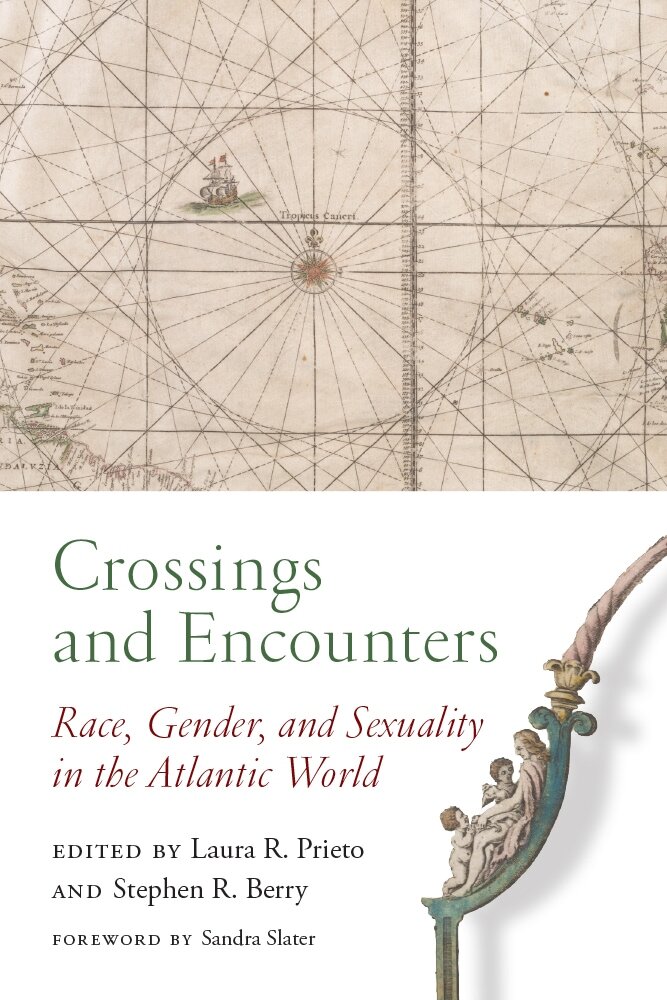
Crossings and Encounters: Race, Gender, and Sexuality in the Atlantic World
(University of South Carolina Press, 2020)
By Laura Prieto
(University of South Carolina Press, 2020)
By Laura Prieto
For centuries the Atlantic world has been a site of encounter and exchange, a rich point of transit where one could remake one's identity or find it transformed. Through this interdisciplinary collection of essays, Laura R. Prieto and Stephen R. Berry offer vivid new accounts of how individuals remapped race, gender, and sexuality through their lived experience and in the cultural imagination. Crossings and Encounters is the first single volume to address these three intersecting categories across the Atlantic world and beyond the colonial period.
The Atlantic world offered novel possibilities to and exposed vulnerabilities of many kinds of people, from travelers to urban dwellers, native Americans to refugees. European colonial officials tried to regulate relationships and impose rigid ideologies of gender, while perceived distinctions of culture, religion, and ethnicity gradually calcified into modern concepts of race. Amid the instabilities of colonial settlement and slave societies, people formed cross-racial sexual relationships, marriages, families, and households. These not only afforded some women and men with opportunities to achieve stability; they also furnished ways to redefine one's status.
Crossings and Encounters spans broadly from early contact zones in the seventeenth-century Americas to the postcolonial present, and it covers the full range of the Atlantic world, including the Caribbean, North America, and Latin America. The essays examine the historical intersections between race and gender to illuminate the fluid identities and the dynamic communities of the Atlantic world.

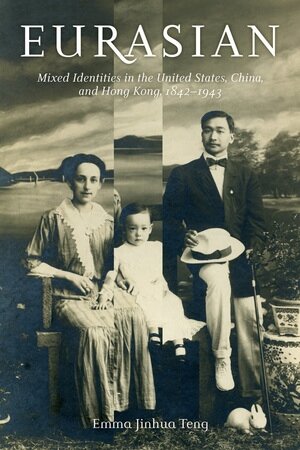
EurasianMixed Identities in the United States, China, and Hong Kong, 1842–1943
(University of California Press, 2013)
By Emma Teng
(University of California Press, 2013)
By Emma Teng
In the second half of the nineteenth century, global labor migration, trade, and overseas study brought China and the United States into close contact, leading to new cross-cultural encounters that brought mixed-race families into being. Yet the stories of these families remain largely unknown. How did interracial families negotiate their identities within these societies when mixed-race marriage was taboo and “Eurasian” often a derisive term?
In Eurasian, Emma Jinhua Teng compares Chinese-Western mixed-race families in the United States, China, and Hong Kong, examining both the range of ideas that shaped the formation of Eurasian identities in these diverse contexts and the claims set forth by individual Eurasians concerning their own identities. Teng argues that Eurasians were not universally marginalized during this era, as is often asserted. Rather, Eurasians often found themselves facing contradictions between exclusionary and inclusive ideologies of race and nationality, and between overt racism and more subtle forms of prejudice that were counterbalanced by partial acceptance and privilege.
By tracing the stories of mixed and transnational families during an earlier era of globalization, Eurasian also demonstrates to students, faculty, scholars, and researchers how changes in interracial ideology have allowed the descendants of some of these families to reclaim their dual heritage with pride.

The Life and Art of Anne Eisner: An American Artist Between Cultures
(Officina Libraria, 2020)
By Christie McDonald

(Officina Libraria, 2020)
By Christie McDonald
A biography of Anne Eisner: from her early years and art in New York to the Ituri Forest in the Congo with Patrick Putnam, and back again.
This biography traces Anne Eisner's life and art between cultures: from her early years and artistic career in New York, through living at the edge of the Ituri Forest in the ex-Belgian Congo (now Democratic Republic of the Congo), to her return to New York.
Eisner came of age in the 1930s and 1940s, with the struggle among artists and intellectuals to combat fascism and create a better world. Leaving behind a successful career as a painter, Anne followed anthropologist Patrick Putnam, with whom she fell in love, to the multi-cultural community of Epulu. As an American woman and painter, her focus on cultural and aesthetic values, her belief in freedom and equality, brought an eccentric perspective to the colonial context. Unanticipated challenges forced her to think about who she was, as she agreed to marry under unfamiliar conditions, became one of the mothers, hosted researchers and tourists, and attempted to care for Putnam in his tragic decline. That her art sustained her throughout as a discipline (sketching, drawing, painting) reveals to what extent Anne was able to express joy in creativity; the beauty of her art testifies to its transformative power.

Transnational Reversed: Women Organizing Against Gendered Violence in Bangladesh
(SUNY Press, 2011)
By Elora Chowdhury

(SUNY Press, 2011)
By Elora Chowdhury
Acid attacks against women and girls have captured the attention of the global media, with several high-profile reports ranging from the BBC to The Oprah Winfrey Show. In Bangladesh, reasons for the attacks include women’s rejection of sexual advances from men, refusal of marriage proposals, family or land disputes, and unmet dowry demands. The consequences are multiple: permanent marks on the body, disfiguration, and potential blindness. In Transnationalism Reversed, Elora Halim Chowdhury explores the complicated terrain of women’s transnational antiviolence organizing by focusing on the work done in Bangladesh around acid attacks—and the ways in which the state, international agencies, local expatriates, US media, Bangladeshi immigrants in the United States, survivor-activists, and local women’s organizations engage the pragmatics and the transnational rhetoric of empowerment, rescue, and rehabilitation. Grounded in careful ethnographic work, oral history, and theoretical and filmic analysis, Transnationalism Reversed makes a significant contribution to conversations around gendered violence, transnational feminist praxis, and the politics of organizing—particularly around NGOs—in the global South.

Forever Suspect: Racialized Surveillance of Muslim Americans in the War on Terror (2018)
(Rutgers University Press, 2018)
By Saher Selod

(Rutgers University Press, 2018)
By Saher Selod
The declaration of a “War on Terror” in the aftermath of the September 11, 2001 terrorist attacks brought sweeping changes to the American criminal justice and national security systems, as well as a massive shift in the American public opinion of both individual Muslims and the Islamic religion generally. Since that time, sociologist Saher Selod argues, Muslim Americans have experienced higher levels of racism in their everyday lives. In Forever Suspect, Selod shows how a specific American religious identity has acquired racial meanings, resulting in the hyper surveillance of Muslim citizens. Drawing on forty-eight in-depth interviews with South Asian and Arab Muslim Americans, she investigates how Muslim Americans are subjected to racialized surveillance in both an institutional context by the state and a social context by their neighbors and co-workers. Forever Suspect underscores how this newly racialized religious identity changes the social location of Arabs and South Asians on the racial hierarchy further away from whiteness and compromises their status as American citizens.

Immigration Policy in the Age of Punishment: Detention, Deportation and Border Control
(Columbia University Press, 2018)
Edited by David C. Brotherton and Philip Kretsedemas

(Columbia University Press, 2018)
Edited by David C. Brotherton and Philip Kretsedemas
The events of 2016 catapulted immigration policy to the forefront of public debate, and Donald Trump’s administration has signaled a harsh turn in enforcement. Yet the deportation, detention, and border-control policies that North American and European countries have embraced are by no means new. In this book, sociologists David C. Brotherton and Philip Kretsedemas bring together an interdisciplinary group of contributors to reconsider the immigration policies of the Obama era and beyond in terms of a decades-long “age of punishment.”
Immigration Policy in the Age of Punishment takes a critical, interdisciplinary, and transnational look at current issues surrounding immigration in the U.S. and abroad. It examines key features of this age of punishment, connecting neoliberal governance, global labor markets, and the national obsession with securing borders to explain critical research and theory on immigration enforcement. Contributors document the continuities between presidential administrations and across countries from many perspectives, with chapters discussing Canada, Australia, France, the UK, the Dominican Republic, and Mexico in addition to the U.S. They offer macro-level analyses of deportations and border enforcement, analyses of national policy and jurisprudence, and ethnographic accounts of the daily life experience of the prison-to-deportation pipeline, the making of deportability, and post-deportation transitions for noncitizens. This book highlights new directions in critical immigration policy and enforcement and deportation studies with the aim of problematizing the age of punishment that currently reigns over borders and those who seek to cross them.

Outsourced Children: Orphanage Care and Adoption in Globalizing China
(Stanford University Press, 2016)
By Leslie K. Wang

(Stanford University Press, 2016)
By Leslie K. Wang
It's no secret that tens of thousands of Chinese children have been adopted by American parents and that Western aid organizations have invested in helping orphans in China—but why have Chinese authorities allowed this exchange, and what does it reveal about processes of globalization?
Countries that allow their vulnerable children to be cared for by outsiders are typically viewed as weaker global players. However, Leslie K. Wang argues that China has turned this notion on its head by outsourcing the care of its unwanted children to attract foreign resources and secure closer ties with Western nations. She demonstrates the two main ways that this "outsourced intimacy" operates as an ongoing transnational exchange: first, through the exportation of mostly healthy girls into Western homes via adoption, and second, through the subsequent importation of first-world actors, resources, and practices into orphanages to care for the mostly special needs youth left behind.
Outsourced Children reveals the different care standards offered in Chinese state-run orphanages that were aided by Western humanitarian organizations. Wang explains how such transnational partnerships place marginalized children squarely at the intersection of public and private spheres, state and civil society, and local and global agendas. While Western societies view childhood as an innocent time, unaffected by politics, this book explores how children both symbolize and influence national futures.