
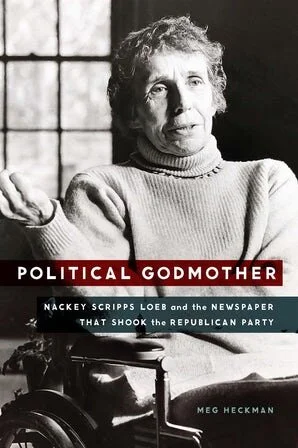
Political Godmother: Nackey Scripps Loeb and the Newspaper That Shook the Republican Party
(Potomac Books/University of Nebraska Press, 2020)
By Meg Heckman
( Potomac Books/University of Nebraska Press, 2020)
By Meg Heckman
Newspaper publisher and GOP kingmaker Nackey Scripps Loeb headed the Union Leader Corporation, one of the most unusual—and influential—local newspaper companies in the United States. Her unapologetic conservatism and powerful perch in the home of the first-in-the-nation presidential primary elicited fear and respect while her leadership of New Hampshire’s Union Leader gave her an outsized role in American politics.
In Political Godmother Meg Heckman looks at Loeb’s rough-and-tumble political life against the backdrop of the right-wing media landscape of the late twentieth century. Heckman reveals Loeb as a force of nature, more than willing to wield her tremendous clout and able to convince the likes of Pat Buchanan to challenge a sitting president. Although Loeb initially had no interest in the newspaper business, she eventually penned more than a thousand front-page editorials, drew political cartoons, and became a regular on C-SPAN.
A fascinating look at power politics in action, Political Godmother reveals how one woman ignited conservatism’s transformation of the contemporary Republican Party.

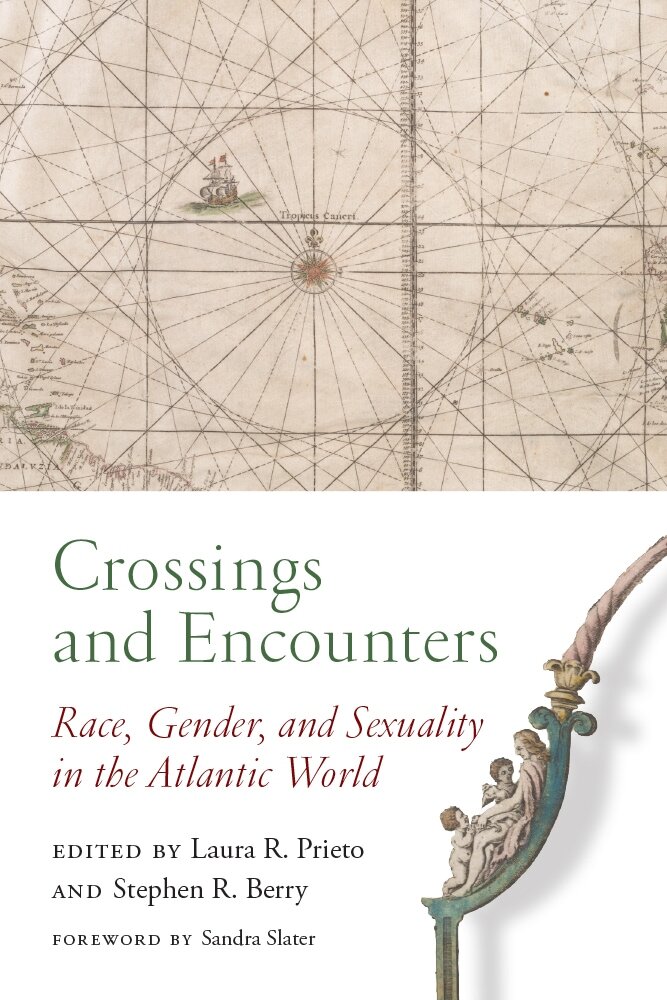
Crossings and Encounters: Race, Gender, and Sexuality in the Atlantic World
(University of South Carolina Press, 2020)
By Laura Prieto
(University of South Carolina Press, 2020)
By Laura Prieto
For centuries the Atlantic world has been a site of encounter and exchange, a rich point of transit where one could remake one's identity or find it transformed. Through this interdisciplinary collection of essays, Laura R. Prieto and Stephen R. Berry offer vivid new accounts of how individuals remapped race, gender, and sexuality through their lived experience and in the cultural imagination. Crossings and Encounters is the first single volume to address these three intersecting categories across the Atlantic world and beyond the colonial period.
The Atlantic world offered novel possibilities to and exposed vulnerabilities of many kinds of people, from travelers to urban dwellers, native Americans to refugees. European colonial officials tried to regulate relationships and impose rigid ideologies of gender, while perceived distinctions of culture, religion, and ethnicity gradually calcified into modern concepts of race. Amid the instabilities of colonial settlement and slave societies, people formed cross-racial sexual relationships, marriages, families, and households. These not only afforded some women and men with opportunities to achieve stability; they also furnished ways to redefine one's status.
Crossings and Encounters spans broadly from early contact zones in the seventeenth-century Americas to the postcolonial present, and it covers the full range of the Atlantic world, including the Caribbean, North America, and Latin America. The essays examine the historical intersections between race and gender to illuminate the fluid identities and the dynamic communities of the Atlantic world.

The Unforgettable Queens of Islam: Succession, Authority, Gender
(Cambridge Univesity Press, 2020)
By Shahla Haeri

(Cambridge Univesity Press, 2020)
By Shahla Haeri
In this landmark study, Shahla Haeri offers the extraordinary biographies of several Muslim women rulers and leaders who reached the apex of political systems of their times. Their stories illuminate the complex and challenging imperatives of dynastic succession, electoral competition and the stunning success they achieved in medieval Yemen and India, and modern Pakistan and Indonesia. The written history of Islam and the Muslim world is overwhelmingly masculine, having largely ignored women and their contributions until well into the 20th century. Religious and legal justifications have been systematically invoked to justify Muslim women's banishment from politics and public domains. Yet this patriarchal domination has not gone on without serious challenges by women - sporadic and exceptional though their participation in the battle of succession has been. The Unforgettable Queens of Islam highlights lives and legacies of a number of charismatic women engaged in fierce battles of succession, and their stories offer striking insights into the workings of political power in the Muslim world.
Takes a cross-cultural and ethno-historical perspective to explore the lives and legacies of several Muslim women rulers from medieval to modern times
Challenges both the western stereotypes and Islamist religious and political arguments against Muslim women political leadership
Makes the striking history of the lives of charismatic Muslim women rulers accessible to a broad readership

Anna Seghers: The Challenge of History
(Brill 2020)
By Christiane Zehl Romero

(Brill, 2020)
Edited by Helen Fehervary, Christiane Zehl Romero, and Amy Kepple Strawser
Anna Seghers: The Challenge of History features essays by leading scholars devoted to this most important German writer whose novels and stories have been read by millions worldwide. The volume is intended for teachers and students of literature and for general readers. The contributions address facets of Seghers’s large body of work which is characterized by reflections on political events shaping world history and written in a highly imaginative array of narrative styles. The first section focuses on the author’s famous novel The Seventh Cross. Articles in the next two sections analyze her reactions to crises that marked the twentieth century and her connections to other relevant thinkers of her time. The last section features new translations of Seghers’s works.

Maria Baldwin’s Worlds: A Story of Black New England and the Fight for Racial Justice
(University of Massachusetts Press, 2019)
By Kathleen Weiler

(University of Massachusetts Press, 2019)
By Kathleen Weiler
Maria Baldwin (1856–1922) held a special place in the racially divided society of her time, as a highly respected educator at a largely white New England school and an activist who carried on the radical spirit of the Boston area’s internationally renowned abolitionists from a generation earlier.
African American sociologist Adelaide Cromwell called Baldwin “the lone symbol of Negro progress in education in the greater Boston area” during her lifetime. Baldwin used her respectable position to fight alongside more radical activists like William Monroe Trotter for full citizenship for fellow members of the black community. And, in her professional and personal life, she negotiated and challenged dominant white ideas about black womanhood. In Maria Baldwin’s Worlds, Kathleen Weiler reveals both Baldwin’s victories and what fellow activist W. E. B. Du Bois called her “quiet courage” in everyday life, in the context of the wider black freedom struggle in New England.

The Television Code: Regulating the Screen to Safeguard the Industry
(University of Texas Press, 2018)
By Deborah Jaramillo

(University of Texas Press, 2018)
By Deborah Jaramillo
The broadcasting industry’s trade association, the National Association of Broadcasters (NAB), sought to sanitize television content via its self-regulatory document, the Television Code. The Code covered everything from the stories, images, and sounds of TV programs (no profanity, illicit sex and drinking, negative portrayals of family life and law enforcement officials, or irreverence for God and religion) to the allowable number of commercial minutes per hour of programming. It mandated that broadcasters make time for religious programming and discouraged them from charging for it. And it called for tasteful and accurate coverage of news, public events, and controversial issues.
Using archival documents from the Federal Communications Commission, NBC, the NAB, and a television reformer, Senator William Benton, this book explores the run-up to the adoption of the 1952 Television Code from the perspectives of the government, TV viewers, local broadcasters, national networks, and the industry’s trade association. Deborah L. Jaramillo analyzes the competing motives and agendas of each of these groups as she builds a convincing case that the NAB actually developed the Television Code to protect commercial television from reformers who wanted more educational programming, as well as from advocates of subscription television, an alternative distribution model to the commercial system. By agreeing to self-censor content that viewers, local stations, and politicians found objectionable, Jaramillo concludes, the NAB helped to ensure that commercial broadcast television would remain the dominant model for decades to come.

Women and Jews in the Sachsenspiegel Picture-Books
(Brepols Publisher, 2019)
By M. H. Caviness and C. G. Nelson

(Brepols Publisher, 2019)
By M. H. Caviness and C. G. Nelson
A Germanist and an art historian examine the pictures and text in the four densely illustrated manuscripts of the Sachsenspiegel that were produced in the century following its composition by Eike von Repgow. This is the first extensive study of these famous picture books in English. Using critical frameworks based on performative and feminist theory, the authors give detailed consideration to the social differences reshaped and maintained by text and image. Although Eike’s project, realized in the early 1220s, was concerned with peaceful interaction between diverse groups, including Slavic Wends as well as Germans, and with the provision of guardians for the young, the handicapped and the judicially impaired, his text is open to subversion by the images. Changing emphases in the pictures accord with changing attitudes to women and Jews in the period of production of these works, between c. 1300 and 1360. A burgeoning book culture in the fourteenth century carried Eike’s law into the town halls at a time when the German cities were increasingly Christianized; market churches were constructed in the judicial and economic hub even as Synagogues disappeared from town centres during the pogroms. The market complex became part of the material culture of the law.

An Archive of the Catastrophe: The Unused Footage of Claude Lanzmann's Shoah
(SUNY Press, 2019)
By Jennifer Cazenave

(SUNY Press, 2019)
By Jennifer Cazenave
Comprehensive analysis of 220 hours of outtakes that impels us to reexamine our assumptions about a crucial Holocaust documentary.
Claude Lanzmann’s 1985 magnum opus, Shoah, is a canonical documentary on the Holocaust—and in film history. Over the course of twelve years, Lanzmann gathered 230 hours of location filming and interviews with survivors, witnesses, and perpetrators, which he condensed into a 9½-hour film. The unused footage was scattered and inaccessible for years before it was restored and digitized by the United States Holocaust Memorial Museum. In An Archive of the Catastrophe, Jennifer Cazenave presents the first comprehensive study of this collection. She argues that the outtakes pose a major challenge to the representational and theoretical paradigms produced by the documentary, while offering new meanings of Shoah and of Holocaust testimony writ large. They lend fresh insight into issues raised by the film, including questions of resistance, rescue, refugees, and, above all, gender—Lanzmann’s twenty hours of interviews with women make up a mere ten minutes of the finished documentary. As a rare instance of outtakes preserved during the predigital era of cinema, this unused footage challenges us to establish a new critical framework for understanding how documentaries are constructed and reshapes the way we view this key Holocaust film.

Moxie and a Good Sense of Balance: Nancy Drew and the Power of the Teenage Girl
(Rowman & Littlefield, 2018)
By Lynne Byall Benson

(Rowman & Littlefield, 2018)
By Lynne Byall Benson
The literary character of Nancy Drew, created by the Stratemeyer publishing syndicate in the 1930s, has endured for more than eighty years. Successfully solving complicated mysteries, Nancy Drew offered girls the role model of a confident, independent young woman, functioning simultaneously within what was considered appropriate within the sphere of her gender and outside of that sphere in terms of her so-called moxie. Nancy Drew’s portrayal in the books has changed over the years, reflecting changing social norms, becoming a more obedient and less independent in the 1940s as women returned to traditional roles after World War II. Surprisingly, the Nancy Drew of the 1970s and 1980s did not reflect the changes brought about by the women’s movement and instead was transformed into a glamorous, globe-trotting professional private investigator in The Nancy Drew Files. The publishers soon came to their senses and brought back the plucky Nancy of old. In addition to analyzing Nancy Drew as a proto-feminist role model, Lynne Byall Benson provides a comprehensive bibliography of sources that can be used by scholars and teachers.

Witnessing Girlhood: Toward an Intersectional Tradition of Life Writing
(Fordham University Press, 2019)
By Leigh Gilmore and Elizabeth Marshall

(Fordham University Press, 2019)
By Leigh Gilmore and Elizabeth Marshall
When more than 150 women testified in 2018 to the sexual abuse inflicted on them by Dr. Larry Nassar when they were young, competitive gymnasts, they exposed and transformed the conditions that shielded their violation, including the testimonial disadvantages that cluster at the site of gender, youth, and race. In Witnessing Girlhood, Leigh Gilmore and Elizabeth Marshall argue that they also joined a long tradition of autobiographical writing led by women of color in which adults use the figure and narrative of child witness to expose harm and seek justice. Witnessing Girlhood charts a history of how women use life narrative to transform conditions of suffering, silencing, and injustice into accounts that enjoin ethical response. Drawing on a deep and diverse archive of self-representational forms―slave narratives, testimonio, memoir, comics, and picture books―Gilmore and Marshall attend to how authors return to a narrative of traumatized and silenced girlhood and the figure of the child witness in order to offer public testimony. Emerging within these accounts are key scenes and figures that link a range of texts and forms from the mid–nineteenth century to the contemporary period. Gilmore and Marshall offer a genealogy of the reverberations across timelines, self-representational acts, and jurisdictions of the child witness in life writing. Reconstructing these historical and theoretical trajectories restores an intersectional testimonial history of writing by women of color about sexual and racist violence to the center of life writing and, in so doing, furthers our capacity to engage ethically with representations of vulnerability, childhood, and collective witness.

Monstrous Intimacies: Making Post Slavery Subjects
(Duke University Press Books, 2010)
By Christina Sharpe

(Duke University Press Books, 2010)
By Christina Sharpe
Arguing that the fundamental, familiar, sexual violence of slavery and racialized subjugation have continued to shape black and white subjectivities into the present, Christina Sharpe interprets African diasporic and Black Atlantic visual and literary texts that address those “monstrous intimacies” and their repetition as constitutive of post-slavery subjectivity. Her illuminating readings juxtapose Frederick Douglass’s narrative of witnessing the brutal beating of his Aunt Hester with Essie Mae Washington-Williams’s declaration of freedom in Dear Senator: A Memoir by the Daughter of Strom Thurmond, as well as the “generational genital fantasies” depicted in Gayl Jones’s novel Corregidora with a firsthand account of such “monstrous intimacies” in the journals of an antebellum South Carolina senator, slaveholder, and vocal critic of miscegenation. Sharpe explores the South African–born writer Bessie Head’s novel Maru—about race, power, and liberation in Botswana—in light of the history of the KhoiSan woman Saartje Baartman, who was displayed in Europe as the “Hottentot Venus” in the nineteenth century. Reading Isaac Julien’s film The Attendant, Sharpe takes up issues of representation, slavery, and the sadomasochism of everyday black life. Her powerful meditation on intimacy, subjection, and subjectivity culminates in an analysis of Kara Walker’s black silhouettes, and the critiques leveled against both the silhouettes and the artist.

Acts of Gaiety: LGBT Performance and the Politics of Pleasure
(University of Michigan Press, 2012)
By Sarah Warner

(University of Michigan Press, 2012)
By Sarah Warner
Against queer theory's long-suffering romance with mourning and melancholia and a national agenda that urges homosexuals to renounce pleasure if they want to be taken seriously, Acts of Gaiety seeks to reanimate notions of "gaiety" as a political value for LGBT activism by recovering earlier mirthful modes of political performance. The book mines the archives of lesbian-feminist activism of the 1960s–70s, highlighting the outrageous gaiety—including camp, kitsch, drag, guerrilla theater, zap actions, rallies, manifestos, pageants, and parades alongside "legitimate theater”-- at the center of the social and theatrical performances of the era. Juxtaposing figures such as Valerie Solanas and Jill Johnston with more recent performers and activists including Hothead Paisan, Bitch and Animal, and the Five Lesbian Brothers, Sara Warner shows how reclaiming this largely discarded and disavowed past elucidates possibilities for being and belonging. Acts of Gaietyexplores the mutually informing histories of gayness as politics and as joie de vivre, along with the centrality of liveliness to queer performance and protest.
The Sexuality of History: Modernity and the Sapphic, 1565-1830
(University of Chicago Press, 2014)
By Sue Lanser
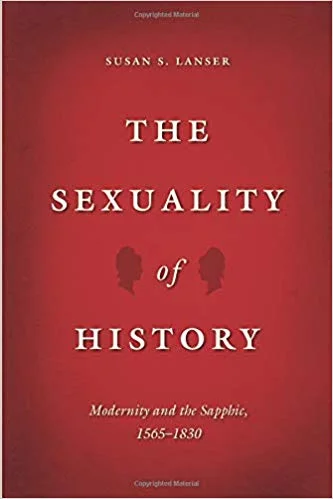
(University of Chicago Press, 2014)
By Sue Lanser
The period of reform, revolution, and reaction that characterized seventeenth- and eighteenth-century Europe also witnessed an intensified interest in lesbians. In scientific treatises and orientalist travelogues, in French court gossip and Dutch court records, in passionate verse, in the rising novel, and in cross-dressed flirtations on the English and Spanish stage, poets, playwrights, philosophers, and physicians were placing sapphic relations before the public eye.
In The Sexuality of History, Susan S. Lanser shows how intimacies between women became harbingers of the modern, bringing the sapphic into the mainstream of some of the most significant events in Western Europe. Ideas about female same-sex relations became a focal point for intellectual and cultural contests between authority and liberty, power and difference, desire and duty, mobility and change, order and governance. Lanser explores the ways in which a historically specific interest in lesbians intersected with, and stimulated, systemic concerns that would seem to have little to do with sexuality. Departing from the prevailing trend of queer reading whereby scholars ferret out hidden content in “closeted” texts, Lanser situates overtly erotic representations within wider spheres of interest. The Sexuality of History shows that just as we can understand sexuality by studying the past, so too can we understand the past by studying sexuality.

Miss Anne in Harlem: The White Women of the Black Renaissance
(Harper Paperback, 2014)
By Carla Kaplan

(Harper Paperback, 2014)
By Carla Kaplan
Celebrated scholar Carla Kaplan’s cultural biography, Miss Anne in Harlem: The White Women of the Black Renaissance, focuses on white women, collectively called “Miss Anne,” who became Harlem Renaissance insiders.
The 1920s in New York City was a time of freedom, experimentation, and passion—with Harlem at the epicenter. White men could go uptown to see jazz and modern dance, but women who embraced black culture too enthusiastically could be ostracized.
Miss Anne in Harlem focuses on six of the unconventional, free-thinking women, some from Manhattan high society, many Jewish, who crossed race lines and defied social conventions to become a part of the culture and heartbeat of Harlem.
Ethnic and gender studies professor Carla Kaplan brings the interracial history of the Harlem Renaissance to life with vivid prose, extensive research, and period photographs.

Encounter on the Great Plains: Scandinavian Settlers and the Dispossession of Dakota Indians, 1890-1930
(Oxford University Press, 2013)
By Karen Hansen

(Oxford University Press, 2013)
By Karen Hansen
In 1904, the first Scandinavian settlers moved onto the Spirit Lake Dakota Indian Reservation. These land-hungry immigrants struggled against severe poverty, often becoming the sharecropping tenants of Dakota landowners. Yet the homesteaders' impoverishment did not impede their quest to acquire Indian land, and by 1929 Scandinavians owned more reservation acreage than their Dakota neighbors. Norwegian homesteader Helena Haugen Kanten put it plainly: "We stole the land from the Indians."
With this largely unknown story at its center, Encounter on the Great Plains brings together two dominant processes in American history: the unceasing migration of newcomers to North America, and the protracted dispossession of Indigenous peoples who inhabited the continent.
Drawing on fifteen years of archival research and 130 oral histories, Karen V. Hansen explores the epic issues of co-existence between settlers and Indigenous peoples and the effect of racial hierarchies, both legal and cultural, on marginalized peoples. Hansen offers a wealth of intimate detail about daily lives and community events, showing how both Dakotas and Scandinavians resisted assimilation and used their rights as new citizens to combat attacks on their cultures. In this flowing narrative, women emerge as resourceful agents of their own economic interests. Dakota women gained autonomy in the use of their allotments, while Scandinavian women staked and "proved up" their own claims.
Hansen chronicles the intertwined stories of Dakotas and immigrants-women and men, farmers, domestic servants, and day laborers. Their shared struggles reveal efforts to maintain a language, sustain a culture, and navigate their complex ties to more than one nation. The history of the American West cannot be told without these voices: their long connections, intermittent conflicts, and profound influence over one another defy easy categorization and provide a new perspective on the processes of immigration and land taking.

Law of Desire: Temporary Marriage in Shi'i Iran
(Syracuse University Press, 2014)
By Shahla Haeri

(Syracuse University Press, 2014)
By Shahla Haeri
As an Iranian Muslim woman and a granddaughter of a well-known ayatollah, Shahla Haeri was accepted into the communities where she conducted her fieldwork on mut’a, temporary marriage. Mut’a is legally sanctioned among the Twelver Shi’ites who live predominantly in Iran.
Drawing on rich interviews that would have been denied a Western anthropologist, the author describes the concept of a temporary-marriage contract, in which a man and an unmarried woman (virgin, widow, or divorcee) decide how long they want to stay married to each other (from one hour to ninety-nine years) and how much money is to be given to the temporary wife. Since the Iranian revolution of 1979, the regime has conduction an intensive campaign to revitalize this form of marriage, and Shi’i ulama (religious scholars) support it as positive, self-affirming, and cognizant of human needs. Challenged by secularly educated urban Iranian women, and men and by the West, the ulama have been called upon to address themselves to the implications of this custom for modern Iranian society, to respond to the changes that mut’a is legally equivalent to hire or lease, that it is abusive of women, and that it is in fact legalized prostitution. Law if Desire thus makes available previously untapped and undocumented data about an institution in which sexuality, morality, religious rules, secular laws, and cultural practices converge. This important work will be of interest to cultural anthropologist, religious scholars, scholars of the Middle East, and lawyers as well as to those interested in the role of women in Islamic society.

Fragile Minds and Vulnerable Souls: The Matter of Obscenity in Nineteenth-Century Germany (
(University of Pennsylvania Press, 2014)
By Sarah L. Leonard

(University of Pennsylvania Press, 2014)
By Sarah L. Leonard
Fragile Minds and Vulnerable Souls investigates the creation of "obscene writings and images" as a category of print in nineteenth-century Germany. Sarah L. Leonard charts the process through which texts of many kinds—from popular medical works to stereoscope cards—were deemed dangerous to the intellectual and emotional lives of vulnerable consumers. She shows that these definitions often hinged as much on the content of texts as on their perceived capacity to distort the intellect and inflame the imagination.
Leonard tracks the legal and mercantile channels through which sexually explicit material traveled as Prussian expansion opened new routes for the movement of culture and ideas. Official conceptions of obscenity were forged through a heterogeneous body of laws, police ordinances, and expert commentary. Many texts acquired the stigma of immorality because they served nonelite readers and passed through suspect spaces; books and pamphlets sold by peddlers or borrowed from fly-by-night lending libraries were deemed particularly dangerous. Early on, teachers and theologians warned against the effects of these materials on the mind and soul; in the latter half of the century, as the study of inner life was increasingly medicalized, physicians became the leading experts on the detrimental side effects of the obscene. In Fragile Minds and Vulnerable Souls, Leonard shows how distinctly German legal and medical traditions of theorizing obscenity gave rise to a new understanding about the mind and soul that endured into the next century.

Inventing a Feminist Institution In Boston
(NWSA Journal, Vol. 8 no. 2, 1996)
Co-authored by Ruth Perry, Joyce Antler, Renee Fall, Laura Levine Frader, Carol Hurd Green, Barbara Haber, Alice Jardine, and Christiane Zehl Romero
Inventing a Feminist Institution In Boston
(NWSA Journal, Vol. 8 no. 2, 1996)
Co-authored by Ruth Perry, Joyce Antler, Renee Fall, Laura Levine Frader, Carol Hurd Green, Barbara Haber, Alice Jardine, and Christiane Zehl Romero

Novel Relations: The Transformation of Kinship in English Literature and Culture, 1748–1818
(Cambridge University Press, 2004)
By Ruth Perry
(Cambridge University Press, 2004)
By Ruth Perry
Ruth Perry describes the transformation of the English family as a function of several major social changes taking place in the eighteenth century including the development of a market economy and waged labor, enclosure and the redistribution of land, urbanization, the 'rise' of the middle class, and the development of print culture. In particular, Perry traces the shift from a kinship orientation based on blood relations to a kinship axis constituted by conjugal ties as it is revealed in popular literature of the second half of the eighteenth century. Perry focuses particularly on the effect these changes had on women's position in families. She uses social history, literary analysis and anthropological kinship theory to examine texts by Samuel Richardson, Charlotte Lennox, Henry MacKenzie, Frances Burney, Jane Austen, and many others. This important study by a leading eighteenth-century scholar will be of interest to social and literary historians.