
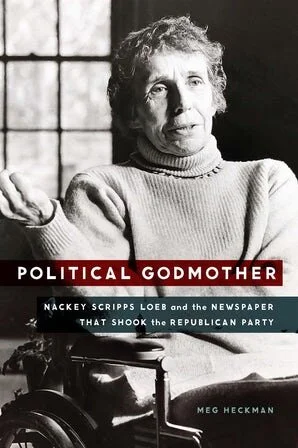
Political Godmother: Nackey Scripps Loeb and the Newspaper That Shook the Republican Party
(Potomac Books/University of Nebraska Press, 2020)
By Meg Heckman

( Potomac Books/University of Nebraska Press, 2020)
By Meg Heckman
Newspaper publisher and GOP kingmaker Nackey Scripps Loeb headed the Union Leader Corporation, one of the most unusual—and influential—local newspaper companies in the United States. Her unapologetic conservatism and powerful perch in the home of the first-in-the-nation presidential primary elicited fear and respect while her leadership of New Hampshire’s Union Leader gave her an outsized role in American politics.
In Political Godmother Meg Heckman looks at Loeb’s rough-and-tumble political life against the backdrop of the right-wing media landscape of the late twentieth century. Heckman reveals Loeb as a force of nature, more than willing to wield her tremendous clout and able to convince the likes of Pat Buchanan to challenge a sitting president. Although Loeb initially had no interest in the newspaper business, she eventually penned more than a thousand front-page editorials, drew political cartoons, and became a regular on C-SPAN.
A fascinating look at power politics in action, Political Godmother reveals how one woman ignited conservatism’s transformation of the contemporary Republican Party.

Diversifying Power: Why We Need Antiracist, Feminist Leadership on Climate and Energy
(Island Press, 2020)
By Jennie C. Stephens

(Island Press, 2020)
By Jennie C. Stephens
The climate crisis is a crisis of leadership. For too long too many leaders have prioritized corporate profits over the public good, exacerbating climate vulnerabilities while reinforcing economic and racial injustice. Transformation to a just, sustainable renewable-based society requires leaders who connect social justice to climate and energy.
During the Trump era, connections among white supremacy; environmental destruction; and fossil fuel dependence have become more conspicuous. Many of the same leadership deficiencies that shaped the inadequate response in the United States to the coronavirus pandemic have also thwarted the US response to the climate crisis. The inadequate and ineffective framing of climate change as a narrow, isolated, discrete problem to be “solved” by technical solutions is failing. The dominance of technocratic, white, male perspectives on climate and energy has inhibited investments in social change and social innovations. With new leadership and diverse voices, we can strengthen climate resilience, reduce racial and economic inequities, and promote social justice.
In Diversifying Power, energy expert Jennie Stephens argues that the key to effectively addressing the climate crisis is diversifying leadership so that antiracist, feminist priorities are central. All politics is now climate politics, so all policies, from housing to health, now have to integrate climate resilience and renewable energy.
Stephens takes a closer look at climate and energy leadership related to job creation and economic justice, health and nutrition, housing and transportation. She looks at why we need to resist by investing in bold diverse leadership to curb the “the polluter elite.” We need to reclaim and restructure climate and energy systems so policies are explicitly linked to social, economic, and racial justice.
Inspirational stories of diverse leaders who integrate antiracist, feminist values to build momentum for structural transformative change are woven throughout the book, along with Stephens’ experience as a woman working on climate and energy. The shift from a divided, unequal, extractive, and oppressive society to a just, sustainable, regenerative, and healthy future has already begun.
But structural change needs more bold and ambitious leaders at all levels, like Alexandria Ocasio-Cortez with the Green New Deal, or the Secwepemc women of the Tiny House Warriors resisting the Trans Mountain pipeline.
Diversifying Power offers hope and optimism. Stephens shows how the biggest challenges facing society are linked and anyone can get involved to leverage the power of collective action. By highlighting the creative individuals and organizations making change happen, she provides inspiration and encourages transformative action on climate and energy justice.

Interdisciplinary Approaches to Human Rights: History, Politics, Practice
(Routledge, 2018)
Edited By Rajini Srikanth and Elora Halim Chowdhury

(Routledge, 2018)
Edited By Rajini Srikanth and Elora Halim Chowdhury
Interdisciplinary Approaches to Human Rights: History, Politics, Practice is an edited collection that brings together analyses of human rights work from multiple disciplines. Within the academic sphere, this book will garner interest from scholars who are invested in human rights as a field of study, as well as those who research, and are engaged in, the praxis of human rights.
Referring to the historical and cross-cultural study of human rights, the volume engages with disciplinary debates in political philosophy, gender and women’s studies, Global South/Third World studies, international relations, psychology, and anthropology. At the same time, the authors employ diverse methodologies including oral history, theoretical and discourse analysis, ethnography, and literary and cinema studies. Within the field of human rights studies, this book attends to the critical academic gap on interdisciplinary and praxis-based approaches to the field, as opposed to a predominantly legalistic focus, drawing from case studies from a wide range of contexts in the Global South, including Bangladesh, Colombia, Haiti, India, Mexico, Palestine, and Sudan, as well as from Australia and the United States in the Global North.
For students who will go on to become researchers, practitioners, policy makers, and activists, this collection of essays will demonstrate the multifaceted landscape of human rights and the multiple forces (philosophical, political, cultural, economic, historical) that affect it.

Contested Transformation: Race, Gender & Political Leadership in 21st Century America
(Cambridge University Press, 2016)
By Carol Hardy-Fanta

(Cambridge University Press, 2016)
By Carol Hardy-Fanta
Contested Transformation constitutes the first comprehensive study of racial and ethnic minorities holding elective office in the United States at the beginning of the twenty-first century. Building on data from the Gender and Multicultural Leadership (GMCL) National Database and Survey, it provides a baseline portrait of Black, Latino, Asian American, and American Indian elected officials - the women and men holding public office at national, state, and local levels of government. Analysis reveals commonalities and differences across race and gender groups on their backgrounds, paths to public office, leadership roles, and policy positions. Challenging mainstream political science theories in their applicability to elected officials of color, the book offers new understandings of the experiences of those holding public office today. Gains in political leadership and influence by people of color are transforming the American political landscape, but they have occurred within a contested political context, one where struggles for racial and gender equality continue.
Provides detailed findings on the backgrounds and political trajectories of elected officials of color by race and gender giving academics access to new information needed for their research
The book's compelling narrative of contested transformation makes it accessible to a wide audience, from students to political activists to media commentators
Explores topics currently under debate such as immigration policy, voting rights, and the death penalty, being relevant for the 2016 US Presidential election and beyond

Women in Global Science: Advancing Academic Careers through International Collaboration
(Stanford University Press, 2017)
By Kathrin Zippel

(Stanford University Press, 2017)
By Kathrin Zippel
Scientific and engineering research is increasingly global, and international collaboration can be essential to academic success. Yet even as administrators and policymakers extol the benefits of global science, few recognize the diversity of international research collaborations and their participants, or take gendered inequalities into account. Women in Global Science is the first book to consider systematically the challenges and opportunities that the globalization of scientific work brings to U.S. academics, especially for women faculty.
Kathrin Zippel looks to the STEM fields as a case study, where gendered cultures and structures in academia have contributed to an underrepresentation of women. While some have approached underrepresentation as a national concern with a national solution, Zippel highlights how gender relations are reconfigured in global academia. For U.S. women in particular, international collaboration offers opportunities to step outside of exclusionary networks at home. International collaboration is not the panacea to gendered inequalities in academia, but, as Zippel argues, international considerations can be key to ending the steady attrition of women in STEM fields and developing a more inclusive academic world.

Gender and Risk-Taking: Economics, Evidence, and Why the Answer Matters
(Routledge, 2017)
By Julie A. Nelson

(Routledge, 2017)
By Julie A. Nelson
The belief that men and women have fundamentally distinct natures, resulting in divergent preferences and behaviours, is widespread. Recently, economists have also engaged in the search for gender differences, with a number claiming to find fundamental gender differences regarding risk-taking, altruism, and competition. In particular, the idea that "women are more risk-averse than men" has become accepted as a truism. But is it true? And what are its causes and consequences?
Gender and Risk Taking makes three contributions. First, it asks whether the belief that men and women have distinct risk preferences is backed up by high quality empirical evidence. The answer turns out to be "no." This leads to a second question: Why, then, does so much of the literature claim to find evidence of "difference"? This, it will be shown, can be attributed to biases arising from too-easy categorical thinking, widespread stereotyping, and a tendency to prefer results that are publishable and that fit one’s prior beliefs. Third, the book explores the economic implications of the conventional association of risk-taking with masculinity and risk-aversion with femininity. Not only fairness in employment, but also the health of the financial sector and national responses to climate change, this book argues, are being compromised.
This volume will be eye-opening for anyone interested in gender, decision-making, cognition, and/or risk, especially in areas relating to employment, finance, management, or public policy.