

A Duty to Resist: When Disobedience Should Be Uncivil
(Oxford University Press, 2018)
By Candice Delmas

(Oxford University Press, 2018)
By Candice Delmas
What are our responsibilities in the face of injustice? How far should we go to fight it? Many would argue that as long as a state is nearly just, citizens have a moral duty to obey the law. Proponents of civil disobedience generally hold that, given this moral duty, a person needs a solid justification to break the law. But activists from Henry David Thoreau and Mohandas Gandhi to the Movement for Black Lives have long recognized that there are times when, rather than having a duty to obey the law, we have a duty to disobey it.
Taking seriously the history of this activism, A Duty to Resist wrestles with the problem of political obligation in real world societies that harbor injustice. Candice Delmas argues that the duty of justice, the principle of fairness, the Samaritan duty, and political association impose responsibility to resist under conditions of injustice. We must expand political obligation to include a duty to resist unjust laws and social conditions even in legitimate states.

After the Wrath of God: AIDS, Sexuality, & American Religion
(Oxford University Press, 2015)
By Anthony M. Petro

(Oxford University Press, 2015)
By Anthony M. Petro
On a cold February morning in 1987, amidst freezing rain and driving winds, a group of protesters stood outside of the Unitarian Universalist Church in Amherst, Massachusetts. The target of their protest was the minister inside, who was handing out condoms to his congregation while delivering a sermon about AIDS, dramatizing the need for the church to confront the seemingly ever-expanding crisis. The minister's words and actions were met with a standing ovation from the overflowing audience, but he could not linger to enjoy their applause. Having received threats in advance of the service, he dashed out of the sanctuary immediately upon finishing his sermon. Such was the climate for religious AIDS activism in the 1980s.
In After the Wrath of God, Anthony Petro vividly narrates the religious history of AIDS in America. Delving into the culture wars over sex, morality, and the future of the American nation, he demonstrates how religious leaders and AIDS activists have shaped debates over sexual morality and public health from the 1980s to the present day. While most attention to religion and AIDS foregrounds the role of the Religious Right, Petro takes a much broader view, encompassing the range of mainline Protestant, evangelical, and Catholic groups--alongside AIDS activist organizations--that shaped public discussions of AIDS prevention and care in the U.S. Petro analyzes how the AIDS crisis prompted American Christians across denominations and political persuasions to speak publicly about sexuality--especially homosexuality--and to foster a moral discourse on sex that spoke not only to personal concerns but to anxieties about the health of the nation. He reveals how the epidemic increased efforts to advance a moral agenda regarding the health benefits of abstinence and monogamy, a legacy glimpsed as much in the traction gained by abstinence education campaigns as in the more recent cultural purchase of gay marriage.
The first book to detail the history of religion and the AIDS epidemic in the U.S., After the Wrath of God is essential reading for anyone concerned with the intersection of religion and public health.

Inventing a Feminist Institution In Boston
(NWSA Journal, Vol. 8 no. 2, 1996)
Co-authored by Ruth Perry, Joyce Antler, Renee Fall, Laura Levine Frader, Carol Hurd Green, Barbara Haber, Alice Jardine, and Christiane Zehl Romero
Inventing a Feminist Institution In Boston
(NWSA Journal, Vol. 8 no. 2, 1996)
Co-authored by Ruth Perry, Joyce Antler, Renee Fall, Laura Levine Frader, Carol Hurd Green, Barbara Haber, Alice Jardine, and Christiane Zehl Romero

Feminist Approaches To Theory And Methodology
(Oxford University Press, 1999)
Edited by Sharlene Hesse-Biber, Christina Gilmartin, Robin Lydenberg

(Oxford University Press, 1999)
Edited by Sharlene Hesse-Biber, Christina Gilmartin, Robin Lydenberg
Feminist Approaches to Theory and Methodology addresses the theoretical issues raised by doing feminist research from an interdisciplinary perspective. Bringing together the work of leading scholars and emerging new critics, the editors have selected the best, most representative and recent work in feminist scholarship.
The collection is organized around key issues in feminist theory and empirical research as impacted by post-structuralist dialogue. Several essays address the tensions between disciplinary and interdisciplinary knowledge building, exposing male biases embedded in disciplinary paradigms. Other essays deal with dramatic changes in two foundational concepts in feminist theory—identity and experience—which are presented not as innate and unproblematic, but as constituted by discourse, representation, and the effects of power. Additional essays examine the complex terrain in which differences within and between women are used as tools of oppression and of resistance both inside and outside feminist praxis. These essays uncover a subtext of racial anxiety, offering critical insights for academic and social change.
The gender dynamics of power and resistance are taken up by several critics whose research encourages the development of a feminist scholarly methodology that focuses on women's subjective experiences, the ways in which they mediate relations of power, and their capacity for implementing personal and collective activism. These essays deal with the importance in feminist scholarship of resisting the inclination to view women as passive and powerless victims. Another major focus of the volume brings together visual and discursive representations of the female body in which heterosexuality and reproduction are imposed as the norm.
The volume concludes with a set of essays which presents students with some methodological and political dilemmas feminists encounter as they expose the underlying ideological distortions in existing social policies. Distinct for its interdisciplinary scope as well as its global orientation, Feminist Approaches to Theory and Methodology is an ideal text for courses in a wide range of social science and humanities disciplines including research methods and women's studies.

Novel Relations: The Transformation of Kinship in English Literature and Culture, 1748–1818
(Cambridge University Press, 2004)
By Ruth Perry
(Cambridge University Press, 2004)
By Ruth Perry
Ruth Perry describes the transformation of the English family as a function of several major social changes taking place in the eighteenth century including the development of a market economy and waged labor, enclosure and the redistribution of land, urbanization, the 'rise' of the middle class, and the development of print culture. In particular, Perry traces the shift from a kinship orientation based on blood relations to a kinship axis constituted by conjugal ties as it is revealed in popular literature of the second half of the eighteenth century. Perry focuses particularly on the effect these changes had on women's position in families. She uses social history, literary analysis and anthropological kinship theory to examine texts by Samuel Richardson, Charlotte Lennox, Henry MacKenzie, Frances Burney, Jane Austen, and many others. This important study by a leading eighteenth-century scholar will be of interest to social and literary historians.
Selected Excerpts:
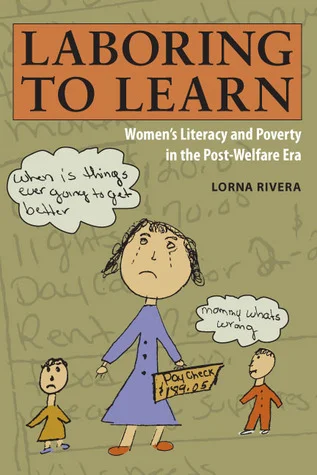
Laboring to Learn: Women's Literacy and Poverty in the Post-Welfare Era
(University of Illinois Press, 2008)
By Lorna Rivera
(University of Illinois Press, 2008)
By Lorna Rivera

The American adult education system has become an alternative for school dropouts, with some state welfare policies requiring teen mothers and women without high school diplomas to participate in adult education programs to receive aid. Very little has been published about women’s experiences in these mandatory programs and whether the programs reproduce the conditions that forced women to drop out in the first place. Lorna Rivera bridges the gap with this important study, the product of ten years’ active ethnographic research with formerly homeless women who participated in adult literacy education classes before and after welfare reform. Analyzing the web of ideological contradictions regarding “work first” welfare reform policies, Rivera argues that poverty is produced and reproduced when women with low literacy skills are pushed into welfare-to-work programs and denied education.