

The Color of Creatorship: Race, Intellectual Property, and the Making of Americans
(Stanford University Press, 2020)
By Anjali Vats
(Stanford University Press, 2020)
By Anjali Vats
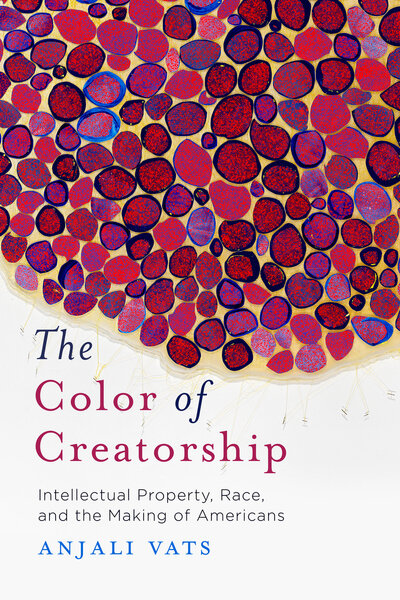
The Color of Creatorship examines how copyright, trademark, and patent discourses work together to form American ideals around race, citizenship, and property.
Working through key moments in intellectual property history since 1790, Anjali Vats reveals that even as they have seemingly evolved, American understandings of who is a creator and who is an infringer have remained remarkably racially conservative and consistent over time. Vats examines archival, legal, political, and popular culture texts to demonstrate how intellectual properties developed alongside definitions of the "good citizen," "bad citizen," and intellectual labor in racialized ways. Offering readers a theory of critical race intellectual property, Vats historicizes the figure of the citizen-creator, the white male maker who was incorporated into the national ideology as a key contributor to the nation's moral and economic development. She also traces the emergence of racial panics around infringement, arguing that the post-racial creator exists in opposition to the figure of the hyper-racial infringer, a national enemy who is the opposite of the hardworking, innovative American creator.
The Color of Creatorship contributes to a rapidly-developing conversation in critical race intellectual property. Vats argues that once anti-racist activists grapple with the underlying racial structures of intellectual property law, they can better advocate for strategies that resist the underlying drivers of racially disparate copyright, patent, and trademark policy.e harassment, fought racial discrimination, and aligned themselves with the dispossessed. Whether they were themselves straight, gay, or otherwise queer, they brought sexual dissidence and radicalism into conversation at the height of the Left's influence on American culture.
Combining rich archival research with inventive analysis of art and literature, Love’s Next Meeting explores the relationship between homosexuality and the Left in American culture between 1920 and 1960. Aaron S. Lecklider uncovers a lively cast of individuals and dynamic expressive works, revealing remarkably progressive engagement with homosexuality among radicals, workers, and the poor. Leftists connected sexual dissidence with radical gender politics, antiracism, and challenges to censorship and obscenity laws through the 1920s and 1930s. In the process, a wide array of activists, organizers, artists, and writers laid the foundation for a radical movement through which homosexual lives and experiences were given shape and new political identities were forged. Love's Next Meeting cuts to the heart of some of the biggest questions in American history: questions about socialism, about sexuality, about the supposed clash still making headlines today between leftist politics and identity politics. What emerges is a dramatic, sexually vibrant story of the shared struggles for liberation across the twentieth century.

Coming of Age in Jim Crow DC: Navigating the Politics of Everyday Life
(New York University Press, 2019)
By Paula Austin

(New York University Press, 2019)
By Paula Austin
Coming of Age in Jim Crow DC offers a complex narrative of the everyday lives of black young people in a racially, spatially, economically, and politically restricted Washington, DC, during the 1930s. In contrast to the ways in which young people have been portrayed by researchers, policy makers, law enforcement, and the media, Paula C. Austin draws on previously unstudied archival material to present black poor and working class young people as thinkers, theorists, critics, and commentators as they reckon with the boundaries imposed on them in a Jim Crow city that was also the American emblem of equality.
The narratives at the center of this book provide a different understanding of black urban life in the early twentieth century, showing that ordinary people were expert at navigating around the limitations imposed by the District of Columbia’s racially segregated politics. Coming of Age in Jim Crow DC is a fresh take on the New Negro movement, and a vital contribution to the history of race in America.

From Domestic Women to Sensitive Young Men: Translating the Individual in Early Colonial Korea
(Harvard University Asia Center, 2017)
By Yoon Sun Yang

(Harvard University Asia Center, 2017)
By Yoon Sun Yang
The notion of the individual was initially translated into Korean near the end of the nineteenth century and took root during the early years of Japanese colonial influence. Yoon Sun Yang argues that the first literary iterations of the Korean individual were prototypically female figures appearing in the early colonial domestic novel—a genre developed by reform-minded male writers—as schoolgirls, housewives, female ghosts, femmes fatales, and female same-sex partners. Such female figures have long been viewed as lacking in modernity because, unlike numerous male characters in Korean literature after the late 1910s, they did not assert their own modernity, or that of the nation, by exploring their interiority. Yang, however, shows that no reading of Korean modernity can ignore these figures, because the early colonial domestic novel cast them as individuals in terms of their usefulness or relevance to the nation, whether model citizens or iconoclasts.
By including these earlier narratives within modern Korean literary history and positing that they too were engaged in the translation of individuality into Korean, Yang’s study not only disrupts the canonical account of a non-gendered, linear progress toward modern Korean selfhood but also expands our understanding of the role played by translation in Korea’s construction of modern gender roles.

Inceptions: Literary Beginnings and Contingencies of Form
(Fordham University Press, 2021)
By Kevin Ohi

(Fordham University Press, 2021)
By Kevin Ohi
The beginning is both internal and external to the text it initiates, and that noncoincidence points to the text’s vexed relation with its outside. Hence the nontrivial self-reflexivity of any textual beginning, which must bear witness to the self-grounding quality of the literary work— its inability either to comprise its inception or to externalize it in an authorizing exteriority. In a different but related way, the fact that they must begin renders our lives and our desires opaque to us; what Freud called “latency” marks not only sexuality but human thought with a self-division shaped by asynchronicity.
From Henry James’s New York Edition prefaces to George Eliot’s epigraphs, from Ovid’s play with meter to Charles Dickens’s thematizing of the ex nihilo emergence of character, from Wallace Stevens’s abstract consideration of poetic origins to James Baldwin’s, Carson McCullers’s, and Eudora Welty’s descriptions of queer childhood, writers repeatedly confront the problem of inception. Inception introduces a fundamental contingency into texts and psyches alike: in the beginning, all could have been otherwise.
For Kevin Ohi, the act of inception, and the potential it embodies, enables us to see making and unmaking coincide within the mechanism of creation. In this sense, Inceptions traces an ethics of reading, the possibility of perceiving, in the ostensibly finished forms of lives and texts, the potentiality inherent in their having started forth.

Misogynoir Transformed: Black Women's Digital Resistance
(New York University, 2021)
By Moya Bailey

(New York University Press, 2021)
By Moya Bailey
When Moya Bailey first coined the term misogynoir, she defined it as the ways anti-Black and misogynistic representation shape broader ideas about Black women, particularly in visual culture and digital spaces. She had no idea that the term would go viral, touching a cultural nerve and quickly entering into the lexicon. Misogynoir now has its own Wikipedia page and hashtag, and has been featured on Comedy Central’s The Daily Show and CNN’s Cuomo Prime Time. In Misogynoir Transformed, Bailey delves into her groundbreaking concept, highlighting Black women’s digital resistance to anti-Black misogyny on YouTube, Facebook, Tumblr, and other platforms.
At a time when Black women are depicted as more ugly, deficient, hypersexual, and unhealthy than their non-Black counterparts, Bailey explores how Black women have bravely used social-media platforms to confront misogynoir in a number of courageous—and, most importantly, effective—ways. Focusing on queer and trans Black women, she shows us the importance of carving out digital spaces, where communities are built around queer Black webshows and hashtags like #GirlsLikeUs.
Bailey shows how Black women actively reimagine the world by engaging in powerful forms of digital resistance at a time when anti-Black misogyny is thriving on social media. A groundbreaking work, Misogynoir Transformed highlights Black women’s remarkable efforts to disrupt mainstream narratives, subvert negative stereotypes, and reclaim their lives.

Research Handbook on Human Rights and Poverty
(Elgar, 2021)
By Martha Davis

(Elgar, 2021)
By Martha Davis
This important Research Handbook explores the nexus between human rights, poverty and inequality as a critical lens for understanding and addressing key challenges of the coming decades, including the objectives set out in the Sustainable Development Goals. The Research Handbook starts from the premise that poverty is not solely an issue of minimum income and explores the profound ways that deprivation and distributive inequality of power and capability relate to economic, social, cultural, civil and political rights.
Leading experts in the human rights field representing a range of disciplines outline a future research agenda to address poverty and inequality head on. Beginning with an interrogation of the definition of poverty, subsequent chapters analyse the dynamics of poverty and inequality in relation to matters such as race, gender, age, disability, sexual orientation, geography and migration status. The rights to housing, land, health, work, education, protest and access to justice are also explored, with a recognition of the challenges posed by corruption, climate change and new technologies.
The Research Handbook on Human Rights and Poverty is an essential reference guide for those who teach in these areas and for scholars and students developing future research agendas of their own. This will also be a much-needed resource for people working practically to address poverty in both the Global North and Global South.

#HashtagActivism: Networks of Race and Gender Justice
(MIT Press, 2020)
By Moya Bailey

(MIT Press, 2020)
By Moya Bailey
How marginalized groups use Twitter to advance counter-narratives, preempt political spin, and build diverse networks of dissent.
The power of hashtag activism became clear in 2011, when #IranElection served as an organizing tool for Iranians protesting a disputed election and offered a global audience a front-row seat to a nascent revolution. Since then, activists have used a variety of hashtags, including #JusticeForTrayvon, #BlackLivesMatter, #YesAllWomen, and #MeToo to advocate, mobilize, and communicate. In this book, Sarah Jackson, Moya Bailey, and Brooke Foucault Welles explore how and why Twitter has become an important platform for historically disenfranchised populations, including Black Americans, women, and transgender people. They show how marginalized groups, long excluded from elite media spaces, have used Twitter hashtags to advance counternarratives, preempt political spin, and build diverse networks of dissent.
The authors describe how such hashtags as #MeToo, #SurvivorPrivilege, and #WhyIStayed have challenged the conventional understanding of gendered violence; examine the voices and narratives of Black feminism enabled by #FastTailedGirls, #YouOKSis, and #SayHerName; and explore the creation and use of #GirlsLikeUs, a network of transgender women. They investigate the digital signatures of the “new civil rights movement”—the online activism, storytelling, and strategy-building that set the stage for #BlackLivesMatter—and recount the spread of racial justice hashtags after the killing of Michael Brown in Ferguson, Missouri, and other high-profile incidents of killings by police. Finally, they consider hashtag created by allies, including #AllMenCan and #CrimingWhileWhite.

Reading Contemporary African American and Black British Women Writers: Narrative, Race, Ethics.
(Routledge, 2020)
By Sheldon George

(Routledge, 2020)
By Sheldon George
Contemporary African American and Black British Women Writers: Narrative, Race, Ethics brings together British and American scholars to explore how, in texts by contemporary black women writers in the U. S. and Britain, formal narrative techniques express new understandings of race or stimulate ethical thinking about race in a reader. Taken together, the essays also demonstrate that black women writers from both sides of the Atlantic borrow formal structures and literary techniques from one another to describe the workings of structural racism in the daily lives of black subjects and to provoke readers to think anew about race. Narratology has only recently begun to use race as a category of narrative theory. This collection seeks both to show the ethical effects of narrative form on individual readers and to foster reconceptualizations of narrative theory that account for the workings of race within literature and culture.

Adulthood and Other Fictions: American Literature and the Unmaking of Age
(Oxford University Press, 2019)
By Sari Edelstein

(Oxford University Press, 2019)
By Sari Edelstein
While the field of childhood studies has blossomed in recent years, few scholars have taken up the question of age more broadly as a lens for reading American literature. Adulthood and Other Fictions shows how a diverse array of nineteenth-century writers, thinkers, and artists responded to the rise of chronological age in social and political life. Over the course of the century, age was added to the census; schools were organized around age groups; birthday cards were mass-produced; geriatrics became a medical specialty. Adulthood and Other Fictions reads American literature as a rich, critical account of this modern culture of age, and it examines how our most well-known writers registered and often resisted age expectations, particularly as they applied to women and people of color.
More than simply adding age to the list of identity categories that have become de rigueur sites of scholarly attention, Adulthood and Other Fictions argues that these other measures of social location (race, gender, sexuality, class) are largely legible through the seemingly more natural and essential identity defined by age. That is, longstanding cultural ideals about maturity and development anchor ideologies of heterosexuality, race, nationalism, and capitalism, and in this sense, age rhetoric serves as one of our most pervasive disciplinary discourses. Writers including Louisa May Alcott, Frederick Douglass, and Henry James anticipated the ageism of our moment, but they also recognized how age norms both structure and limit the lives of individuals at all points on the age continuum. Ultimately, the volume argues for an intersectional understanding of age that challenges the celebration of independence and autonomy imbricated in US fantasies of adulthood and in American identity itself.

Lacan and Race: Racism, Identity and Psychoanalytic Theory
(Routledge, 2021)
By Sheldon George

(Routledge, 2021)
By Sheldon George
This edited volume draws upon Lacanian psychoanalytic theory to examine the conscious and unconscious forces underlying race as a social formation, conceptualizing race, racial identity, and racism in ways that go beyond traditional modes of psychoanalytic thought.
Featuring contributions by Lacanian scholars from diverse geographical and disciplinary contexts, chapters span a wide breadth of topics, including white nationalism and contemporary debates over confederate monuments; emergent theories of race rooted in Afropessimism and postcolonialism; analyses of racism in apartheid and American slavery; clinical reflections on Latinx and other racialized patients; and applications of Lacan’s concepts of the lamella, drive and sexuation to processes of racialization. The collection both reorients readers’ understandings of race through its deployment of Lacanian theory and redefines the Lacanian subject through its theorizing of subjectivity in relation to race, racism and racial identification.
Lacan and Race will be a definitive text for psychoanalytic theorists and contemporary scholars of race, appealing to readers across the fields of psychology, cultural studies, humanities, politics, and sociology.

Design Justice: Community-Led Practices to Build the Worlds We Need
(MIT Press, 2020)
By Sasha Costanza-Chock

(MIT Press, 2020)
By Sasha Costanza-Chock
An exploration of how design might be led by marginalized communities, dismantle structural inequality, and advance collective liberation and ecological survival.
The open access edition of this book was made possible by generous funding from Knowledge Unlatched and the MIT Press Frank Urbanowski Memorial Fund.
What is the relationship between design, power, and social justice? “Design justice” is an approach to design that is led by marginalized communities and that aims explicitly to challenge, rather than reproduce, structural inequalities. It has emerged from a growing community of designers in various fields who work closely with social movements and community-based organizations around the world.
This book explores the theory and practice of design justice, demonstrates how universalist design principles and practices erase certain groups of people—specifically, those who are intersectionally disadvantaged or multiply burdened under the matrix of domination (white supremacist heteropatriarchy, ableism, capitalism, and settler colonialism)—and invites readers to “build a better world, a world where many worlds fit; linked worlds of collective liberation and ecological sustainability.” Along the way, the book documents a multitude of real-world community-led design practices, each grounded in a particular social movement. Design Justice goes beyond recent calls for design for good, user-centered design, and employment diversity in the technology and design professions; it connects design to larger struggles for collective liberation and ecological survival.

No Refuge: Ethics and the Global Refugee Crisis
(Oxford, 2020)
By Serena Parekh

(Oxford, 2020)
By Serena Parekh
Syrians crossing the Mediterranean in ramshackle boats bound for Europe; Sudanese refugees, their belongings on their backs, fleeing overland into neighboring countries; children separated from their parents at the US/Mexico border--these are the images that the Global Refugee Crisis conjures to many. In the news we often see photos of people in transit, suffering untold deprivations in desperate bids to escape their countries and find safety. But behind these images, there is a second crisis--a crisis of arrival. Refugees in the 21st century have only three real options--urban slums, squalid refugee camps, or dangerous journeys to seek asylum--and none provide genuine refuge.
In No Refuge, political philosopher Serena Parekh calls this the second refugee crisis: the crisis of the millions of people who, having fled their homes, are stuck for decades in the dehumanizing and hopeless limbo of refugees camps and informal urban spaces, most of which are in the Global South. Ninety-nine percent of these refugees are never resettled in other countries. Their suffering only begins when they leave their war-torn homes. As Parekh urgently argues by drawing from numerous first-person accounts, conditions in many refugee camps and urban slums are so bleak that to make people live in them for prolonged periods of time is to deny them human dignity. It's no wonder that refugees increasingly risk their lives to seek asylum directly in the West.
Drawing from extensive first-hand accounts of life as a refugee with nowhere to go, Parekh argues that we need a moral response to these crises--one that assumes the humanity of refugees in addition to the challenges that states have when they accept refugees. Only once we grasp that the global refugee crisis has these two dimensions--the asylum crisis for Western states and the crisis for refugees who cannot find refuge--can we reckon with a response proportionate to the complexities we face. Countries and citizens have a moral obligation to address the structures that unjustly prevent refugees from accessing the minimum conditions of human dignity. As Parekh shows, there are ways we as citizens can respond to the global refugee crisis, and indeed we are morally obligated to do so.

The Unforgettable Queens of Islam: Succession, Authority, Gender
(Cambridge Univesity Press, 2020)
By Shahla Haeri

(Cambridge Univesity Press, 2020)
By Shahla Haeri
In this landmark study, Shahla Haeri offers the extraordinary biographies of several Muslim women rulers and leaders who reached the apex of political systems of their times. Their stories illuminate the complex and challenging imperatives of dynastic succession, electoral competition and the stunning success they achieved in medieval Yemen and India, and modern Pakistan and Indonesia. The written history of Islam and the Muslim world is overwhelmingly masculine, having largely ignored women and their contributions until well into the 20th century. Religious and legal justifications have been systematically invoked to justify Muslim women's banishment from politics and public domains. Yet this patriarchal domination has not gone on without serious challenges by women - sporadic and exceptional though their participation in the battle of succession has been. The Unforgettable Queens of Islam highlights lives and legacies of a number of charismatic women engaged in fierce battles of succession, and their stories offer striking insights into the workings of political power in the Muslim world.
Takes a cross-cultural and ethno-historical perspective to explore the lives and legacies of several Muslim women rulers from medieval to modern times
Challenges both the western stereotypes and Islamist religious and political arguments against Muslim women political leadership
Makes the striking history of the lives of charismatic Muslim women rulers accessible to a broad readership

Anna Seghers: The Challenge of History
(Brill 2020)
By Christiane Zehl Romero

(Brill, 2020)
Edited by Helen Fehervary, Christiane Zehl Romero, and Amy Kepple Strawser
Anna Seghers: The Challenge of History features essays by leading scholars devoted to this most important German writer whose novels and stories have been read by millions worldwide. The volume is intended for teachers and students of literature and for general readers. The contributions address facets of Seghers’s large body of work which is characterized by reflections on political events shaping world history and written in a highly imaginative array of narrative styles. The first section focuses on the author’s famous novel The Seventh Cross. Articles in the next two sections analyze her reactions to crises that marked the twentieth century and her connections to other relevant thinkers of her time. The last section features new translations of Seghers’s works.

At Risk: Indian Sexual Politics and the Global AIDS Crisis
(Stanford University Press, 2021)
By Gowri Vijayakumar

(Stanford University Press, 2021)
By Gowri Vijayakumar
In the mid-1990s, experts predicted that India would face the world's biggest AIDS epidemic by 2000. Though a crisis at this scale never fully materialized, global public health institutions, donors, and the Indian state initiated a massive effort to prevent it. HIV prevention programs channeled billions of dollars toward those groups designated as at-risk—sex workers and men who have sex with men. At Risk captures this unique moment in which these criminalized and marginalized groups reinvented their "at-risk" categorization and became central players in the crisis response. The AIDS crisis created a contradictory, conditional, and temporary opening for sex-worker and LGBTIQ activists to renegotiate citizenship and to make demands on the state.
Working across India and Kenya, Gowri Vijayakumar provides a fine-grained account of the political struggles at the heart of the Indian AIDS response. These range from everyday articulations of sexual identity in activist organizations in Bangalore to new approaches to HIV prevention in Nairobi, where prevention strategies first introduced in India are adapted and circulate, as in the global AIDS field more broadly. Vijayakumar illuminates how the politics of gender, sexuality, and nationalism shape global crisis response. In so doing, she considers the precarious potential for social change in and after a crisis.

Diversifying Power: Why We Need Antiracist, Feminist Leadership on Climate and Energy
(Island Press, 2020)
By Jennie C. Stephens

(Island Press, 2020)
By Jennie C. Stephens
The climate crisis is a crisis of leadership. For too long too many leaders have prioritized corporate profits over the public good, exacerbating climate vulnerabilities while reinforcing economic and racial injustice. Transformation to a just, sustainable renewable-based society requires leaders who connect social justice to climate and energy.
During the Trump era, connections among white supremacy; environmental destruction; and fossil fuel dependence have become more conspicuous. Many of the same leadership deficiencies that shaped the inadequate response in the United States to the coronavirus pandemic have also thwarted the US response to the climate crisis. The inadequate and ineffective framing of climate change as a narrow, isolated, discrete problem to be “solved” by technical solutions is failing. The dominance of technocratic, white, male perspectives on climate and energy has inhibited investments in social change and social innovations. With new leadership and diverse voices, we can strengthen climate resilience, reduce racial and economic inequities, and promote social justice.
In Diversifying Power, energy expert Jennie Stephens argues that the key to effectively addressing the climate crisis is diversifying leadership so that antiracist, feminist priorities are central. All politics is now climate politics, so all policies, from housing to health, now have to integrate climate resilience and renewable energy.
Stephens takes a closer look at climate and energy leadership related to job creation and economic justice, health and nutrition, housing and transportation. She looks at why we need to resist by investing in bold diverse leadership to curb the “the polluter elite.” We need to reclaim and restructure climate and energy systems so policies are explicitly linked to social, economic, and racial justice.
Inspirational stories of diverse leaders who integrate antiracist, feminist values to build momentum for structural transformative change are woven throughout the book, along with Stephens’ experience as a woman working on climate and energy. The shift from a divided, unequal, extractive, and oppressive society to a just, sustainable, regenerative, and healthy future has already begun.
But structural change needs more bold and ambitious leaders at all levels, like Alexandria Ocasio-Cortez with the Green New Deal, or the Secwepemc women of the Tiny House Warriors resisting the Trans Mountain pipeline.
Diversifying Power offers hope and optimism. Stephens shows how the biggest challenges facing society are linked and anyone can get involved to leverage the power of collective action. By highlighting the creative individuals and organizations making change happen, she provides inspiration and encourages transformative action on climate and energy justice.

Sexual States: Governance and the Struggle over the Antisodomy Law in India
(Duke University Press, 2016)
By Jyoti Puri
(Duke University Press, 2016)
By Jyoti Puri
In Sexual States, Jyoti Puri uses the example of the efforts to decriminalize homosexuality in India to show how the regulation of sexuality is fundamentally tied to the creation and enduring existence of the state. Between 2001 and 2013, activists attempted to rewrite section 377 of the Indian Penal Code, which outlaws homosexual behavior. Having interviewed activists and NGO workers throughout five metropolitan centers, investigated crime statistics at the National Crime Records Bureau, visited various state institutions, and met with the police, Puri found that section 377 is but one element of the large and complex systems of laws, practices, policies, and discourses that regulate Indian sexuality. Intended to mitigate sexuality's threat to the social order, this regulation works to preserve the views of the state as inevitable, legitimate, and indispensable. By highlighting the various means through which the regulation of sexuality constitutes India's heterogeneous and fragmented.

Laiza- Sometimes the End is Only a Beginning
(Notionpress, 2016)
By Kudrat Dutta Chaudhary

(Notionpress, 2016)
By Kudrat Dutta Chaudhary
In the summer of 2015, an earthquake that strikes Nepal causes destruction and the entire Nepali community perishes in the catastrophe.
Nineteen-year-old Laiza's parents die in the disaster and she and her younger brother, Ratan are forced to move to Kathmandu with their uncle. The struggle to find resources and the strained relationship between Laiza and her aunt forces her to move to India. Once she reaches there Laiza stays with her aunt's cousin, Rohit, as she looks for a better future and is subsequently hired as a lady's maid by a high profile household that holds a dark secret. She soon finds herself trapped in a world she never imagined. While tackling with the sorrow of her past and present, Laiza finds friends where she least expects them- in the company of a Manipuri and a Ukrainian girl along with an Indian Army soldier of the Gorkha Regiment, whose father went missing in the Earthquake.
Follow Laiza on her journey as a young woman who overcomes grief and learns to hold on to hope in the face of tragedy.

Maria Baldwin’s Worlds: A Story of Black New England and the Fight for Racial Justice
(University of Massachusetts Press, 2019)
By Kathleen Weiler

(University of Massachusetts Press, 2019)
By Kathleen Weiler
Maria Baldwin (1856–1922) held a special place in the racially divided society of her time, as a highly respected educator at a largely white New England school and an activist who carried on the radical spirit of the Boston area’s internationally renowned abolitionists from a generation earlier.
African American sociologist Adelaide Cromwell called Baldwin “the lone symbol of Negro progress in education in the greater Boston area” during her lifetime. Baldwin used her respectable position to fight alongside more radical activists like William Monroe Trotter for full citizenship for fellow members of the black community. And, in her professional and personal life, she negotiated and challenged dominant white ideas about black womanhood. In Maria Baldwin’s Worlds, Kathleen Weiler reveals both Baldwin’s victories and what fellow activist W. E. B. Du Bois called her “quiet courage” in everyday life, in the context of the wider black freedom struggle in New England.

Imagining "We" in the Age of "I" Romance and Social Bonding in Contemporary Culture
(Routledge Press, 2021)
By Suzanne Leonard

(Routledge Press, 2021)
By Suzanne Leonard
In the early twenty-first century shifts in gender and sexuality, work and mobility patterns and especially technology have provoked interest in perceived threats to social bonding on a global scale. This edited collection explores the fracturing of couple culture but also its persistence.
Looking at a variety of media sites—including film, television, popular print fiction, new media and new technologies—this volume’s diverse range of contributors examine how mediated scenes of intimacy proliferate, while real-life experiences are cast in a newly uncertain light. The collection thus challenges a latent but growing tendency towards perceptions of romantic decline, in a variety of cultural contexts and with attention to the impact of COVID-19.
This is an accessible and timely collection suitable for scholars in gender studies, media, cultural studies and communication studies.