

Waiting for Cancer to Come: Genetic Testing and Women's Medical Decision Making for Breast and Ovarian Cancer
(University of Michigan Press, 2014)
By Sharlene Hesse-Biber

(University of Michigan Press, 2014)
By Sharlene Hesse-Biber
Waiting for Cancer to Come tells the stories of women who are struggling with their high risk for cancer. Based on interviews and surveys of dozens of women, this book pieces together the diverse yet interlocking experiences of women who have tested positive for the BRCA 1/2 gene mutations, which indicate a higher risk of developing breast and ovarian cancer. Sharlene Hesse-Biber brings these narratives to light and follows women’s journeys from deciding to get screened for BRCA, to learning the test has come back positive, to dealing with their risk. Many women already know the challenges of a family history riddled with cancer and now find themselves with the devastating knowledge of their own genetic risk. Using the voices of the women themselves to describe the under-explored BRCA experience, Waiting for Cancer to Come looks at the varied emotional, social, economic, and psychological factors at play in women’s decisions about testing and cancer prevention.

Museums and Public Art: A Feminist Vision
By Karen Hansen

By Hilde Hein
As professor of Philosophy at Holy Cross College, Hilde Hein expanded her study and teaching of Aesthetics to include museums, and then feminist theory and public art. The essays assembled in this book reflect the blending of these topics over a period of several decades. Some of the essays have been previously published; others were presented as public lectures. Combining analysis and advocacy, the book proposes that museums follow a trajectory taken by public art, replacing veneration of the heroic with respectful appreciation of the transient and variable. "Add women and stir" is not good enough.

Encounter on the Great Plains: Scandinavian Settlers and the Dispossession of Dakota Indians, 1890-1930
(Oxford University Press, 2013)
By Karen Hansen

(Oxford University Press, 2013)
By Karen Hansen
In 1904, the first Scandinavian settlers moved onto the Spirit Lake Dakota Indian Reservation. These land-hungry immigrants struggled against severe poverty, often becoming the sharecropping tenants of Dakota landowners. Yet the homesteaders' impoverishment did not impede their quest to acquire Indian land, and by 1929 Scandinavians owned more reservation acreage than their Dakota neighbors. Norwegian homesteader Helena Haugen Kanten put it plainly: "We stole the land from the Indians."
With this largely unknown story at its center, Encounter on the Great Plains brings together two dominant processes in American history: the unceasing migration of newcomers to North America, and the protracted dispossession of Indigenous peoples who inhabited the continent.
Drawing on fifteen years of archival research and 130 oral histories, Karen V. Hansen explores the epic issues of co-existence between settlers and Indigenous peoples and the effect of racial hierarchies, both legal and cultural, on marginalized peoples. Hansen offers a wealth of intimate detail about daily lives and community events, showing how both Dakotas and Scandinavians resisted assimilation and used their rights as new citizens to combat attacks on their cultures. In this flowing narrative, women emerge as resourceful agents of their own economic interests. Dakota women gained autonomy in the use of their allotments, while Scandinavian women staked and "proved up" their own claims.
Hansen chronicles the intertwined stories of Dakotas and immigrants-women and men, farmers, domestic servants, and day laborers. Their shared struggles reveal efforts to maintain a language, sustain a culture, and navigate their complex ties to more than one nation. The history of the American West cannot be told without these voices: their long connections, intermittent conflicts, and profound influence over one another defy easy categorization and provide a new perspective on the processes of immigration and land taking.

Law of Desire: Temporary Marriage in Shi'i Iran
(Syracuse University Press, 2014)
By Shahla Haeri

(Syracuse University Press, 2014)
By Shahla Haeri
As an Iranian Muslim woman and a granddaughter of a well-known ayatollah, Shahla Haeri was accepted into the communities where she conducted her fieldwork on mut’a, temporary marriage. Mut’a is legally sanctioned among the Twelver Shi’ites who live predominantly in Iran.
Drawing on rich interviews that would have been denied a Western anthropologist, the author describes the concept of a temporary-marriage contract, in which a man and an unmarried woman (virgin, widow, or divorcee) decide how long they want to stay married to each other (from one hour to ninety-nine years) and how much money is to be given to the temporary wife. Since the Iranian revolution of 1979, the regime has conduction an intensive campaign to revitalize this form of marriage, and Shi’i ulama (religious scholars) support it as positive, self-affirming, and cognizant of human needs. Challenged by secularly educated urban Iranian women, and men and by the West, the ulama have been called upon to address themselves to the implications of this custom for modern Iranian society, to respond to the changes that mut’a is legally equivalent to hire or lease, that it is abusive of women, and that it is in fact legalized prostitution. Law if Desire thus makes available previously untapped and undocumented data about an institution in which sexuality, morality, religious rules, secular laws, and cultural practices converge. This important work will be of interest to cultural anthropologist, religious scholars, scholars of the Middle East, and lawyers as well as to those interested in the role of women in Islamic society.

The Political Consequences of Motherhood
(University of Michigan Press, 2014)
By Jill Greenlee

(University of Michigan Press, 2014)
By Jill Greenlee
American political activists and candidates have used motherhood to rally women’s interest, support, and participation throughout American history. Jill S. Greenlee investigates the complex relationship between motherhood and women’s political attitudes. Combining a historical overview of the ways motherhood has been used for political purposes with recent political opinion surveys and individual-level analysis, she explains how and when motherhood shapes women’s thoughts and preferences.
Greenlee argues that two mechanisms account for the durability of motherhood politics. First, women experience attitudinal shifts when they become mothers. Second, “mother” is a broad-based identity, widely shared and ideologically unconstrained, that lends itself to appeals across the political spectrum to build support for candidates and policy issues.

Reclaiming the Feminist Vision: Consciousness-Raising and Small Group Practice
(McFarland, 2014)
By Janet L. Freedman

(McFarland, 2014)
By Janet L. Freedman
It’s called consciousness-raising (CR). Asking questions about our experiences and sharing insights and analyses with others can be the basis for informed activism for positive social change. CR provided the entry point for feminists who shaped the women’s liberation movement in the late 1960s and 1970s, and is now being revitalized across class, race and geography in face-to-face groups and on the internet.
Reclaiming the Feminist Vision traces the origins, principles and impact of consciousness-raising; reveals how the process migrated to other settings, sometimes maintaining the original political intent and sometimes diluting it. The book calls for the renewal of the practice to help feminists regain their voices and their power in shaping social movement history.

Regulating Desire: From the Virtuous Maiden to the Purity Princess
(SUNY, 2014)
By Shoshanna Ehrlich

(SUNY, 2014)
By Shoshanna Ehrlick
Starting with the mid-nineteenth-century campaign by the American Female Moral Reform Society to criminalize seduction and moving forward to the late twentieth-century conservative effort to codify a national abstinence-only education policy, Regulating Desire explores the legal regulation of young women’s sexuality in the United States. The book covers five distinct time periods in which changing social conditions generated considerable public anxiety about youthful female sexuality and examines how successive generations of reformers sought to revise the law in an effort to manage unruly desires and restore a gendered social order. J. Shoshanna Ehrlich draws upon a rich array of primary source materials, including reform periodicals, court cases, legislative hearing records, and abstinence curricula to create an interdisciplinary narrative of socially embedded legal change. Capturing the complex and dynamic nature of the relationship between the state and the sexualized youthful female body, she highlights how the law both embodies and shapes gendered understandings of normative desire as mediated by considerations of race and class.

Between the Novel and the News: The Emergence of American Women's Writing
(University of Virginia Press, 2014)
By Sari Edelstein

(University of Virginia Press, 2014)
By Sari Edelstein
While American literary history has long acknowledged the profound influence of journalism on canonical male writers, Sari Edelstein argues that American women writers were also influenced by a dynamic relationship with the mainstream press. From the early republic through the turn of the twentieth century, she offers a comprehensive reassessment of writers such as Catharine Maria Sedgwick, Harriet Jacobs, and Charlotte Perkins Gilman. Drawing on slave narratives, sentimental novels, and realist fiction, Edelstein examines how advances in journalism—including the emergence of the penny press, the rise of the story-paper, and the birth of eyewitness reportage—shaped not only a female literary tradition but also gender conventions themselves.
Excluded from formal politics and lacking the vote, women writers were deft analysts of the prevalent tropes and aesthetic gestures of journalism, which they alternately relied upon and resisted in their efforts to influence public opinion and to intervene in political debates. Ultimately, Between the Novel and the News is a project of recovery that transforms our understanding of the genesis and the development of American women’s writing.

How To Do Things With Pornography
(Harvard University Press, 2015)
By Nancy Bauer

(Harvard University Press)
By Nancy Bauer
In Nancy Bauer’s view, most feminist philosophers are content to work within theoretical frameworks that are false to human beings’ everyday experiences. Here she models a new way to write about pornography, women’s self-objectification, hook-up culture, and other contemporary phenomena, and in doing so she raises basic questions about philosophy.

The New Soft War on Women: How the Myth of Female Ascendance is Hurting Women, Men - and Our Economy
(Tarcher/Penguin, 2015)
By Rosalind Barnett

(Tarcher/Penguin, 2015)
By Rosalind Barnett
For the first time in history, women make up half the educated labor force and are earning the majority of advanced degrees. It should be the best time ever for women, and yet... it’s not. Storm clouds are gathering, and the worst thing is that most women don’t have a clue what could be coming. In large part this is because the message they’re being fed is that they now have it made. But do they?
In The New Soft War on Women, respected experts on gender issues and the psychology of women Caryl Rivers and Rosalind C. Barnett argue that an insidious war of subtle biases and barriers is being waged that continues to marginalize women. Although women have made huge strides in recent years, these gains have not translated into money and influence. Consider the following:
- Women with MBAs earn, on average, $4,600 less than their male counterparts in their first job out of business school.
- Female physicians earn, on average, 39 percent less than male physicians.
- Female financial analysts take in 35 percent less, and female chief executives one quarter less than men in similar positions.
In this eye-opening book, Rivers and Barnett offer women the real facts as well as tools for combating the “soft war” tactics that prevent them from advancing in their careers. With women now central to the economy, determining to a large degree whether it thrives or stagnates, this is one war no one can afford for them to lose.

Frida Kahlo (Critical Lives Series)
(Reaktion Books, London and University of Chicago Press, 2013)
By Gannit Ankori

(Reaktion Books, London and University of Chicago Press, 2013)
By Gannit Ankori
Frida Kahlo is a legendary figure in modern art: images of and by Kahlo, both photographs and self-portraits, are recognized world-wide. This book explores the life and art of Frida Kahlo, cutting through ‘Fridamania’ to look closely at the myths, contradictions and ambiguities that riddle her story. Based on detailed analyses of the artist’s paintings, drawings, diary, personal letters, photographs, medical records and first-hand interviews with her surviving relatives and friends, Gannit Ankori examines Kahlo’s life, illuminating the reasons for her posthumous iconic status, and assessing her critical impact on contemporary art and culture.
Throughout Kahlo’s life she was emphatically of her time, deeply immersed in the political, social, scientific and cultural issues that dominated the first half of the twentieth century. Yet as this book reveals Kahlo was also ahead of her time. Many of the themes with which she engaged through her paintings – related to gender, cross-dressing, identity politics, the body, religion – were considered marginal during her lifetime, but are central concerns in the twenty-first century, decades after her death. Kahlo’s art conjures up timeless issues that relate to the human condition and which transcend any biography.
For anyone interested in Kahlo, this is an original and succinct account of the life, work, and artistic legacy of a hugely popular artist.

Creating a Nation with Cloth: Women, Wealth, and Tradition in the Tongan Diaspora
(Berghahn Books, 2013)
By Ping-Ann Addo

(Berghahn Books, 2013)
By Ping-Ann Addo
Tongan women living outside of their island homeland create and use hand-made, sometimes hybridized, textiles to maintain and rework their cultural traditions in diaspora. Central to these traditions is an ancient concept of homeland or nation— fonua—which Tongans retain as an anchor for modern nation-building. Utilizing the concept of the “multi-territorial nation,” the author questions the notion that living in diaspora is mutually exclusive with authentic cultural production and identity. The globalized nation the women build through gifting their barkcloth and fine mats, challenges the normative idea that nations are always geographically bounded or spatially contiguous. The work suggests that, contrary to prevalent understandings of globalization, global resource flows do not always primarily involve commodities. Focusing on first-generation Tongans in New Zealand and the relationships they forge across generations and throughout the diaspora, the book examines how these communities centralize the diaspora by innovating and adapting traditional cultural forms in unprecedented ways.

Wife, Inc.: The Business of Marriage in the Twenty-First Century
(NYU Press, 2018)
By Suzanne Leonard

(NYU Press, 2018)
By Suzanne Leonard
After a half century of battling for gender equality, women have been freed from the necessity of securing a husband for economic stability, sexual fulfillment, or procreation. Marriage is a choice, and increasingly women (and men) are opting out. Yet despite these changes, the cultural power of marriage has burgeoned. What was once an obligation has become an exclusive club into which heterosexual women with the right amount of self-discipline may win entry. The newly exalted professionalized wife is no longer reliant on her husband’s status or money; instead she can wield her own power provided she can successfully manage the business of being a wife.
Wife, Inc. tells a fiercely contemporary story revealing that today’s wives do not labor in kitchens or even homes. Instead, the work of wifedom occurs in online dating sites, on reality television, in social media, and on the campaign trail. Dating, marital commitment, and married life have been reconfigured. No longer the stuff of marriage vows, these realms are now controlled by brand management and marketability. To prosper, women must appear confident, empowered, and sexually savvy.
Guiding readers through the stages of the “wife-cycle,” Suzanne Leonard follows women as they date, prepare to wed, and toil as wives, using examples from popular television, film, and literature, as well as mass market news, women’s magazines, new media, and advice culture. The first major study to focus on this new definition of “working wives,” Wife, Inc. reveals how marriage occupies a newly professionalized role in the lives of American women. Being a wife is a business that takes a lot more than a vow to maintain—this book tells that story.

We’ll Call You if We Need You: Experiences of Women Working Construction, with a New Preface
(ILR Press, 2018)
By Susan Eisenberg

(ILR Press, 2018)
By Susan Eisenberg
Susan Eisenberg began her apprenticeship with Local 103 of the International Brotherhood of Electrical Workers in 1978, the year president Jimmy Carter set goals and timetables for the hiring of women on federally assisted construction projects and for the inclusion of women in apprenticeship programs. Eisenberg expected not only a challenging job and the camaraderie of a labor union but also the chance to be part of a historic transformation, social and economic, that would make the construction trades accessible to women.
That transformation did not happen. In this book, full of the raw drama and humor found on a construction site, Eisenberg gracefully weaves the voices of thirty women who worked as carpenters, electricians, ironworkers, painters, and plumbers to examine why their numbers remained small. Speaking as if to a friend, women recall their decisions to enter the trades, their first days on the job, and their strategies to gain training and acceptance. They assess with thought, passion, and twenty years' perspective the affirmative action efforts. Eisenberg introduces this new edition with a preface that shows how things have changed and how they have stayed the same since the book’s original publication. She ends with a discussion of the practices and policies that would be required to uproot gender barriers where they are deeply embedded in the organization and culture of the workplace.
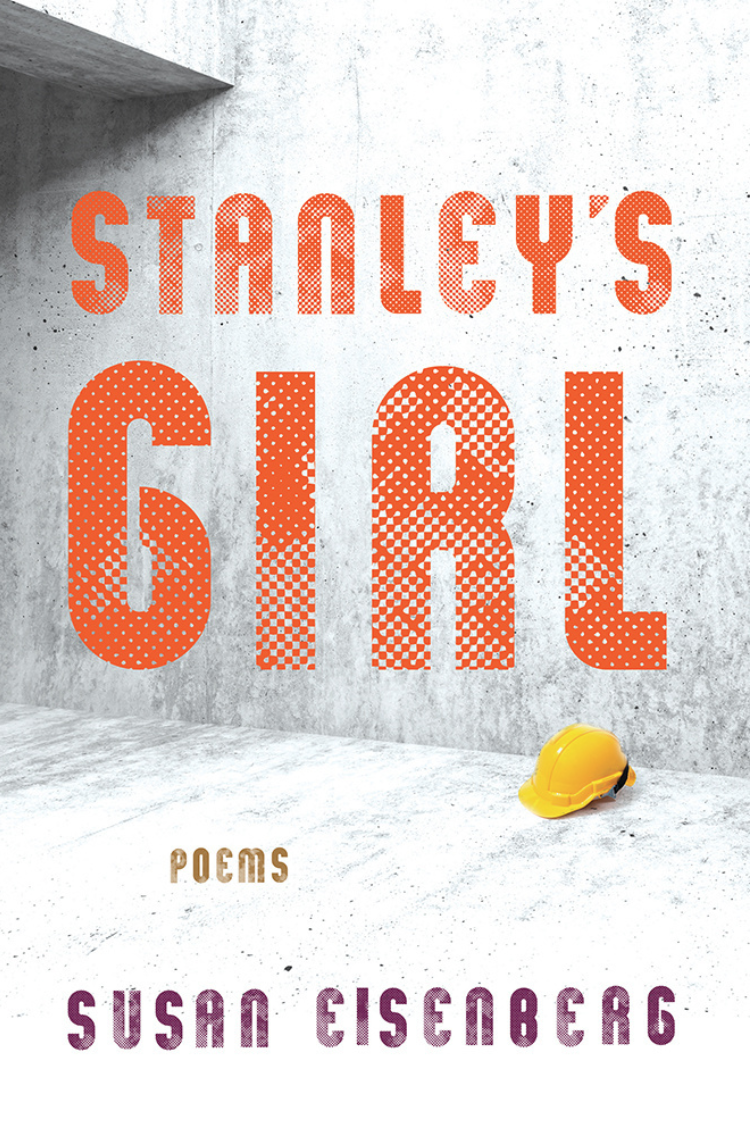
Stanley’s Girl: Poems
(ILR Press, 2018)
By Susan Eisenberg

(ILR Press, 2018)
By Susan Eisenberg
The fiercely lyrical poetry of Stanley’s Girl is rooted in Susan Eisenberg’s experience as one of the first women to enter the construction industry and from her decades gathering accounts of others to give scaffolding to that history. Eisenberg charts her own induction into the construction workplace culture and how tradeswomen from across the country grappled with what was required to become a team player and succeed in a dangerous workplace where women were unwelcome. The specifics of construction become metaphor as she explores resonances in other spheres—from family to other social and political issues—where violence, or its threat, maintains order. Prying open memory, her poems investigate how systems of discrimination, domination, and exclusion are maintained and how individuals and institutions accommodate to injustice and its agreed-on lies, including her own collusion. Poems in this collection probe workplace-linked suicide, sexual assault, and sometimes-fatal intentional accidents, as well as the role of bystander silence and the responsibility of witness.

Fragile Minds and Vulnerable Souls: The Matter of Obscenity in Nineteenth-Century Germany (
(University of Pennsylvania Press, 2014)
By Sarah L. Leonard

(University of Pennsylvania Press, 2014)
By Sarah L. Leonard
Fragile Minds and Vulnerable Souls investigates the creation of "obscene writings and images" as a category of print in nineteenth-century Germany. Sarah L. Leonard charts the process through which texts of many kinds—from popular medical works to stereoscope cards—were deemed dangerous to the intellectual and emotional lives of vulnerable consumers. She shows that these definitions often hinged as much on the content of texts as on their perceived capacity to distort the intellect and inflame the imagination.
Leonard tracks the legal and mercantile channels through which sexually explicit material traveled as Prussian expansion opened new routes for the movement of culture and ideas. Official conceptions of obscenity were forged through a heterogeneous body of laws, police ordinances, and expert commentary. Many texts acquired the stigma of immorality because they served nonelite readers and passed through suspect spaces; books and pamphlets sold by peddlers or borrowed from fly-by-night lending libraries were deemed particularly dangerous. Early on, teachers and theologians warned against the effects of these materials on the mind and soul; in the latter half of the century, as the study of inner life was increasingly medicalized, physicians became the leading experts on the detrimental side effects of the obscene. In Fragile Minds and Vulnerable Souls, Leonard shows how distinctly German legal and medical traditions of theorizing obscenity gave rise to a new understanding about the mind and soul that endured into the next century.

Forever Suspect: Racialized Surveillance of Muslim Americans in the War on Terror (2018)
(Rutgers University Press, 2018)
By Saher Selod

(Rutgers University Press, 2018)
By Saher Selod
The declaration of a “War on Terror” in the aftermath of the September 11, 2001 terrorist attacks brought sweeping changes to the American criminal justice and national security systems, as well as a massive shift in the American public opinion of both individual Muslims and the Islamic religion generally. Since that time, sociologist Saher Selod argues, Muslim Americans have experienced higher levels of racism in their everyday lives. In Forever Suspect, Selod shows how a specific American religious identity has acquired racial meanings, resulting in the hyper surveillance of Muslim citizens. Drawing on forty-eight in-depth interviews with South Asian and Arab Muslim Americans, she investigates how Muslim Americans are subjected to racialized surveillance in both an institutional context by the state and a social context by their neighbors and co-workers. Forever Suspect underscores how this newly racialized religious identity changes the social location of Arabs and South Asians on the racial hierarchy further away from whiteness and compromises their status as American citizens.

Festschrift in Honour of Professor Janet Todd: A Life in Feminist Scholarship
(Women’s Writing Journal, Vol. 23 no. 3, 2016)
Co-authored by Ruth Perry & Ros Ballaster
Festschrift in Honour of Professor Janet Todd: A Life in Feminist Scholarship
(Women’s Writing Journal, Vol. 23 no. 3, 2016)
Co-authored by Ruth Perry & Ros Ballaster

Myths & Ms.: An Inter-Generational Play about Reincarnation and Abortion
(Anaphora Literary Press, 2018)
By Rosie Rosenzweig

(Anaphora Literary Press, 2018)
By Rosie Rosenzweig
A ghost hovers watching and waiting to embody itself in the most auspicious womb. Its goal is to fulfill what it couldn’t in its last lifetime called “soul work.” Myths & Ms. is an intergenerational play about abortion and reincarnation, dramatizing the changing attitudes and conditions towards abortion in the 20th and 21st centuries. This idea of reincarnation highlights the strident voices from the pro-choice and pro-life camps.

Immigration Policy in the Age of Punishment: Detention, Deportation and Border Control
(Columbia University Press, 2018)
Edited by David C. Brotherton and Philip Kretsedemas

(Columbia University Press, 2018)
Edited by David C. Brotherton and Philip Kretsedemas
The events of 2016 catapulted immigration policy to the forefront of public debate, and Donald Trump’s administration has signaled a harsh turn in enforcement. Yet the deportation, detention, and border-control policies that North American and European countries have embraced are by no means new. In this book, sociologists David C. Brotherton and Philip Kretsedemas bring together an interdisciplinary group of contributors to reconsider the immigration policies of the Obama era and beyond in terms of a decades-long “age of punishment.”
Immigration Policy in the Age of Punishment takes a critical, interdisciplinary, and transnational look at current issues surrounding immigration in the U.S. and abroad. It examines key features of this age of punishment, connecting neoliberal governance, global labor markets, and the national obsession with securing borders to explain critical research and theory on immigration enforcement. Contributors document the continuities between presidential administrations and across countries from many perspectives, with chapters discussing Canada, Australia, France, the UK, the Dominican Republic, and Mexico in addition to the U.S. They offer macro-level analyses of deportations and border enforcement, analyses of national policy and jurisprudence, and ethnographic accounts of the daily life experience of the prison-to-deportation pipeline, the making of deportability, and post-deportation transitions for noncitizens. This book highlights new directions in critical immigration policy and enforcement and deportation studies with the aim of problematizing the age of punishment that currently reigns over borders and those who seek to cross them.