

Tainted Witness: Why We Doubt What Women Say About Their Lives
(Columbia University Press, 2017)
By Leigh Gilmore

(Columbia University Press, 2017)
By Leigh Gilmore
In 1991, Anita Hill's testimony during Clarence Thomas's Senate confirmation hearing brought the problem of sexual harassment to a public audience. Although widely believed by women, Hill was defamed by conservatives and Thomas was confirmed to the Supreme Court. The tainting of Hill and her testimony is part of a larger social history in which women find themselves caught up in a system that refuses to believe what they say. Hill's experience shows how a tainted witness is not who someone is, but what someone can become.
Why are women so often considered unreliable witnesses to their own experiences? How are women discredited in legal courts and in courts of public opinion? Why is women's testimony so often mired in controversies fueled by histories of slavery and colonialism? How do new feminist witnesses enter testimonial networks and disrupt doubt? Tainted Witnessexamines how gender, race, and doubt stick to women witnesses as their testimony circulates in search of an adequate witness. Judgment falls unequally upon women who bear witness, as well-known conflicts about testimonial authority in the late twentieth and early twenty-first centuries reveal. Women's testimonial accounts demonstrate both the symbolic potency of women's bodies and speech in the public sphere and the relative lack of institutional security and control to which they can lay claim. Each testimonial act follows in the wake of a long and invidious association of race and gender with lying that can be found to this day within legal courts and everyday practices of judgment, defining these locations as willfully unknowing and hostile to complex accounts of harm. Bringing together feminist, literary, and legal frameworks, Leigh Gilmore provides provocative readings of what happens when women's testimony is discredited. She demonstrates how testimony crosses jurisdictions, publics, and the unsteady line between truth and fiction in search of justice.

Jewish Radical Feminism: Voices from the Women’s Liberation Movement
(NYU Press, 2018)
By Joyce Antler

(NYU Press, 2018)
By Joyce Antler
Jewish women were undeniably instrumental in shaping the women’s liberation movement of the 1960s, 70s, and 80s. Yet historians and participants themselves have overlooked their contributions as Jews. This has left many vital questions unasked and unanswered—until now. Delving into archival sources and conducting extensive interviews with these fierce pioneers, Joyce Antler has at last broken the silence about the confluence of feminism and Jewish identity.
Antler’s exhilarating new book features dozens of compelling biographical narratives that reveal the struggles and achievements of Jewish radical feminists in Chicago, New York and Boston, as well as those who participated in the later, self-consciously identified Jewish feminist movement that fought gender inequities in Jewish religious and secular life. Disproportionately represented in the movement, Jewish women’s liberationists helped to provide theories and models for radical action that were used throughout the United States and abroad. Their articles and books became classics of the movement and led to new initiatives in academia, politics, and grassroots organizing. Other Jewish-identified feminists brought the women’s movement to the Jewish mainstream and Jewish feminism to the Left. For many of these women, feminism in fact served as a “portal” into Judaism.
Recovering this deeply hidden history, Jewish Radical Feminismplaces Jewish women’s activism at the center of feminist and Jewish narratives. The stories of over forty women’s liberationists and identified Jewish feminists—from Shulamith Firestone and Susan Brownmiller to Rabbis Laura Geller and Rebecca Alpert—illustrate how women’s liberation and Jewish feminism unfolded over the course of the lives of an extraordinary cohort of women, profoundly influencing the social, political, and religious revolutions of our era.

Control and Protect: Collaboration, Carceral Protection, and Domestic Sex Trafficking in the United States
(University of California Press, 2016)
By Jennifer Musto

(University of California Press, 2016)
By Jennifer Musto
Control and Protect explores the meaning and significance of efforts designed to combat sex trafficking in the United States. A striking case study of the new ways in which law enforcement agents, social service providers, and nongovernmental advocates have joined forces in this campaign, this book reveals how these collaborations consolidate state power and carceral control. This book examines how partnerships forged in the name of fighting domestic sex trafficking have blurred the boundaries between punishment and protection, victim and offender, and state and nonstate authority.

Stand Your Ground: A History of America's Love Affair with Lethal Self-Defense
(Beacon Press, 2018)
By Caroline E. Light

(Beacon Press, 2018)
By Caroline E. Light
After a young, white gunman killed twenty-six people at Sandy Hook Elementary School in Newtown, Connecticut, in December 2012, conservative legislators lamented that the tragedy could have been avoided if the schoolteachers had been armed and the classrooms equipped with guns. Similar claims were repeated in the aftermath of other recent shootings—after nine were killed in a church in Charleston, South Carolina, and in the aftermath of the massacre in the Pulse nightclub in Orlando, Florida. Despite inevitable questions about gun control, there is a sharp increase in firearm sales in the wake of every mass shooting.
Yet, this kind of DIY-security activism predates the contemporary gun rights movement—and even the stand-your-ground self-defense laws adopted in thirty-three states, or the thirteen million civilians currently licensed to carry concealed firearms. As scholar Caroline Light proves, support for “good guys with guns” relies on the entrenched belief that certain “bad guys with guns” threaten us all.
Stand Your Ground explores the development of the American right to self-defense and reveals how the original “duty to retreat” from threat was transformed into a selective right to kill. In her rigorous genealogy, Light traces white America’s attachment to racialized, lethal self-defense by unearthing its complex legal and social histories—from the original “castle laws” of the 1600s, which gave white men the right to protect their homes, to the brutal lynching of “criminal” Black bodies during the Jim Crow era and the radicalization of the NRA as it transitioned from a sporting organization to one of our country’s most powerful lobbying forces.
In this convincing treatise on the United States’ unprecedented ascension as the world’s foremost stand-your-ground nation, Light exposes a history hidden in plain sight, showing how violent self-defense has been legalized for the most privileged and used as a weapon against the most vulnerable.
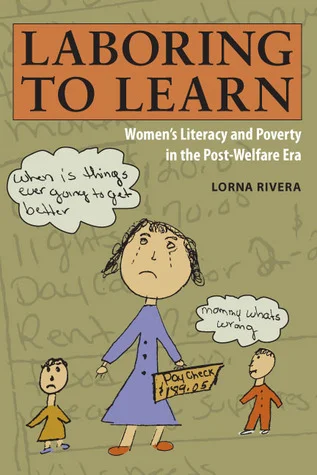
Laboring to Learn: Women's Literacy and Poverty in the Post-Welfare Era
(University of Illinois Press, 2008)
By Lorna Rivera
(University of Illinois Press, 2008)
By Lorna Rivera

The American adult education system has become an alternative for school dropouts, with some state welfare policies requiring teen mothers and women without high school diplomas to participate in adult education programs to receive aid. Very little has been published about women’s experiences in these mandatory programs and whether the programs reproduce the conditions that forced women to drop out in the first place. Lorna Rivera bridges the gap with this important study, the product of ten years’ active ethnographic research with formerly homeless women who participated in adult literacy education classes before and after welfare reform. Analyzing the web of ideological contradictions regarding “work first” welfare reform policies, Rivera argues that poverty is produced and reproduced when women with low literacy skills are pushed into welfare-to-work programs and denied education.