
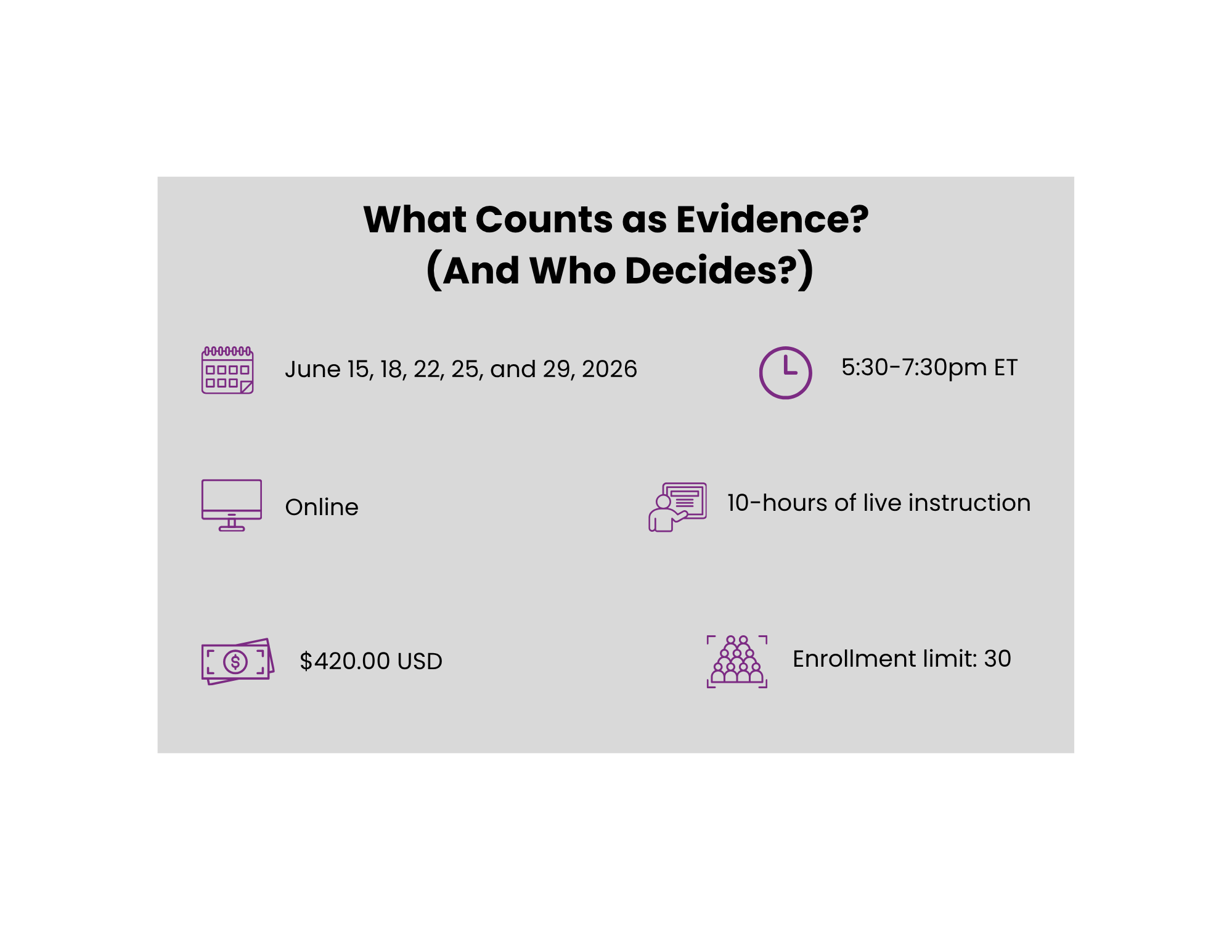
What Counts as Evidence? (And Who Decides?)
$420.00
Session dates: June 15, 18, 22, 25, and 29, 2026
Overview
What counts as “evidence”? Who decides—and what gets left out?
In many fields, we rely on data, research, and evaluation to guide decisions. Yet the standards we use to define “good evidence” are not neutral—they are shaped by history, power, and whose knowledge is recognized as legitimate. This course invites students to examine how evidence is understood and used in their own work, and to explore more equitable, community-informed approaches to research and evaluation. Grounded in Black Feminist Thought and critical traditions, the course introduces key ideas about how knowledge is produced, while consistently connecting those ideas to real-world decisions about what to measure, how to interpret data, and how to design studies or evaluations. Students will engage with examples from multiple fields and consider how different forms of evidence—from quantitative data to lived experience, community knowledge, and narrative—can be brought into more responsible and responsive relationship. This course is designed to be accessible to participants from a wide range of backgrounds. While anyone interested in how knowledge and evidence shape real-world decisions is welcome, those who currently engage with research, data, or evaluation in their work or studies may find especially immediate opportunities to apply what they learn. By the end of the course, participants will develop a draft idea, revision, or framework they can use to strengthen a current or future project, with greater attention to equity, context, and the role of power in knowledge production.
What You Will Learn
By the end of this micro-course, students will be able to:
Recognize how common approaches to “evidence” are shaped by underlying assumptions about knowledge, credibility, and power
Reflect on how their own experiences, roles, and perspectives influence how they interpret data and make decisions in their work or research
Identify strengths and limitations in different approaches to research and evaluation, particularly when working with communities impacted by inequity
Apply practical strategies to develop or revise research questions, data collection approaches, or evaluation plans that informed by and responsive to the lived experience of communities
Develop a draft idea, plan, or revision of an existing project that more fully integrates equity, lived experience, and multiple forms of evidence
Meet the Faculty

Adrianna E. Crossing
Adrianna E. Crossing, PhD, NCSP (she/they) is an Assistant Professor in the Department of Applied Psychology and the Department of Public Health and Health Sciences at Northeastern University, where she also holds an affiliate appointment in the Africana Studies Program and serves as Community and Belonging Lead for the School of Community Health and Behavioral Sciences.
Dr. Crossing is the originator of PsyCrit: A Critical Race Theory of Psychology as Praxis, a theoretical framework examining how psychology—as a discipline, profession, and set of practice—has participated in the construction and maintenance of racial hierarchy, and what it would mean to reimagine it otherwise. Rooted in Critical Race Theory and Liberation Psychology, her scholarship advocates for a pluralistic, justice-oriented methodological toolkit capable of holding the complexity of racialized experience without flattening it into variables. Her research program moves from theory to method to intervention, and is animated throughout by the conviction that science should serve the communities it studies rather than extract from them.
Her teaching reflects the same commitments. Drawing on Freirean dialogic pedagogy and anti-oppressive frameworks, Dr. Crossing designs learning experiences that center co-creation of knowledge, structural awareness, and the active dismantling of deficit-oriented thinking. She directs the REPAIR Lab and the ROADMAP Summer Program for undergraduate scholars interested in ameliorating behavioral health disparities at Northeastern University.. Dr. Crossing also chairs the National Association of School Psychologists Social Justice Committee.
For the inaugural Summer Feminist Learning Institute, Dr. Crossing will be teaching What Counts as Evidence? (And Who Decides?) — a course she describes as the most direct translation of her scholarly program into a pedagogical experience.
Northeastern University